Birds of a Feather

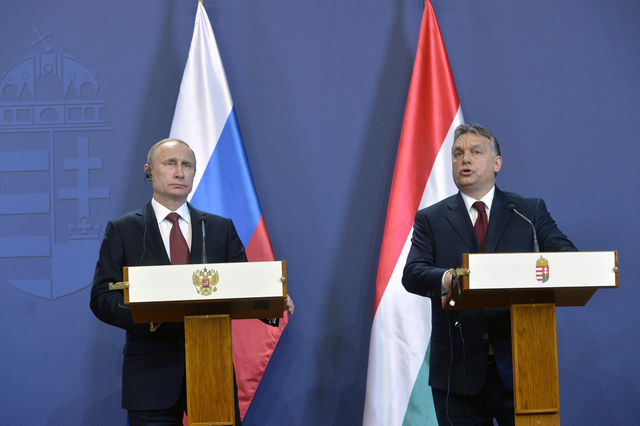
President Vladimir Putin of Russia and Prime Minister Viktor Orbán of Hungary during a joint press conference in Budapest on February 17, 2015 (photo: Hungarian News Agency).

President Putin and Prime Minister Orbán at a joint press conference in Budapest on February 17, 2015 (photo: Hungarian News Agency).

On February 17, 2015, President Vladimir Putin of Russia made an eight-hour official visit to Budapest. There hadn’t been so much portentous excitement among Hungarians surrounding the arrival of a foreign statesman to their country in a long time, perhaps even since the System Change. Not because Putin had any important business to do in Hungary, but merely because he is Putin―the larger-than-life and all-powerful leader of the newly revitalized and assertive Russia. 

President Putin initiated the visit to Hungary as a means of breaking his foreign isolation and showing the West that he was a welcome guest in the capital of a NATO and European Union member state (source in Hungarian).

See entire post.

—————————————————————————————————————————————–

Taking the Ball

Jobbik President Gábor Vona (Orange Files photo).

          Jobbik President Gábor Vona           (photo: Orange Files).

On January 31, 2015, President Gábor Vona of the radical-nationalist party Jobbik presented his annual “appraisal of the year” (évértékelő) address in Budapest (source in Hungarian). Below is an Orange Files translation of an abridged version of Vona’s speech:

Hungary is in trouble. How often do we hear this on the street, in our everyday lives, on the television, everywhere. For this reason, this phrase has become worn out, often it means almost nothing―it is an empty cliché. I would nevertheless begin my speech with it: Hungary is in trouble. And what’s more, big trouble. . . .

(For the entire translation, see Gábor Vona Appraisal of the Year Speech—January 31, 2015). 

Jobbik President Vona’s address was similar in theme, outlook and tone to those that Prime Minister Viktor Orbán has delivered for years, even as Fidesz president before his return to power as head of government in 2010 (see: Proclamation of the Illiberal Hungarian State; Prime Minister Orbán’s Speech to National Assembly – May 10, 2014; Prime Minister Orbán’s Speech to Supporters – May 10, 2014; Vlad Beyond Reproach; and Notable Quotes: Prime Minister Viktor Orbán). The Vona speech shares the following specific attributes with many Orbán speeches: 

—Emphasis on the notion that “Hungary is in trouble” in order to exploit the ingrained political hysteria of Hungarians as a means of garnering political support (see The Phony Realist);

—The claim that “the type of liberal democracy that gained power over Hungary in 1989 is not a functioning system” and that “the system of the past 25 years became exhausted and failed” and “was built upon lies”;

—The allegation that “Brussels currently rests on profit-oriented foundations from which the West can exploit the eastern states and as glass beads offer a little support in exchange”;

—The precedence of the “community” of the Hungarian nation over the individual (“the multitude of people”);

—Reference to God and Christianity forces unifying the Hungarian nation;

—The assertion that “dramatic international transformation” has placed Hungary in a perilous position “at the intersection of global conflict”; 

—Rejection of the “the unilateral world domination of the United States”;

—The insistence that “Hungary must develop and independent Russian policy” and “remain neutral” in the renewed conflict between the West and Russia.

—And the contention that “the fate of a quarter million Hungarians in Ukraine has come into doubt” and criticism of the policies of the latter country toward its Hungarian minority because it has “humiliated and threatened them and circumscribed their rights.”

Prime Minister Viktor Orbán speaking to supporters outside the Hungarian Parliament Building after taking his oath of office for the new parliamentary cycle beginning in 2014.

Prime Minister Viktor Orbán speaking to supporters outside the Hungarian Parliament Building in May 2014 (photo: Hungarian News Agency).

Both Vona, as the leader of Jobbik, and Orbán, as the leader of Fidesz, have long articulated these common attitudes and positions (see Follow the Evil Twin). However, the speech that Vona delivered on January 31, 2015 lacked the central element that distinguished the Jobbik president’s previous discourse from that of Prime Minister Orbán: expressions of collective antipathy toward Hungarian Jews and Gypsies (see Notable Quotes: Jobbik President Gábor Vona).

Over the past few weeks, Vona has distanced himself from anti-Gypsy and -Semitic racism. On February 9, 2015, he issued a statement condemning “in the most resolute manner possible” the anti-Gypsy Facebook posts of a newly elected Jobbik municipal-council member from Mezőtúr and required him to move into the house of the Gypsy leader of the party’s local chapter in nearby Hajdúszoboszló for a period of three days (source in Hungarian). On February 11, 2015, Vona said during an interview on the opposition television station ATV “Maybe I expressed myself somewhat angularly on certain matters, but I don’t think that I [ever] made any anti-Semitic statements” (source in Hungarian)

Vona has presumably attempted to divest himself and Jobbik of the mantle of racism in order to appropriate in its full material and spiritual form the political program that propelled Fidesz to landslide victories in Hungary’s past two National Assembly elections in 2010 and 2014, but which the Orbán government has been compelled to moderate considerably over the past few months as the result of pressure from the United States and the European Union, specifically Germany (see Back in the Fold?, The Spectacular Fall and Teutonic Shift).

Gábor Vona’s gradual transformation into the leading proponent of many of the Hungarian nationalist tenets and policies that Viktor Orbán skillfully employed to attain an unprecedented degree of power for a head of government in a Western democratic state after 2010 has arguably been one of main factors behind Jobbik’s steady rise to all-time highs in opinion polls since October and Fidesz’s drop to multi-year lows over that same period (source in Hungarian).

The phenomenon of a political leader renouncing his formerly explicit racism in order to consolidate his authority is not without precedent in Hungarian history: in his first speech after becoming prime minister in 1932, the former leader of the anti-Semitic Racial-Defense Party (Fajvédő Párt), Gyula Gömbös, declared “To the Jews I openly and frankly state: I have revised my opinion. I wish to regard those Jews who recognize a community of fate with the nation as brothers and sisters in the same way as I do my Hungarian brothers and sisters” (source in Hungarian).

And indeed, although he did much to incorporate Hungary into the authoritarian political sphere of Nazi Germany and fascist Italy, Prime Minister Gömbös initiated no measures that served to directly impair the rights or otherwise harm the interests of Hungarian Jews during his four years in office from 1932 to 1936. 

—————————————————————————————————————————————–

The Fury of an Oligarch Scorned

S

Lajos Simicska (photo: Magyar Nemzet).

On the morning of February 6, 2015, the directors and chief editors of the pro-government television station, radio station and newspaper under the ownership of former Fidesz oligarch Lajos Simicska―Hír TV, Lánchíd Rádió and Magyar Nemzet―abruptly resigned, asserting that they had decided to leave their jobs “for reasons of conscience” (source in Hungarian).

The collective resignations infuriated Simicska, who learned of them only after their publication on the Magyar Nemzet website. En route to Budapest to appoint successors, the notoriously reclusive former oligarch conducted short telephone interviews with many of the major opposition media during which he accused the prime minister and his “entourage” of orchestrating the resignations (source in Hungarian) and denounced the prime minister in vulgar terms, frequently using an epithet denoting sperm—geci—that has no equivalent in English and might best be translated as “fuckhead.”¹

The direct cause of the resignations: on the evening of February 5, the website of the opposition newspaper Népszava quoted Simiscka, a longtime personal friend and political ally of Prime Minister Viktor Orbán, as saying “The media war could become full-blown if the government really introduces the five-percent advertising-revenue tax in the name of making peace with RTL” (source in Hungarian). 

Simicska’s statement to Népszava referred to the Orbán government’s recent proposal to transform the progressive tax on advertising revenue, which generates over half of its proceeds from the television station RTL Klub, into a flat-rate tax that would redistribute the burden among a greater number of companies, notably Simicska-owned media and public advertising concerns (see source in Hungarian and Black Screen of Protest and The Big Gun Swings into Action).

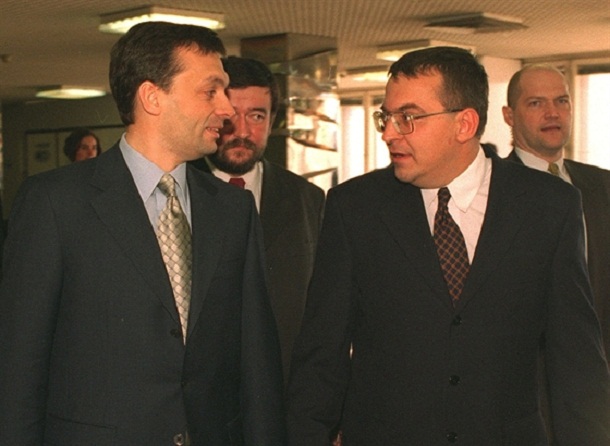
Prime Minister Orbán (left) and ÁPEH President Simicska chat in the late 1990s.

Prime Minister Orbán (left) and ÁPEH President Simicska chat in the late 1990s.

The restructuring of the advertising-revenue tax would be one of several measures that the third Orbán government has taken since its formation last spring which have harmed the financial interests of Simicska, who generated much of his current wealth through state contracts awarded to his construction company, Közgép, at the time of the second Orbán government from 2010 to 2014 (see Lajos Simicska/Közgép).

The Simicska-owned media have attacked these measures and the government ministers identified directly with them, though have never criticized Prime Minister Orbán personally (see Cleft in the Monolith). The “full-blown” media war that Simicska cited in his statement to Népszava on February 5 would certainly entail lifting the taboo on direct criticism of Orbán―a presumption that the opposition website hvg.hu has corroborated, quoting an unnamed “reliable source” (source in Hungarian). If this hypothesis is correct, reluctance to participate in personal attacks on the prime minister constituted the “reasons of conscience” to which the formerly Simicska-affiliated journalists and media directors referred in their joint resignation.

By the evening of February 6, Simicska had named replacements for those who had resigned that morning, including himself as the director of Hír TV (source in Hungarian). Simicska told index.hu  “I am going to fire every Orbánist, then I will appoint my people in their place who cannot be bribed and intimidated. I will say it once again, my people will be sitting everywhere” (source in Hungarian).

The long steadfastly pro-Orbán Hír TV, Lánchíd Rádió and Magyar Nemzet therefore appear certain to become harsh critics of the prime minister and government. Below are quotes from Simicska’s February 6 interviews which may provide an insight into the type of criticism that his media are likely to articulate:

Believe it or not, my alliance with Orbán was based on the fact that we wanted to bring down the dictatorship and the post-communist system. This proved not to be an easy thing, it required a lot of work. But building another dictatorship in its place was certainly not a fucking part of this alliance. I am not a partner in this (source in Hungarian).

I grew up when the Soviet Union was here and I do not have good memories of the activities of the Ruskies in Hungary. I can’t make a clear distinction, to say the least, between the political behavior of the Soviets of that time and the Russians of today (source in Hungarian).

I imagined him [Orbán] to be a statesman who could do good for this country, but I had to realize that he’s not (source in Hungarian).

Naturally an independent media always deals with current things, though the Orbán government has ambitions to essentially abolish the independent media; but naturally this media―our media―will resist this and will not give a fucking shit about what Orbán wants (source in Hungarian).

"Orbán

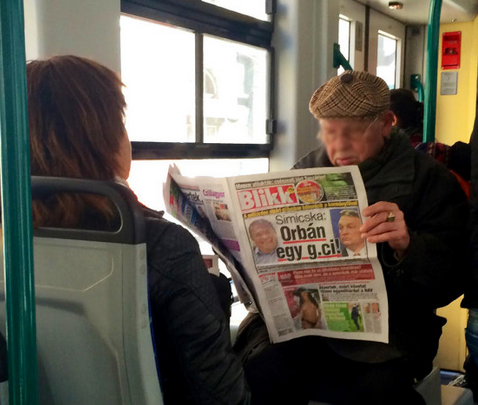
“Orbán Is a F.ckhead!” Front page of the tabloid Blikk on February 7, 2015 (photo: 444.hu).

As for those who resigned from the Simicska-owned media on February 6: they are likely to find immediate employment at the state-run television and radio stations and news agency, which according to several sources, Prime Minister Orbán has chosen to serve as the primary channels of pro-government news (sources A and B in Hungarian). However, the owner of the pro-government television station Echo TV and newspaper Magyar Hírlap, Gábor Széles, wrote on his Facebook site on February 7 that he will gladly hire any of them who do not find employment at the state-run media (source in Hungarian).

The nearly certain anti-Orbán transformation of Hír TV, Lánchíd Rádió and Magyar Nemzet would represent the most sudden and radical change in Hungary’s political media landscape in the 35 years since the end of the Hungarian Socialist Workers’ Party dictatorship.This transformation would serve to further elevate the already heightened degree of political tension and conflict in Hungary. And its outcome would almost certainly entail either the collapse of the Orbán government or that of the Simicska-owned business and media empire—more likely the latter. 

¹ “Orbán is a fuckhead!” (source in Hungarian)

“Viktor Orbán is also a fuckhead! He is also a fuckhead!” (source in Hungarian)

“Yes, I stand by it: he’s a fuckhead. Maybe I will retract it tomorrow morning, because I am already calming down, but now you can go ahead and write that he is a fuckhead.” (source in Hungarian)

—————————————————————————————————————————————–

Back in the Fold?

On January 23, 2015, Prime Minister Viktor Orbán held talks with European Union officials in Brussels during which they discussed his recent comments against non-European immigration (see Je Suis Viktor) and the impending official visit to Hungary of Russian President Vladimir Putin (source in Hungarian).

After the talks Prime Minister Orbán and European Commission President Jean-Claude Juncker shook hands and smiled for the cameras. However, instead of loosening his grip at the end of the joint photo-op, Juncker said “Let’s go now!” and led Orbán off stage by the hand in a gesture calculated to symbolize the assertion of European Union authority over the previously defiant, euro-skeptic prime minister of Hungary (see video below).


Until recently, Orbán would not have allowed himself to be placed in a position of such blatant and humiliating subordination, particularly toward an official from the European Union. 

However, over the past couple of months his position has weakened considerably both internally and externally:

According to all five major polling companies in Hungary, the popularity of the prime minister’s FideszChristian Democratic People’s Party (KDNP) governing alliance has declined sharply among Hungarian voters since October (source in Hungarian);

Unprecedented public conflict has taken place among Fidesz government and National Assembly officials since November, suggesting that the Orbán administration’s previously rock-solid internal cohesion is diminishing (see Another Cleft in the Monolith);

Officials from the dominant countries within in the European and Euro-Atlantic alliances that provide Hungary with vital developmental funding and military protection—Germany and the United States—have sent strong messages to the Orbán government that they will no longer tolerate its autocratic and explicitly illiberal domestic policies (see Proclamation of the Illiberal Hungarian State) and reluctance to support collective measures designed to penalize the Putin administration for Russia’s occupation of Crimea and proxy attacks on Ukraine (see Teutonic Shift and The Spectacular Fall);

And the main foreign-policy endeavor of the Orbán government, building (economic) ties with the rapidly developing states of Asia, Eurasia and the Middle East through in what it refers to as Eastern Opening [keleti nyitás], has failed to produce the anticipated results (source in Hungarian).

The above factors, coupled with the greater emphasis that European states have placed on internal unity to combat Jihadist terrorism following the Charlie Hebdo attacks in early January 2015, have apparently compelled Prime Minister Orbán to at least temporarily steer Hungary back toward the western political sphere.

The political force in Hungary that stands to benefit the most from Orbán’s volte-face: the radical-nationalist Jobbik party, which opinion polls show has gained popularity among Hungarian voters as that of Fidesz-KDNP has declined (see source in Hungarian and 24 Bastions). Jobbik will likely generate significant political profit from the anti-liberal, anti-capitalist, anti-European Union, anti-West sentiment that Prime Minister Orbán has so proficiently incited among Hungarians over the past five years in order to legitimize his authoritarian domestic policies, though now appears ready to moderate or abandon.

—————————————————————————————————————————————–

Je Suis Viktor

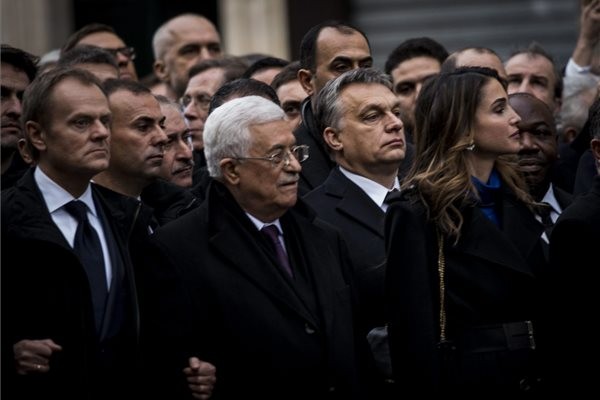
Prime Minister Viktor Orbán among heads of government and state in Paris on January 11, 2015 to show solidarity with Republican Marches.

Prime Minister Viktor Orbán among heads of government and state in Paris on January 11, 2015 to show solidarity with Republican Marches (photo: MTI).

Prime Minister Viktor Orbán was among the approximately 40 heads of government and state who met in Paris on January 11, 2015 to show solidarity with the Republican Marches held throughout France on that date to protest the Charlie Hebdo and related terrorist attacks the previous week.

Orbán used the occasion to open up a new front against another purported external threat to Hungary: “economic” immigration—i.e., migration from non-European countries.

In an interview with Hungarian Television reporter in Paris on the day of the Republican Marches, the prime minister said (source in Hungarian):

Economic immigration is a bad thing in Europe. It shouldn’t be seen as something that is of any use at all, because it just brings difficulty and danger to the European person. This is why immigration must be stopped. This is the Hungarian viewpoint.

And:

At the same time, one must make it very definitely clear that we will not permit—at least as long as I am the prime minister and as long is this government exists—it will not happen that Hungary becomes the target of immigrants.

And:

We do not want to see among us significant minorities that possess different cultural characteristics and background than us. We would like to preserve Hungary as Hungary.

Also on January 11, Prime Minister Orbán told the Hungarian News Agency MTI: “The European person is under attack, the freedom and lifestyle of the European person. . . . current European politics cannot defend European people” (source in Hungarian).

In foreign-policy terms, Orbán’s depiction of the threat of non-European immigration to Hungary in connection to the January 7–9 Jihadist attacks in France is presumably part of his effort to place the “illiberal state” that he has built as prime minister into the context an extra-EU, German-led alliance of central and eastern European countries aimed at repelling external threats (see Teutonic Shift and Designated Adversary 2015: USA).

In domestic terms, the moderate conservative Hungarian political scientist Gábor Török identified the possible motives that may have impelled Prime Minister Orbán to utilize this type of anti-immigration rhetoric for the first time (source in Hungarian):

1. Orbán said this because he believes it is proper, right and to be followed.

2. Orbán said this because he was concerned that Jobbik [Hungary’s radical-nationalist Jobbik party] will be able to exploit the situation and as a result of political calculations he now considered this to be expedient.

3. Orbán said this because now for him avoiding a further loss of votes is the most important and according to their research the base wanted to hear these words in this situation.

4. Orbán said this because he thinks that every sharp “ideological” debate is useful for him now: especially at home, though even internationally as well.

—————————————————————————————————————————————–

Designated Adversary 2015: USA

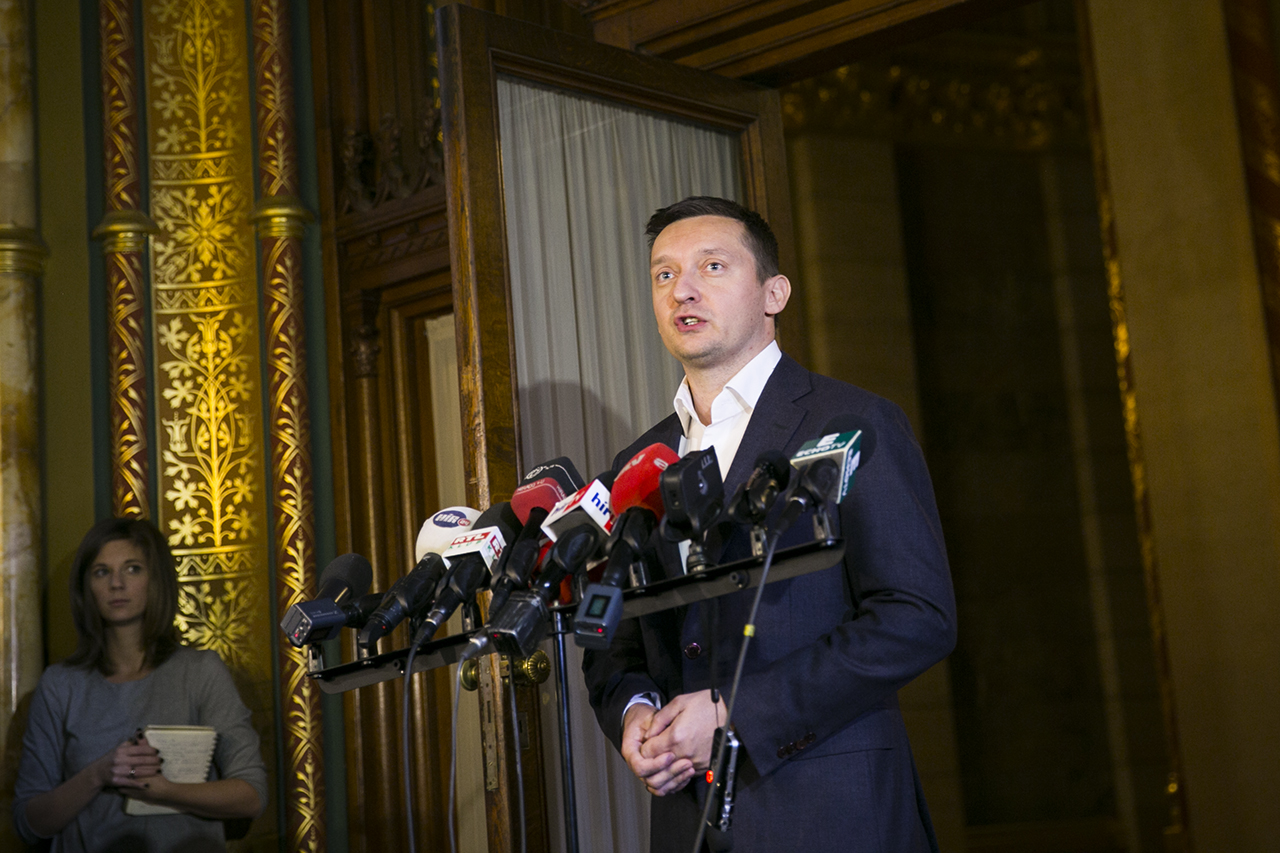
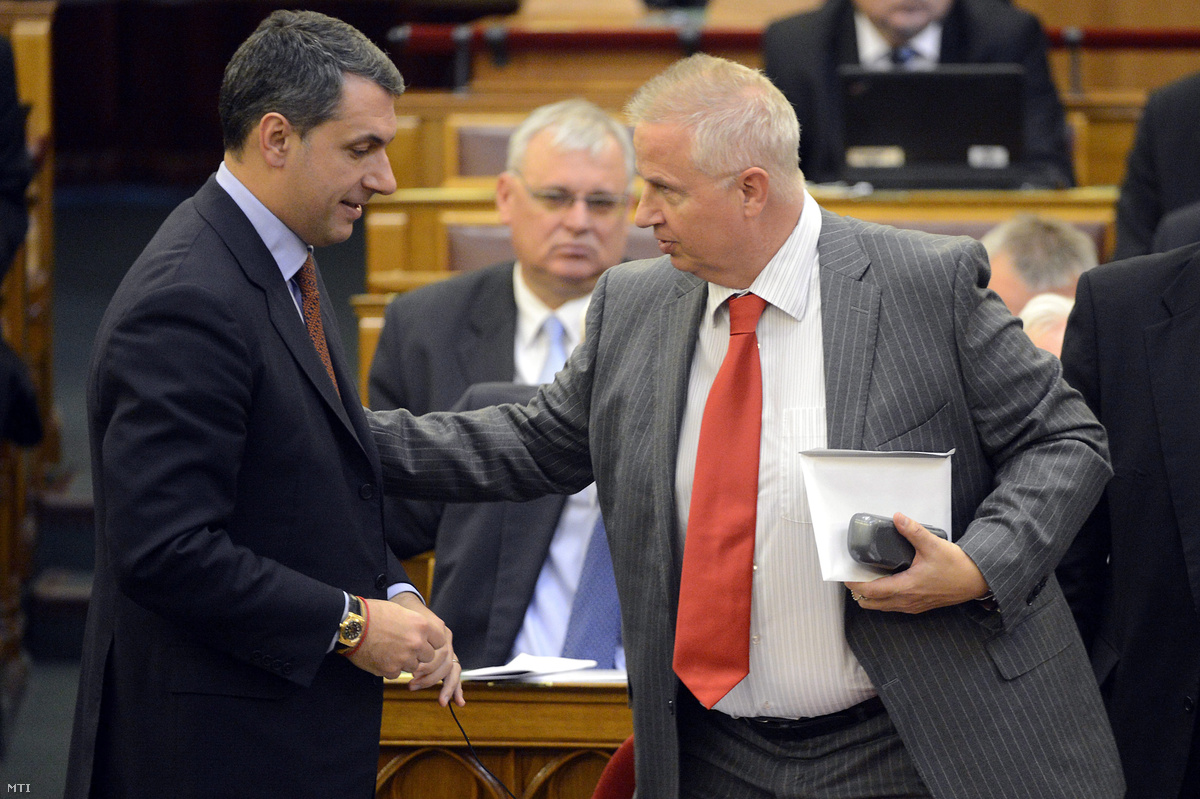
UncleSam_2Prime Minister Viktor Orbán appears to have chosen the United States to serve as Hungary’s designated enemy for the year 2015. Over the final couple of weeks of 2014, Orbán and three of the most powerful officials in his administration—Prime Ministry chief János Lázár, National Assembly Speaker László Kövér and Fidesz National Assembly caucus Chairman Antal Rogán—made statements casting the United States in an adversarial role. 

With regard to the entry ban the United States imposed on several administration officials, notably National Tax and Customs President Ildikó Vida (see The Spectacular Fall), Prime Minister Orbán said during an interview on pro-government Hungarian Television on December 23 (source in Hungarian from 6:23):

Every thoughtful person knows that the charges of corruption that the United States has articulated are a cover story. Here it is a question of the United States having found new interests in this region. It wants to acquire influence. And it is using corruption as a cover story for this. This becomes obvious when we ask for concrete details, when we initiate legal proceedings, when we say lay the cards on the table, let’s clear the air. But somehow this never seems to happen. This is an outgrowth of a typical secret-service influence-gaining action.

Referring to the large number of anti-government demonstrations that took place in Budapest during the final three months of 2014, Prime Ministry chief Lázár told the website mandiner.hu on December 22 (source in Hungarian):

The demonstrations show that the American embassy seems to have assumed the role of the Hungarian opposition. It may appear that they have given up on the possibility that the opposition parties can ever win the confidence of the Hungarians, therefore they [the Americans] are the ones who have stepped up as the leaders of the malcontents.

Lázár continued:

They want to tell us how to behave and how to think about the world. They want to interfere and tell us how we should live. . . . The Americans must respect Hungary’s 1,000-year history and our traditions, which cannot be changed with outside force and pressure.

In an interview with the pro-government newspaper Magyar Hírlap published on December 27, National Assembly Speaker Kövér asserted (source in Hungarian):

Unfortunately we have never been too good at diplomacy. We shouldn’t work now to get the Americans to love us either. We must look for allies elsewhere. Those who are in the same boat with us, moreover on the lower deck. These are the central and eastern European countries.

Kövér also said with regard to Americans:

. . . from a national-security perspective, there is not a square centimeter of territory on Earth that falls outside of their interests. As a result of this, for them it does not exist that aside from themselves another country can have sovereignty.

In an interview with the pro-government Hungarian News Agency published on December 29, Fidesz National Assembly caucus Chairman Rogán stated that the party was formulating a “national protection action plan” (országvédelmi akcióterv) to repel “external attacks” from “economic interest groups and other governments that would have liked another government better” and were therefore attempting to bring down the Orbán administration through “non-electoral methods” (source in Hungarian). Rogán said that an official response to the U.S. entry ban on Orbán administration officials “could be one element” of the Fidesz national-protection plan to defend Hungary against an unnamed “external power,” which under the present circumstances could refer only to the United States (source in Hungarian).

Prime Minister Viktor Orbán has incited hostility against purported enemies of Hungary as a means of gaining and maintaining political support since the very beginning of his political career in the late 1980s (see Fill in the Blanks). For several years after returning to power as prime minister in 2010, Orbán and his subordinates portrayed the International Monetary Fund and, subsequently, the European Union as the main external threats to Hungary’s sovereignty (see Sign of Things to Come). Following the U.S. entry ban on administration officials in October 2014, they have increasingly begun to depict he United States in this role. The Orbán government is likely to continue doing so throughout the year 2015 and perhaps even longer, until a more politically suitable candidate to serve as Hungary’s main adversary emerges.

—————————————————————————————————————————————–

The Spectacular Fall

Fidesz caucus Chairman Antal Rogán announces the party's support for mandatory drug-testing.

Antal Rogán announces the Fidesz’s support for mandatory drug-testing (photo: 444.hu) .

On December 8, 2014, Fidesz National Assembly caucus Chairman Antal Rogán announced that “a significant majority” of party representatives supported proposed mandatory annual drug testing for Hungarians between the ages of 12 and 18 as well as political officials and journalists (source in Hungarian).

Rogán’s announcement of support for the proposed drug-testing was presumably an attempt to divert the Hungarian public’s attention from the issues and events that have dominated news headlines in Hungary since the beginning of the autumn: the entry ban that the United States imposed on allegedly corrupt officials from Hungary’s National Tax and Customs Office; the luxurious lifestyles of officials in Prime Minister Viktor Orbán’s inner circle; highly unpopular legislative initiatives; an unprecedented series of anti-government demonstrations; and disunity within the previously rock-solid Orbán administration, particularly between Fidesz and its allied Christian Democratic People’s Party (KDNP).

The focus of the media on these issues and events has significantly undermined the popularity of the Orbán government and Fidesz. The four major independent polling companies operating in Hungary reported the following month-on-month declines in the proportion of voters surveyed in November who said that they would vote for Fidesz in an upcoming election (source in Hungarian):

                                                                 Medián     Tárki      Ipsos      Nézőpont

                            November                    26              25             30                 29

                            October                         38              37              35                 32

                            Monthly Loss             -12            -12              -5                  -3

The opposition media has pointed out that Fidesz sustained an unprecedented loss in popularity in November, exceeding even that of the Hungarian Socialist Party immediately following the leak of former Prime Minister Ferenc Gyurcsány’s infamous “We fucked up” speech in September 2006 (source in Hungarian).

U.S. Entry Ban

Banned from entering the United States: National Tax and Customs Office President Ildikó Vida (photo: MTI).

Banned from entering the United States: National Tax and Customs Office President Ildikó Vida (photo: MTI).

On October 16, the pro-government business daily Napi Gazdaság reported that the U.S. State Department had prohibited unnamed officials from Hungary’s National Tax and Customs Office (NAV) from entering the United States based on former President George W. Bush’s Proclamation 7750 of January 12, 2004 suspending entry “of persons engaged in or benefiting from corruption” that “has or had serious adverse effects on the national interests of the United States” (source A in Hungarian and B in English). The corruption in question allegedly involved attempts to persuade the Hungarian subsidiary of U.S. agribusiness company Bunge to finance an unnamed pro-government foundation in exchange for NAV’s tacit permission for the company to engage in Value Added Tax fraud (source in Hungarian). The chargé d’affaires at the U.S. embassy in Budapest, André Goodfriend, declined to identify the NAV officials prohibited from entering the United States, though said that the embassy had sent them letters informing them of the ban (source in Hungarian). In a November 5 interview in the pro-government daily Magyar Nemzet, NAV President Ildikó Vida admitted that she was among the tax-office officials subjected to the U.S. travel ban (source in Hungarian).     

Embarrassment of Riches

János Lázár wearing his Rolex Bubbleback.

János Lázár (left) wearing his Rolex Bubbleback at the Hungarian Parliament Building.

Most Hungarians regard wealth as evidence of greed, immorality and treasonous cooperation with external powers (see Kuruc vs. Labanc) and feel particular hostility toward political leaders who appear to have used their position to obtain personal fortune. Since the beginning of the fall, the affluence and lavish lifestyles of the following four members of Prime Minister Orbán’s inner circle have been the focus of media attention: Minister in Charge of the Prime Ministry János Lázár; Minister of External Economy and Foreign Affairs Péter Szijjártó; Prime Ministry State Secretary in Charge of Government Communication András Giró-Szász; and Fidesz Vice President Lajos Kósa.

János Lázár

On December 2, the opposition television station RTL Klub reported that in April Lázár had purchased a house in Budapest under the name of his ten-year-old son at a cost of between 60 million and 70 million forints, or 260 and 300 times the average monthly salary in Hungary of just under 230,000 forints (source in Hungarian).

On November 10, the tabloid Blikk reported that Lázár had cancelled a 75,000-euro, or 23-million-forint, pheasant-hunting trip to the Czech Republic scheduled to take place earlier in the month (source A and B in Hungarian).

On November 25, the opposition website index.hu reported that the Rolex Bubbleback watch that Lázár was seen wearing during a plenary session of the National Assembly the previous month was worth an estimated 1 million forints (source in Hungarian).

Péter Szijjártó

On September 24, RTL Klub reported that Szijjártó had purchased a house in the Budapest suburb of Dunakeszi at a cost of 167 million forints, about 725 times the average monthly salary in Hungary (see Feeling No Shame).

András Giró-Szász

On November 24, index.hu reported that Giró-Szász had recently sold his stake in a media consultancy for 750 million forints (or about 3,265 times the average monthly salary in Hungary) and, according to his newly released asset statement, has 140 million forints in his bank account and owns a yacht worth 25 to 30 million forints (source in Hungarian). On November 25, index.hu reported that Giró-Szász would be the minority owner of a 3-billion-forint hotel being built in the center of Budapest (source in Hungarian).

Lajos Kósa

On October 7, RTL Klub reported that Kósa’s wife had purchased a home worth an estimated 100 million forints, or about 435 times the average monthly salary in Hungary, in the Óbuda district of Budapest (source in Hungarian). On November 22, index.hu reported that Kósa and three travel companions had spent an estimated 1 million forints each on a four-day trip to New Zealand primarily in order to attend a Rolling Stones concert in Auckland (source in Hungarian).

Unpopular Legislation

On October 21, the National Economy Ministry revealed that the government was planning to introduce a 150-forint-per-gigabyte tax on Internet usage (source in Hungarian). Though the proposal stipulated that the tax would be levied on service providers, most Hungarians expected them to build the cost of the tax into customer fees. Prime Minister Orbán revoked the proposed tax following massive demonstrations against it in Budapest, though said his government would revive the proposal in early 2015 (source in Hungarian).

On November 6, Christian Democratic People’s Party National Assembly caucus Chairman Péter Harrach announced that the Orbán government would support the party’s proposed mandatory Sunday closing of shops in Hungary (source in Hungarian). A total of 58 percent of those Hungarians surveyed in a Medián poll conducted in 2007 said that they opposed possible legislation stipulating the mandatory closure of shops on Sunday (source in Hungarian). Orange Files doubts based in empirical evidence that more Hungarians currently support such legislation, which the National Assembly approved on December 16.

Anti-Government Demonstrations

October 28 demonstration in Budapest against the proposed Internet tax (Orange Files photo).

Demonstrators cross the Elisabeth Bridge in Budapest during October 28 protest against the proposed Internet tax (photo: Orange Files).

Several tens of thousands of people took part in demonstrations held in Budapest on October 26 and October 28 to protest the proposed Internet tax (source A and B). With an estimated 30,000–40,000 participants, the October 28 demonstration was likely the largest ever against an Orbán-government measure (source in Hungarian). 

Several smaller demonstrations took place in Budapest over the subsequent weeks to protest the proposed internet tax and government corruption in connection to the U.S. travel ban (source A, B and C in Hungarian).

These culminated in the November 17 “Day of Public Outrage” (Közfelháborodás Napja) demonstration ending with a long standoff between protesters and riot cops in front of the Hungarian Parliament Building that was reminiscent of those that occurred regularly during the wave of anti-government demonstrations that took place in Hungary in 2006 and 2007 (source in Hungarian).

Signs of Disunity

There were growing indications of internal discord within the Orbán government beginning in the fall of 2014:

—in early October, Hungary’s ambassador to Norway, Géza Jeszenszky, resigned from his position, officially to write a book, unofficially because he disapproved of the Orbán government’s crackdown on Norwegian-financed NGOs operating in Hungary (source in Hungarian);

—in late October and early November, Peace March organizers András Bencsik and Zsolt Bayer announced that they would organize another such pro-government demonstration, though the Orbán administration rejected this initiative on the grounds that it would create the impression of weakness (source A, B and C);

—immediately after KDNP National Assembly caucus Chairman Harrach’s November 6 announcement that the government would support a bill calling for the mandatory Sunday closure of shops, the National Economy Ministry issued a communiqué stating that the government would first have to discuss the issue with trade unions organizations representing shop owners before it could formally support it (source in Hungarian);

—on November 26, Fidesz oligarch Lajos Simicska, who has been involved in an indirect and unacknowledged conflict with Prime Minister Orbán since the middle of the year, indicated that he might stand as a candidate in the February, 2015 by-election in the city of Veszprém that Fidesz must win in order to preserve its two-thirds super majority in the National Assembly (source in Hungarian);

—in a December 3 open letter to the Orbán government on the website mandiner.hu, Editor-in-Chief Gábor Bencsik of the pro-government monthly Magyar Krónika wrote “Let us clarify something: this is not why we went out to the Peace Marches. . . . This is not why we tried to convince our friends. We did not stand up for you in every forum so that you could enrich yourselves (source in Hungarian);

—and finally, on December 8, National Assembly Justice Affairs Committee Chairman György Rubovszky of the KDNP told the opposition newspaper Népszabadság that the he was against the proposed mandatory drug-testing legislation, which he said “bleeds from a thousand wounds” (source in Hungarian).

End of Infallibility
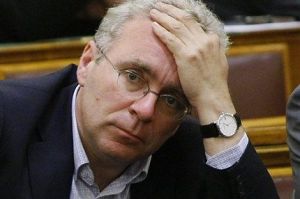
Not a Bubbleback: Fidesz National Assembly caucus Deputy Chairman Zoltán Pokorni.

Not a Bubbleback: Fidesz National Assembly caucus Deputy Chairman Zoltán Pokorni.

The awkward attempt of Prime Minister Orbán and members of his inner circle to divert public attention from the politically damaging topics that dominated the domestic news in Hungary this fall via the red herring of mandatory drug testing suggests that they are either unwilling or unable to understand the true reasons for rapidly growing public dissatisfaction with their rule and to make the necessary adjustments to their political methods and tactics. This fall marked the end of an eight-year period, beginning when Orbán was still in opposition, during which he and his party radiated an aura of unassailable legitimacy and infallibility. From now on they will be forced to defend their public policies and justify the personal conduct of government and party officials against criticism in a truly competitive political arena. Some members of the Orbán administration have apparently understood this. Speaking on the pro-government television station HírTv on November 29, Fidesz National Assembly caucus Deputy Chairman Zoltán Pokorni said (source in Hungarian):

These bigger and smaller affairs—who wears what kind of watch, who goes where to relax or on summer vacation or whose house is how big—these were obviously known over the past years, but they didn’t interest anybody. They were not connected to charges of corruption. However, since the United Stats entry ban, these many small facts that were previously thought to be minor annoyances have now become rearranged into such a cross-section. The United States struck a chink in our armor, just a small hole, though it is through this hole that the water flows. And we must stop this water. There can’t be such living like a lord, that is, it shouldn’t be done, because a responsible government member or leading political official cannot permit himself to engage in the kind of lordly conduct that he could perhaps get by with before.

—————————————————————————————————————————————–
Teutonic Shift

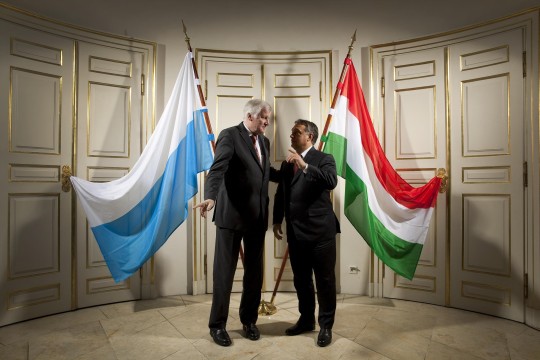
Seehofer and Orbán: pointing the way.

Seehofer and Orbán: pointing the way (Photo: Die Welt).

On November 6, 2014 Prime Minister Viktor Orbán made a seemingly routine trip to Munich to visit Minister-President Horst Seehofer of Bavaria. The stated purpose of the meeting between Orbán and Seehofer was to discuss issues related to the Hungarian state’s purchase of MKB Bank from the Bayerische Landesbank (Bavarian State Bank) earlier in the fall (source in Hungarian).

However, the official visit that Prime Minister Orbán made to Bavaria at the beginning of November in fact represented a major shift away from rapprochement with Russia as part of his administration’s Eastern Opening policy in favor of mending relations with the West via Germany. Though little noticed at the time, Orbán provided the first indication of this reorientation of his foreign policy during a joint interview with Minister-President Seehofer published in the November 9 issue of the Berlin-based conservative daily newspaper Die Welt. During the interview, Prime Minister Orbán said (source A in German and B in Hungarian):

We find ourselves in a very difficult situation. The Russians have made it clear that they want to establish a buffer zone between them and NATO and are willing to violate international law in the interest of doing this. . . Our point of reference in this crisis can only be international law. We cannot accept violation of this. It is moreover in the Hungarian interest that there always be something between us and Russia. Therefore we have a great interest in a stable and independent Ukraine. When I was young there was a Hungarian-Soviet border. This must not repeat itself.

Following the new leader (photo: AFP)

Following the new leader (photo: AFP).

On November 12, the online edition of the opposition weekly HVG reported that “a high-ranking Fidesz political official who plays an important role in the conduct of international relations” told the website that sources close to Chancellor Angela Merkel of Germany had informed the Orbán government through informal channels that within the “current international environment” they consider its “maverick” (különutas) policy to be unacceptable. “We received strong signals regarding what Germany expected of us,” the unnamed Fidesz official told hvg.hu, adding that Prime Minister Orbán had thus decided to make the necessary changes to his administration’s foreign policy (source in Hungarian).

The “current international situation” cited in the hvg.hu report obviously referred to the conflict between Russia and Ukraine and the “maverick” foreign policy of the Orbán government to its failure to condemn Russia’s annexation of Crimea in March 2014 (see Vlad Beyond Reproach) and reluctance to support European Union sanctions intended to punish Russia for the unilateral takeover (see Notable Quotes: Prime Minister Viktor Orbán under heading “European Union Economic Sanctions against Russia” and National Economy Minister Mihály Varga under “Notable Quotes”).

Over the 12 days following the hvg.hu report, both Orbán and Minister of External Economy and Foreign Affairs Péter Szijjártó reinforced the explicit and implicit support for Ukraine’s territorial sovereignty that the prime minister initially articulated in his November 9 interview with Die Welt. Moreover, Orbán and Szijjártó made associated statements intended to affirm Hungary’s loyalty to the European Union in specific and the West in general. The following is a summary of these pronouncements:

November 12: Minister of External Economy and Foreign Affairs Szijjártó said during a joint press-conference with Foreign Minister Frank-Walter Steinmeier of Germany in Berlin that Hungary is committed to Ukraine’s sovereignty and territorial integrity. Szijjártó added that “Hungary will always be loyal toward common European decisions (source in Hungarian).

November 14: Szijjártó stated during an interview with the Financial Times that “Central Europeans know what it means to have a neighbor like the Soviet Union and we never want to experience that again.” With regard to the conflict between Russia and Ukraine, the Orbán government’s minister of external economy and foreign affairs said “The big and strong countries need to put the proposals on the table; they can count on our support for all solutions which bring the conflict to a swift conclusion” (source in English).

November 17: Szijjártó said with regard to EU sanctions against Russia during a visit to Brussels to attend a meeting of European Union foreign ministers that “Hungary supports expansion of the group of individuals subjected to European Union visa bans and if the occasion arises the imposition of further asset freezes” (source in Hungarian).

November 20: Prime Minister Orbán declared at a session of the Hungarian Permanent Conference [Magyar Állandó Értekezlet] in Budapest that “It is in the Hungarian interest, not the American or European, that there be something between Hungary and Russia, and this is Ukraine. A sovereign, democratic Ukraine, where a 200,000-strong Hungarian community lives” (source in Hungarian).

November 21: during a speech at the The Foundation for Family Businesses in Germany and Europe conference in Baden-Baden, Germany, Orbán remarked that “We had a common border with the Soviet Union. It was a big adventure, though it was enough.” The prime minister said that his administration supports Ukrainian sovereignty because “. . . we also believe that there must be something between Russia and Hungary” (source in Hungarian).

November 24: Orbán said in an interview with the German business daily Handelsblatt that “Chinese are necessary for the Chinese model and Russians for the Russian [model]. In Hungary and in Europe these solutions are unusable.” Orbán repeated during the interview that “It is in our interest to have something between Hungary and Russia—and that is a sovereign Ukraine . . . We had a common border with the Soviet Union and it lasted a long time until we were able to get rid of it. We do not want to have this again” (source A in German and B in Hungarian).

The abrupt turnabout of Prime Minister Orbán away from Russia and toward Germany represents the most dramatic policy change he has made in the four and a half years since returning to power in May 2010. This volte-face must be viewed within the context of Orbán’s loss of support among both Western allies (following his highly publicized crackdown on Norwegian Civil Support Fund-financed NGOs in Hungary beginning this spring and proclamation of the illiberal Hungarian state this summer) as well as among domestic advocates (following his announcement of the subsequently withdrawn Internet tax and the emergence of several high-profile instances of corruption, cronyism and apparent politics-for-profit within his administration this fall). In short: Prime Minister Orbán could not afford to further alienate his formal allies abroad as support for his “two-thirds revolution” weakens at home. The prime minister is specifically seeking to obtain political support from Germany, which has long been Hungary’s most significant foreign-trade partner and is currently governed by the two foreign parties with which Fidesz has maintained its closest ties—Chancellor Angela Merkel’s Christian Democratic Union and the affiliated Christian Social Union in Bavaria. However, Orbán, whose political retreats have never been more than tactical, is almost certain to shift Hungary’s external orientation back toward Russia and the East if he regains his domestic political footing. 

—————————————————————————————————————————————–

NYT vs. RT

Russia Today photo:

Russia Today photo: Foreign Minister Sergei Lavrov of Russia and Prime Minister Viktor Orbán of Hungary shaking hands.

On November 7, 2014, both the New York Times and the website of the state-run television station Russia Today (RT) published articles about Prime Minister Viktor Orbán and his administration.

The title of the New York Times piece: “Defying Soviets, Then Pulling Hungary to Putin – Viktor Orban Steers Hungary Toward Russia 25 Years After Fall of the Berlin Wall.”

The title of the Russia Today piece: “The bullying of Hungary – the country that dared to disobey the US and EU.”

These articles are quintessential representations of the fundamental attitudes of the anti- and pro-Orbán camps, both inside and outside Hungary.

In short: globalist vs. anti-globalist; liberal vs. anti-liberal; pro-West vs. anti-West.

Presuming that the opinions expressed in the New York Times and Russia Today largely reflect those of the Obama and Putin administrations, respectively, the November 7 pieces in the NYT and RT also provide further evidence that Hungary has become a secondary theater, behind Ukraine, in the struggle between the U.S.-led North Atlantic Treaty Organization and Russia to retain or regain political supremacy in the post-communist states of eastern Europe.

New York Times photo: Prime Minister Viktor Orbán at the Hungarian Parliament Building.

New York Times photo: Prime Minister Viktor Orbán at the Hungarian Parliament Building.

—————————————————————————————————————————————-

24 Bastions

Marking party victories at the Jobbik municipal-election headquarters on October 12.

“The Future Cannot Be Stopped”: marking party victories at the Jobbik municipal-election headquarters on October 12, 2014 (index.hu photo).

On November 9, 2014, candidates from the radical-nationalist Jobbik party won mayoral elections repeated in the city of Ózd and the village of Recsk, both in northern Hungary, after regional election officials determined that balloting at these locations in early October had failed to produce bona fide winners (source in Hungarian).

These victories raised the number of Jobbik mayors in Hungary pursuant to 2014 mayoral elections to 14, compared to just three as the result of 2010 mayoral elections (main source in Hungarian).

A further 10 independent candidates who ran with official support from Jobbik were victorious in mayoral elections held throughout Hungary on October 12.

Therefore, 24 communities in Hungary now have Jobbik or Jobbik-supported mayors, compared to 12 at the end of the last municipal-government cycle (see note below).

Ten of the latter 12, including László Toroczkai of Ásotthalom (see First Little Pinprick) and Mihály Zoltán Orosz of Érpatak (see The Second Little Pinprick), won reelection this fall.

Supporters carry newly elected 27-year-old Mayor Dávid Janiczak of Ózd on their shoulders on November 9, 2014 (index.hu photo).

Jobbik or Jobbik-supported candidates won two-thirds of their victories in the Northern Hungarian Mountains and the Northern Great Plain, thus signifying a continuation of the party’s success in these impoverished and highly Gypsy-populated regions of the country.

And, for the first time, Jobbik and Jobbik-supported candidates won mayoral elections in cities with populations of over 20,000—Békéscsaba, Ózd and Törökszentmiklós.

One should not exaggerate the significance of the gains that Jobbik achieved in 2014 mayoral elections: party or party-supported mayors still serve as the highest-ranking elected officials in less than one percent of the 3,177 communities in Hungary with municipal governments. However, this fall’s mayoral elections show that Jobbik has not only gained popularity in the party’s established rural strongholds in rural northeastern and eastern Hungary, but has also made political inroads in towns and small cities in these sections of the country and begun to extend its political reach into the more economically developed region of Transdanubia. If these trends continue over the next four years, Jobbik could challenge the Fidesz-KDNP governing alliance’s local-level political supremacy in the part of Hungary lying to the east of the Danube River in 2018.

Note: Four of these 12 mayors won 2010 elections—three as Jobbik candidates and one as a Jobbik-supported independent; two won 2010 elections as independents before joining Jobbik in 2012; and six won by-elections—four as Jobbik candidates and two as Jobbik-supported independents.


l

Jobbik victories in 2014 mayoral elections: black = Jobbik mayor; gray = Jobbik-supported independent mayor (Orange Files graphic).


Communities in which Jobbik candidates won 2014 mayoral elections:

Ózd (pop. 33,944);

Törökszentmiklós (20,827);

Tapolca (15,823);

Tiszavasvári (12,954);

Devecser (4,378);

Monorierdő (4,073);

Ásotthalom, (3,855);

Tuzsér (3,397);

Recsk (2,696);

Kosd (2,447);

Hencida (1,219);

Mátraballa (764);

Bánokszentgyörgy (641).

Gasztony (430).

Communities in which Jobbik-suppported independents won 2014 mayoral elections:

Békéscsaba (60,571);

Rakamaz (4,442);

Békésszentandrás (3,660);

Gyöngyössolymos (2,823);

Érpatak (1,681);

Szabolcsbáka (1,181);

Jéke (727);

Kemenessömjén (591);

Lovászhetény (302);

Martonfa (213).

—————————————————————————————————————————————–