Deal of the Century

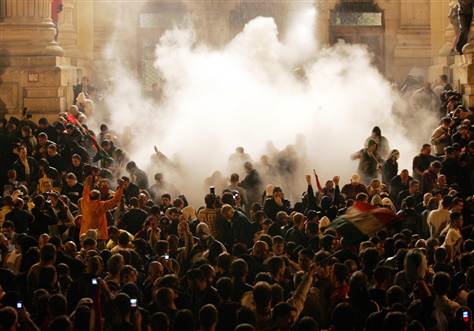
Orbán and Putin shake on the Paks deal.

Orbán and Putin shake on the agreement

On January 14, 2014, National Development Minister Mrs. László Németh of Hungary and CEO Sergey Kiriyenko of Russian state-owned nuclear-energy company Rosatom signed an interstate agreement stipulating that Rosatom will build two new reactors at the Paks Nuclear Power Plant in south-central Hungary at a cost of between 10-12 billion euros, representing one of the biggest investments the government of Hungary has ever made (source in Hungarian).

Rosatom will build two new 1,200-megawatt reactors at the plant to replace its four existing 500-megawatt reactors due to be decommissioned between 2032 and 2037. The Orbán government says that the two new reactors will generate about 50 percent of the total demand for electricity in Hungary, compared to the current total of 40 percent (source in Hungarian).

The agreement calls for Rosatom to build the reactors with 10 billion in loans from Russia to cover 80 percent of the investment, while the government of Hungary will pay for the remaining 20 percent of the cost of the project and begin repaying the loan when the reactors are scheduled to open in 2025 (source in Hungarian).

National Economy Minister Mihály Varga announced on February 5 that the government of Hungary would repay the 10-billion-euro loan to Russia over a period of 21 years from the completion of the first reactor in 2025 through 2046 at an interest rate of 3.95 percent for the first eleven years, 4.5 during the second phase of repayments and 4.9 percent during the third phase of repayments (source in Hungarian)
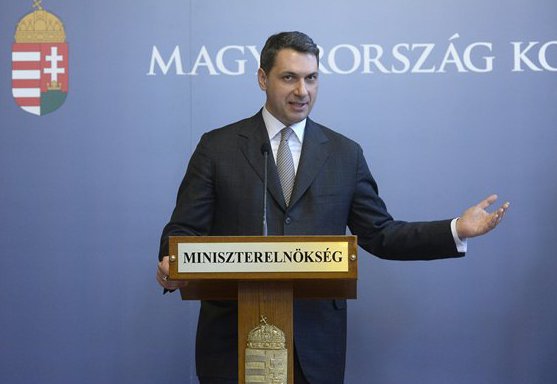
State Secretary Lázár announces the Paks agreement.

State Secretary Lázár announces the agreement.

After announcing the signing of the agreement, State Secretary in Charge of the Prime Ministry János Lázár called it “the deal of the century” (see source A and B in Hungarian).

The Orbán government did not call a tender for bids to build the reactors, claiming that this was not necessary because the pact represented an extension of the 1966 Soviet-Hungarian agreement calling for construction of the original reactors at the Paks Nuclear Power Plant, not a business deal (source in Hungarian).

Hungary’s National Assembly approved the agreement on February 6, 2014 by a vote of 256 to 29 with two abstentions, moving the vote up one week earlier than planned at the recommendation of the Fidesz caucus. Representatives from the FideszChristian Democratic People’s Party alliance and the radical-nationalist  Jobbik party voted in favor of the agreement, while representatives from the democratic-opposition parties voted against it (source in Hungarian).

The most powerful members of the government—Prime Minister Viktor Orbán, Deputy Prime Minister Zsolt Semjén, Minister of Justice and Public Administration Tibor Navracsics, State Secretary Lázár and National Economy Minister Mihály Varga—did not participate in the vote (source in Hungarian). 

 ———-

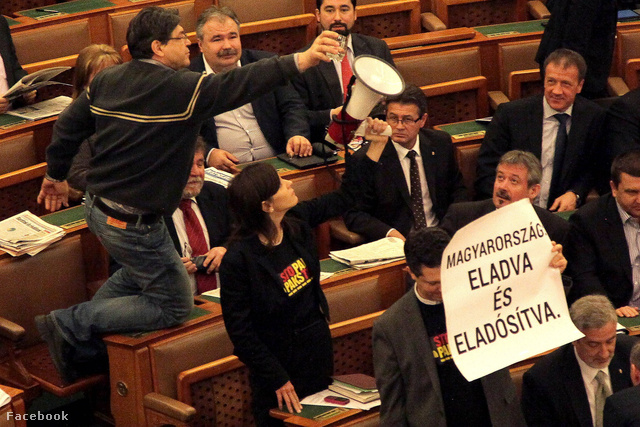
LMP National Assembly representatives protest the Paks deal.

LMP National Assembly representatives protest the agreement.

There are very few people in Hungary who argue that the country does not need to build new reactors at the Paks Nuclear Power Plant. National Assembly representatives from all parties voted nearly unanimously in favor of a resolution to expand the plant during the final days of the Hungarian Socialist Party-led government of former Prime Minister Ferenc Gyurcsány on March 30, 2009 (source in Hungarian).

Among democratic opposition parties in Hungary’s current National Assembly, only the green party Politics Can Be Different (LMP) and its offshoot Dialogue for Hungary opposed the deal on the grounds that the government should invest on development of renewable-energy sources rather than expansion of nuclear-energy capacity.

LMP representatives blasted megaphones in the legislature’s session chamber to delay formal approval of the agreement to build the reactors (while Fidesz-KDNP representatives attempted to silence the devices by stuffing wads of paper and pouring glasses of water into them): the Hungarian Socialist Party and the Democratic Coalition rejected the agreement because they said that the government had concluded it unilaterally, without prior consultation with the National Assembly or the Hungarian people.

The Paks Nuclear Power Plant.

The Paks Nuclear Power Plant.

Orbán government officials claim that the deal with Russia to build new reactors at the Paks Nuclear Power Plant will increase Hungary’s energy security over the long term and provide the foundations for the government’s cuts in the cost of household electricity (source in Hungarian).

However, the government has classified as confidential until the year 2024, one year after the scheduled completion of the two new reactors, the reports containing the data and analysis upon which it based its decision to sign the agreement with Russia (source in Hungarian).

Many of the main consequences and possible drawbacks of the agreement are nevertheless clear:

Indebtedness to the State of Russia

The government of Hungary will be heavily indebted to the state of Russia for the next 32 years, until Prime Minister Orbán is well into his 80s. The opposition newspaper Népszabadság has estimated that the agreement will cost the government of Hungary an average of 300 billion forints per year during the 21-year repayment period (source in Hungarian), equivalent to just under 18 percent of the government’s total 2014 budgetary expenditures and just over 10 percent of Hungary’s 2012 GDP (source A and B in Hungarian).

Russian Influence over the Price of Electricity 

The text of the agreement states that the “cost connected to generating electricity” at the new reactors “will be acceptable of to the Designated Russian Organization” (source in Hungarian). The agreement stipulates that the Russians will choose this state-controlled Designated Russian Organization [Orosz Kijelölt Szervezet] (text of agreement in Hungarian and Russian).

Cost Overruns

The cost overruns that have occurred in connection to all three nuclear power-plant expansions currently taking place in Europe suggest that the Orbán government’s estimated cost of 10-12 billion euros for construction of the two new reactors at the Paks Nuclear Power Plant may be much lower than the actual cost of the project.

The estimated cost of a new reactor under construction at the Olkiluoto Nuclear Power Plant in Finland has risen from an original 3 billion euros to 8.5 billion euros (source in English). The estimated cost of a new reactor being built at the Flamanville Nuclear Power Plant in France has risen from an original 3.3 billion euros to 8.5 billion euros (source in French). The estimated cost of two new reactors under construction at the Mochovce Nuclear Power Plant in Slovakia has risen from an original 1.6 billion euros to 3.7 billion euros (source in English). Former Orbán government.

Deputy State Secretary in Charge of Energy Affairs Attila Holoda believes that the actual cost of building the two new reactors at the Paks Nuclear Power Plant could be up 20 billion euros (source in Hungarian).

The interstate agreement between Russia and Hungary contains no reference to this issue of which country will pay for possible cost overruns. State Secretary Lázár said during his announcement of the agreement on January 14 that the governments of the two countries would share the burden of paying for any excess costs connected to construction of the reactors. In response to a question about stipulated guarantees that the Russian government would help pay for any cost overruns, Lázár said that “We demanded legal guarantees and we will receive them. We are not even considering relinquishing anything from the Hungarian position,” though offered no specific proof that such guarantees existed (source in Hungarian).

Conformity with European Union Tender Regulations
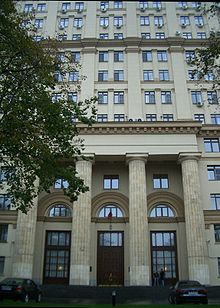
The sole contender: Rosatom headquarters in Moscow.

The sole contender: Rosatom headquarters in Moscow.

The European Union may challenge the Orbán government’s claim that the agreement is not subject to EU tender regulations because it represents an extension of the 1966 pact between “The Revolutionary Worker-Peasant Government of the Hungarian People’s Republic and the Union of Soviet Socialist Republics” to build the original reactors at the Paks Nuclear Power Plant.

Evidence suggests that the government was, in fact, planning to call such a tender until at least the second half of 2013. On June 4, 2013, National Development Minister Mrs. László Németh announced that the government would issue a tender for the construction of the new reactors at the plant before the end of the year (source in Hungarian).

Evidence also suggests that several western companies were interested in submitting bids in a possible tender. On June 5, 2012, CEO István Hamvas of plant operator Paks Nuclear Power told the Hungarian News Agency MTI that “organizing the tender is an extremely important task, which must by all means be issued so that we can choose the contractor that will build the reactor in Paks.” Hamvas said that he expected five companies, including Rosatom, the U.S. company Westinghouse, the French company Areva as well as companies from Japan and Korea, to submit bids in the tender (source in Hungarian). A spokesman for Areva told the British news agency Reuters that the company was interested in participating in the expansion of the Paks Nuclear Power Plant (source in English).

The spokeswomen for European Commissioner for Energy Günther Oettinger and European Commissioner for Internal Market and Services Michel Barnier both said that European Union specialists were examining the Hungarian-Russian agreement to determine if EU regulations would have required that the government of Hungary call a tender for construction of the new reactors (source A and B in Hungarian).

Constitutionality

The Fundamental Law that came into effect on January 1, 2012 prohibits the National Assembly from adopting a government budget the raises state debt to over half of gross domestic product or, in the event that debt is already over half of GDP, from adopting a government budget that does not reduce state debt in proportion to gross domestic product.

Hungary’s state debt was just below 80 percent of gross domestic product in 2013, thus all Hungarian governments for the foreseeable future will be constitutionally obligated to adopt budgets that reduce debt in proportion to GDP (source in English).

The Orbán government has not said how repayment of the cost of building the reactors beginning in 2025 can be achieved without violating this constitutional stipulation. In response to a question regarding this issue, State Secretary Lázár said “When will this situation arise? We are not yet receiving the loans and when we do it will just be gradual. . . . We will pace the drawing down of loans for the investment, paying attention to preserve the long-term declining trend of the debt, thus conforming to the constitutional regulations” (source in Hungarian). Lázár did not provide further details regarding how a future government could stagger the repayment of 10 billion euros in loans plus interest over a period of 21 years without raising debt. 

Conclusion

The Orbán government’s decision to have Rosatom build new reactors at the Paks Nuclear Power plant with at least 10 billion euros in loans from Russia has in political terms moved Hungary closer to Moscow and farther from Brussels. The government concluded the agreement with Rosatom without offering western companies the chance to submit bids to build the reactors. Nor will it make public the background studies and analysis upon which it based its decision to select the Russian state-owned company public until after the scheduled completion of the investment. The Fidesz National Assembly caucus furthermore stifled all potential parliamentary debate on the issue by moving voting on the agreement up one week earlier than scheduled.

Foreign Minister János Martonyi of Hungary told Foreign Minister Frank-Walter Steinmeier of Germany that the agreement was not based on geopolitical considerations, stating that “It is out of the question that with this Hungary is turning toward Russia” (source in Hungarian). However, the lack of transparency, openness and meaningful debate that have surrounded the pact indicate that the Orbán government is attempting to obscure evidence that it is, in fact, the natural culmination of four years of conflict with the European Union, the International Monetary Fund and the West in general and simultaneous rapprochement with Russia, China and other semi- or fully authoritarian states.

Perhaps State Secretary Lázár’s post-agreement characterization of Russian-Hungarian relations as “an increasingly smooth marriage of convenience that is offering greater and greater pleasure to both parties” (source in Hungarian) most accurately describes the emotional impulses that prompted Prime Minister Orbán to look toward Russia rather than the West in his search for construction and financing of the new reactors at the Paks Nuclear Power Plant—impulses that will almost certainly cause him to move Hungary farther into the anti-democratic Eastern political orbit during his next term in office beginning this spring.

5488108_0b8aa8c4b8dc5dcd29f3b2666ed7f48a_wm


—————————————————————————————————————————————–

Notes from the Carnival Ball

DSC_0379Carnival ball (farsangi bál) at the community cultural house in one of the old Swabian towns on the outskirts of Budapest. 

A couple of hundred people, most of them 60 and older, sitting at long tables before a dinner of red cabbage and fried meat dumplings. Everybody is dressed up, almost all the men wear suits and ties. They watch a trio perform a variety of music in the shadowy hall, from German oompha to Hungarian and American pop hits from the 60s and 70s.    

They watch young people perform a waltz. The performers then select partners from among the spectators. Instantly other couples join and the floor is full of shining bald heads and white hair turning to the music. 

The music stops, the couples sit, the mayor stands for a speech. A proficient public speaker, confident, fluent, well-told anecdotes, a single political reference to the event as a needed distraction from the mounting tension of “public life.” 

All heads are turned in the same direction, listening intently to the town father. Conservative folk, many of them of German descent. Disciplined, practical, hard-working people, they are cultured to an equal or greater degree than their equivalents in the West, though are more linguistically isolated and less able to understand the greater world around them. 

Members of a small and vulnerable nation seeking community with those of the same language and background, looking for unaffected pre-System Change companionship in a crass post-System Change world.  

Rock-solid Orbán supporters, they will follow him through thick and thin as he turns Hungary back toward the East, as he wages populist battle against the European Union, as he dismantles the country’s democracy and takes control over their sources of information in order to create a highly centralized, semi-authoritarian state.  

It is a state in which they feel comfortable: secure under a strong leader fighting in the interest of the Hungarian nation against foreign predators and their domestic accomplices, one who has defended them against the manipulations and exploitation of the free-market and ensured their basic subsistence through cuts in the cost of household gas, electricity, heating and water. 

Friendly people. Generous people. Benevolent people, though inherently suspicious of the motives of outsiders.

This demographic—nominally anti-communist, though nevertheless uniformly nostalgic for the monolithic simplicity and unfailing continuity of the Hungarian Socialist Workers’ Party dictatorship—has abandoned the affinity it once felt for the ideals of western liberal democracy. As one of the most powerful constituencies in an aging population, it will provide the Orbán administration with a steady base of support well into the 2020s. 

—————————————————————————————————————————————–

A Thousand Clowns

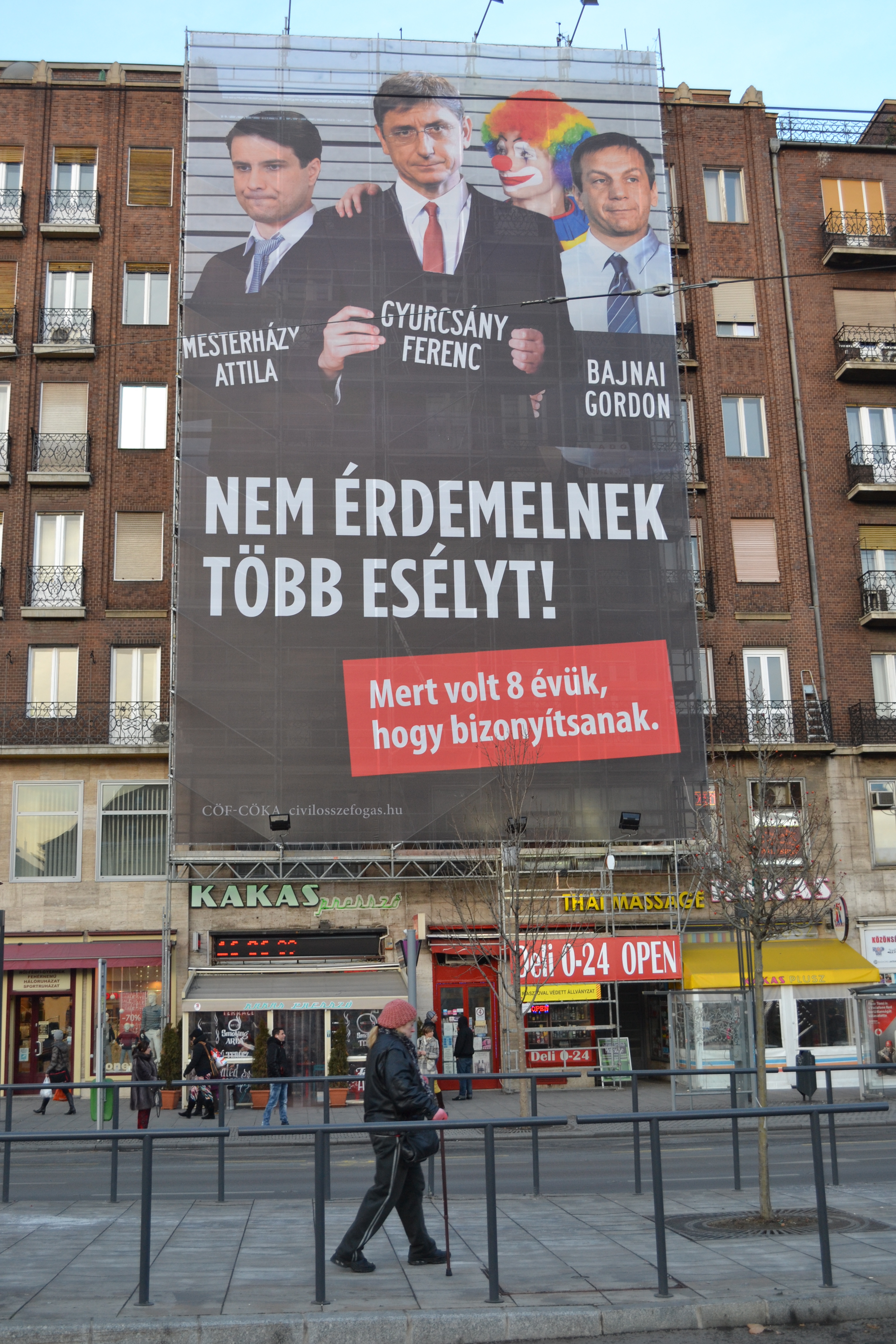
gyucsany_cof_plakatFollowing the establishment of the Cooperation (Összefogás) opposition-party coalition in the middle of January, the pro-Fidesz organization Civil Cooperation Forum (Civil Összefogás Fórum, or CÖF) placed signs like the above throughout Budapest, including a colossal sign in the middle of the city.

The sign portrays the leaders of the three main parties that joined together to form Cooperation—Attila Mesterházy of the Hungarian Socialist Party, former prime minister Ferenc Gyurcsány of the Democratic Coalition and former prime minister Gordon Bajnai of Together 2014—posing for a collective mug shot along with a clown of unknown identity and former Budapest deputy mayor Miklós Hagyó, who is currently facing charges of corruption in connection to severance pay at the Budapest public-transportation authority BKV in what many consider to be another of the Orbán government’s show trials of former Hungarian Socialist Party officials. The text below the images reads “THEY DO NOT DESERVE ANOTHER CHANCE.”

Asked to identify the clown, Civil Cooperation Forum (CÖF) founder László Csizmadia responded:  

The clown teacher on our sign is greeting his disguised associates who receive lessons from him every day and we can say that they are very good students: they have already earned excellent marks in clowning around. They are the parasites whom the voters smoked out in 2010 with the chief clown, Ferenc Gyurcsány, in the lead (source in Hungarian).

a2Csizmadia said that the Civil Cooperation Forum had financed the sign campaign through private donations, though declined to specify the amount of money the organization had paid to have the signs put up or the identity of the donor. 

The Hungarian Socialist Party’s new political sign (above) is only slightly less brazen than CÖF’s, portraying Fidesz oligarch Lajos Simiscka and Prime Minister Viktor Orbán under the text “They Are Living Better. And You?” with the caption “Simicska-Orbán Mafia Government” slipped in between them.   

The Civil Cooperation Forum and Hungarian Socialist Party signs presage a very contentious and mean election campaign this spring; they also symbolize the decline in the level of political discourse in Hungary to that of playground hectoring and reflect the patronizing attitude that political leaders in the country hold toward the national electorate. 

Gigantic sign near Deák Square in Budapest (Orange Files photo).

Gigantic CÖF sign near Deák Square in Budapest (photo: Orange Files).

—————————————————————————————————————————————–

Prophetic Words from 1989

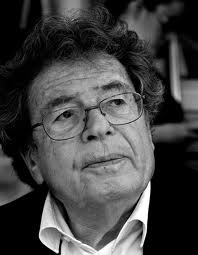
György Konrád.

György Konrád.

The following paragraph is from author György Konrád’s 1989 essay “Jewish-Hungarian Reckoning” (“Zsidó-magyar számvetés”): 

All forms of anti-democratic anti-communism, all revenge-inspired rightism, are contrary to the enduring interests of Hungarian Jews. If a considerable portion of the Hungarian middle class for some reason decides it does not want liberal democracy after all, then the only thing remaining for it would be some type of peripheral amalgam of nationalism and communism, some kind of national-communist authoritative state endowed with its own unique brand of paternalism. 

————–

Konrád wrote this paragraph before Hungary’s first democratic elections, during the final year of the Hungarian Socialist Workers’ Party dictatorship. It is a farsighted reflection on the consequences of the possible failure of Hungary’s transition to democracy—a failure that, unfortunately for all Hungarian citizens, non-Jewish and Jewish alike, took place in precisely the manner he envisioned with Fidesz’s election victory in 2010.     

Note: This is an Orange Files translation of the paragraph, which appears on p. 59 of a collection of Konrád’s essays called Zsidókról [About Jews]. This essay was published in English translation in the 1999 book The Invisible Voice: Meditations on Jewish Themes, to which Orange Files does not have access.

—————————————————————————————————————————————-

An Archconservative Speaks Out

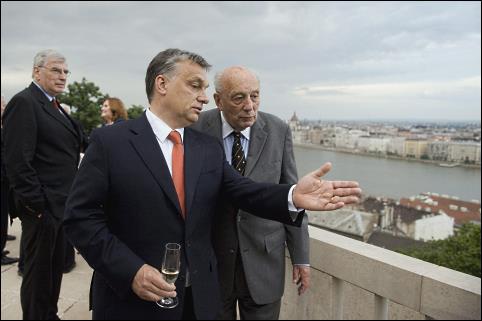
Prime Minister Orbán and John Lukacs looking over Budapest from Castle Hill in May 2013.

Prime Minister Orbán and John Lukacs looking over Budapest from Castle Hill in May 2013.

The opposition newspaper Népszabadság recently (January 25) published the following letter from the deeply conservative Hungarian-born U.S. historian John Lukacs regarding the January 14 interstate agreement between Hungary and Russia to have Russian state-owned company Rosatom build two new reactors at the Paks Nuclear Power Plant in south-central Hungary with 10 billion euros in Russian financing (source in Hungarian; see also: Deal of the Century):

Paks Vobiscum? No: Pax Nobis!

It has been almost 67 years since I left my native land. Since then the fate of my country and my nation has often grasped and wrenched my heart, though I never did deal with or write about Hungarian politics. Nor would this be proper now at the age of 90. But something nevertheless prompts me to do so. At least I spent at least two long winter nights thinking about it.  

The Russian-Hungarian Paks agreement has tempted me.

I do not receive any Hungarian newspapers. And Hungarian periodicals only rarely. I click on Népszabadság for one or two minutes every morning. To my knowledge many Hungarians still read it to this day. It is for this reason that I am sending these lines here. Maybe they will reach a couple of hundred readers.

The present prime minister has honored me with his attention and friendship for years. However, I now consider it to be my obligation to steer my opinion in his direction with these lines. I have been aware of inclinations in his world outlook for more than 20 years now. I see that he felt a certain aversion toward the so-called “West,” western Europe and England, even before 1989. 

Now he has reached a boundary line. I do not agree with those who speak and speculate about the economic consequences of the Paks agreement. Will electricity be cheaper or more expensive when the investment is completed in ten years (if ever)? My dear Hungarians, we cannot know the answer to this, but even if we could know the answer, it would be irrelevant. It is not worth the underside of a dog’s tail. The essence and fate of a country is not an economic detail. The essence of a country determines who we are and where we belong.

History hardly ever repeats itself. And that of the nation only rarely and to a smaller degree. And the character of a person changes the least. This will be perhaps the most profound problem facing the Hungarian people in the future. It is not merely a question of the insufficient degree of self-confidence among Hungarians. (Though this as well!) But one of who we are, where we belong, where we should belong? 

Our great Saint Stephen was not only a singular saint, but a great founding father as well. More than one-thousand years ago, when the immense Greek Orthodox Byzantine Empire nearly embraced the Carpathians. If Stephen had chosen the path of accommodation with this empire, it would have entailed countless short-term benefits for him. But he did not do this: he chose Roman Christianity, a Papal emissary, a western wife, “Europe” (though this term had not yet come into existence). This choice formed the Hungarian Christian faith and character over a period of one-thousand years. Our eternal gratitude for this!

Western countries have often done little or nothing for us. But nevertheless. When the leaders of the Hungarians occasionally chose the “East,” this nearly always proved to be catastrophic. The consequence and essence of the tyranny that trampled Hungary under foot in the recent past was not communism, but the Russian occupation. At the end of the horrible Second World War the great Churchill, who already knew that the Russians would occupy all of Hungary, again told Roosevelt (unfortunately in vain) that Hungary was part of Central, not Eastern Europe. The Hungarian multitudes rejected the East in 1956 and 1989 as well. 

What kind of reward could we have expected from a greater Russian empire? Nothing. Széchenyi and Kossuth foresaw this. One must recognize and respect the Russians as our distant relatives, the wise Finns do. But we do not belong to the Russians. Accommodation to them must never form the central element of our endeavors. We honor their achievements, their great artists. However, the breath of the Hungarian spirit, the Hungarian intellect, Hungarian art and learning is western. Not Russian, and not even American. In spite of their greatness, it is not Tolstoy or Dostoyevsky who speak to us, but Dante, Shakespeare and Pascal, Goethe and Tocqueville. The West has often been our cross, but we must bear it, because it is our guiding light as well. We esteem our great Russian neighbors, but we must not accommodate ourselves to them, must not fawn upon them, because this could become a heavy burden for a long time and turn to the detriment of the Hungarians. 

Since 1989 we have been responsible for everything we have chosen, done and thought. The Hungarian character and spirit cannot be eastern. Pax Vobiscum! These are the closing words to the old Latin mass: Peace be with you! But now Pax Nobis! Let peace be ours! 

———————-

Lukacs has long been among Prime Minister Viktor Orbán’s most favored Hungarian academics. The Hungarian government awarded Lukacs the Hungarian Corvin Chain in 2001, the year the first Orbán administration revived this Horthy-era order of merit recognizing those who have made outstanding contributions to Hungarian science, art and literature. In May 2013, Lukacs was among six recipients of the award invited to an honorary dinner with Prime Minister Orbán, President János Áder and Prime Ministry chief János Lázár at the presidential Sándor Palace in Budapest.

Lukacs’s explicit criticism from his vantage point in the United States of the Hungarian-Russian agreement to expand the Paks Nulcear Power Plant and Prime Minister Orbán’s pro-Russian, pro-East policies suggests that conservative Orbán supporters in Hungary may harbor similar sentiments, though are refraining from expressing them in order to avoid creating a rift among Fidesz voters just ten weeks before national elections. 

—————————————————————————————————————————————–
Back to the Future

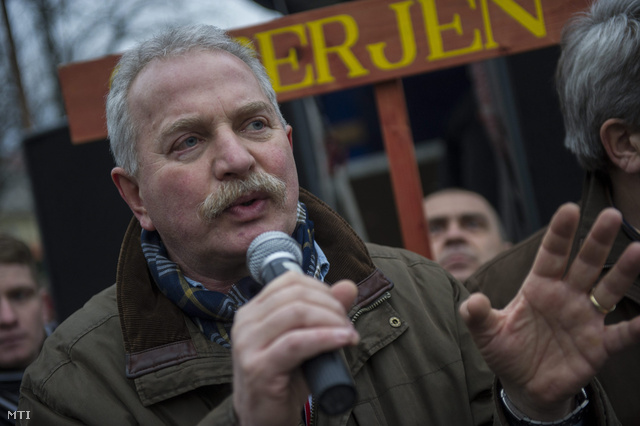
Demokrata editor-in-chief speaking at previous pro-government Peace March.

Demokrata editor-in-chief András Bencsik.

In the most recent issue of the nationalist weekly Magyar Demokrata, editor-in-chief András Bencsik published an appeal for the organization of another pro-government Peace March (source in Hungarian). Below is an Orange Files translation of Bencsik’s appeal: 

. . . As if a change of roles has taken place, as if America has begun to take on the role of the Soviet Union as it came to its inglorious end.  Rather than an ambassador (1), it [America] is sending an arrogantly confident governor, instructor, commissar to the subjugated country, whose task will not be to transmit the petty thoughts of the enslaved people to the imperial capital, but to use all its weight to force this primitive people to adopt the prescribed lifestyle: “checks, balances and marijuana.” 

Russia is the home of tolerance compared to this. Everything bad that could be said about the Soviet-Russians has been said over the past decades. And? They just signed the deal of the century with us regarding the expansion of the Paks Nuclear Power Plant, thanks to which Hungary’s energy dependence will end for a half century (2). President Putin did not voice even a word of objection to Hungary’s domestic political situation, although Russia is still the world’s second greatest power and in light of the visible trends it could easily become number one again within a century.  

Use of the system of checks and balances is, as a matter of fact, part of Hungarian thought. The Princes of Transylvania last used it magnificently between the Austrian and Turkish great powers. It looks like it is no different today: Hungary’s freedom of movement will again increase with the strengthening Russian connection. Of course this doesn’t please everybody, Izsák Schulhof (3) lamented the expulsion of the Turkish occupiers from Buda because for him it was better with them around at the time. 

The balancing ability of Hungarian politics is important to us. Present indications suggest that we must soon hold another Peace March in support of this. March 29, the Saturday before the weekend of elections, seems to be an ideal time.

This would be the sixth Peace March since Bencsik, fellow pro-government journalist Zsolt Bayer and businessman Gábor Széles organized the first such pro-Orbán demonstration in January 2012. The appeal offers an insight into the widespread sympathy among Fidesz supporters toward Putin’s Russia and its highly centralized political and economic systems.         

 Notes

1-Reference to United States Ambassador-designate to Hungary Colleen Bell. 

2-Hungary and Russia signed an inter-state agreement on January 14 to have Russian state-owned company Rosatom build two new reactors at the Paks Nuclear Power Plant in south-central Hungary with 10 billion euros in Russian financing. 

3-Rabbi Isaac Schulhof, author of the Buda Chronicle recounting the expulsion of the Ottoman Turks from Budapest in 1686. 

—————————————————————————————————————————————–
What Is Truth?

Proposed design for the 1944 German-occupation memorial on Szabadság Square in Budapest.

Proposed design for the 1944 German-occupation memorial on Szabadság Square in Budapest.

An official from the fifth district of Budapest recently (January 19) revealed the design for a memorial commemorating the German occupation of Hungary on March 19, 1944 to be unveiled in the district on the 70th anniversary of the invasion this spring (source in Hungarian). 

The planned memorial shows an eagle representing Germany (the Reichsadler, or Imperial Eagle) swooping down upon a helpless, open-armed Archangel  Gabriel, who represents Hungary (source in Hungarian).   

The memorial embodies the declaration in the preamble to the Fundamental Law that came into effect in 2012 stating that Hungary lost its independence on the date of the German invasion (and did not regain it until the first post-communist democratic elections in 1990). 

The implication of this declaration in the Fundamental Law and the symbolism of the memorial: Germany, not Hungary, was responsible for the deportation of some 430,000 Jews to concentration camps (nearly all of them to Auschwitz), between May and July of 1944. 

It is true that under pro-Anglo-American Prime Minister Miklós Kállay, Hungary rejected Nazi Germany’s request to deport Jews from the country beginning in 1942. 

It is true that Hungary would likely not have deported Jews had the German occupation not taken place. 

However, it is also true that Hungary did not resist the German invasion in March 1944—though vigorously resisted the Soviet invasion of the country that began six months later.

German motorcycle unit at the Fisherman's Bastion in Budapest following the invasion of Hungary in 1944.

German motorcycle unit at the Fisherman’s Bastion in Budapest following the invasion of Hungary in 1944.

It is also true that Hungary’s leader, Regent Miklós Horthy, remained in power following the German invasion and throughout the subsequent eight-week period of Jewish deportations. 

Moreover, the Hungarian government under pro-Nazi Prime Minister Döme Sztójay organized the deportations in cooperation with SS Obersturmbannführer Adolf Eichmann, while the Hungarian gendarmerie (csendőrség) carried them out.  

Hungary’s government had, in fact, adopted three separate laws between 1938 and 1941 limiting the number of Jews who could work in various occupations and fields and banning marriage and sexual relations between Christians and Jews. It also deported 18,000 Jews without Hungarian citizenship (primarily refugees) from Hungary to the German-occupied city of Kamyanets-Podilsky, USSR in August 1941, shortly after the launch of the invasion of the Soviet Union. The Germans executed about 15,000 of these deportees in the first mass murder of Jews during the Second World War. 

Officials from the main Hungarian Jewish organization, the Alliance of Hungarian Jewish Communities (MAZSIHISZ), voiced objection to the proposed memorial’s message that angelic Hungary was defenseless in the face of the German predator in 1944 and therefore bears no responsibility for the deportation of Jews from the country. 

Hungarian gendarmes rounding up rural Jews in 1944.

Hungarian gendarmes rounding up rural Jews.

In typical fashion, Prime Minister Viktor Orbán’s reaction to these objections was founded upon the false premise that they were based on rejection of the notion of honoring the hundreds of thousands of Hungarian citizens who died as a result of the 1944 German occupation rather than rejection of the notion that the Hungarian government and people played no role in their deaths.

In a letter to MAZSIHISZ Orbán wrote “I hardly believe that bowing our heads in memory of the victims requires explanation of any kind. This is a question of humanity and not of political views or party affiliation. . . It is my conviction that honor for the victims does not permit us to look upon the fate of the imprisoned, the deported and the murdered without bowing our heads.”   

Fidesz National Assembly Caucus Chairman Antal Rogán, who also serves as mayor of the fifth district of Budapest where the memorial will be located, deflected objections to the proposed design by suggesting that the beholder is solely responsible for interpretations of its symbolism: “Everybody can read whatever they want to into the symbolism,”  he said (source for Rogán and Orbán quotes in Hungarian). 

The proposed design of the memorial, which the Prime Ministry commissioned sculptor Péter Párkányi Raab to complete from start to finish in a period of just over ten (!) weeks, has also been subject to harsh criticism on aesthetic grounds. 

And on financial grounds as well: the government has allocated 318 million forints (1.04 million euros) to build the memorial, of which it will pay 211 million forints (691,000 euros) directly to Péter Párkányi Raab (source in Hungarian). Although the sculptor will obviously have to subtract considerable building costs from this fee, even one-quarter of this sum would amount to 20 years’ pay for the average Hungarian wage earner.

The ostensible purpose the new memorial in Budapest commemorating the German military invasion of Hungary in March 1944 is to honor those who died as a result of the Nazi occupation. The real purpose is to absolve the Hungarian government and people of guilt in connection with the mass deportation of Jews to Auschwitz that began two months after the invasion. 

—————————————————————————————————————————————–
Understanding Fidesz

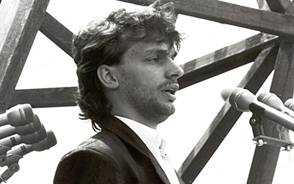
The young villager with higher aspirations.

The village lad striving for respect.

To understand Fidesz is to understand Viktor Orbán

Orbán is an exceptionally competent and charismatic leader who has molded the party in his own image. 

Everybody who has attained any degree of power within Fidesz has totally internalized Orbán’s ideas, objectives, logic, manner and speech. Nothing they do or say deviates from that which Orbán expects of them in either explicit or implicit terms. Their every act, phrase and gesture is orchestrated to meet with his approval.

To understand Fidesz is to understand a man who grew up fighting for his dignity on the fringes of Hungarian village society during the communist era—a tough and unforgiving social milieu within a tough and unforgiving political system.

It is to understand a man who never grew tall (he is officially 174 centimeters in height, or 5-foot 8), though compensated for his lack of physical stature through toughness and aggression that manifested itself primarily on the football pitch, where he excelled as hard-driving forward for several organized clubs in his late teens and early twenties.

It is to understand a man who has cultivated the high intelligence, fortitude and effectiveness of speech needed to survive and thrive as a smallish rural kid at his high school in the city of Székesfehérvár and then in college at the Loránd Eötvös University School of Law and Political Sciences in Budapest.

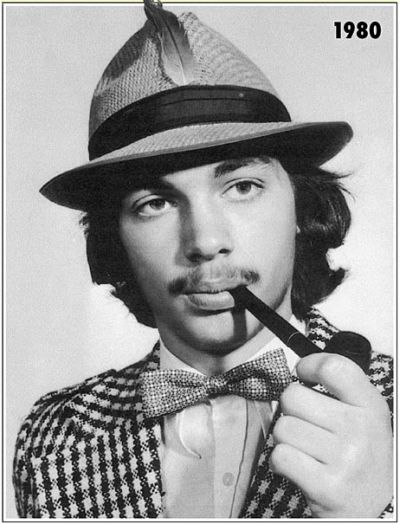
The young, pro-western liberal democrat.

The young pro-West liberal democrat.

Orbán has extended his fight to gain personal stature and dignity to a fight on behalf of the entire Hungarian people to attain what he considers to be its rightful place among nations. Back at the time when he and his fellow law-school students founded Fidesz in 1988, Orbán believed that this fight entailed winning independence from the Soviet Union, casting off the burden of communism and making Hungary part of the liberal-democratic, capitalist West.

Over the next twenty years he became deeply offended by what he viewed as Western exploitation and humiliation of the Hungarian people. He also become convinced that the West had become irremediably decadent and was on the verge of catastrophic collapse.

Since becoming prime minister again 2010, he has waged his fight on behalf of the Hungarian people against predatory Western corporations and culture, compelling him to turn Hungary back toward the east, toward China, Russia, the central Asian republics and the Arab states—countries with which he thinks he can do business without the threat of interference of any kind.

Orbán believes that he must have complete control over Hungary’s political system in order to implement this transition back away from Western free-market liberal democracy to Eastern guided economy and political authoritarianism. He will do anything within the law to hold on to power or regain it if he loses it. 

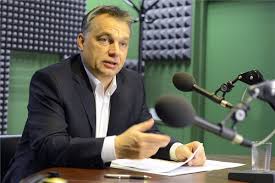
The middle-aged pro-east authoritarian.

The middle-aged pro-east authoritarian.

Orbán sees any internal opposition as a threat to this unity and therefore as harmful to the interests of the Hungarian nation.

He rules according to the logic of a tribal chieftain, not to that of a modern European statesman. Always fighting, always struggling, driven by an extremely unwarranted Hungarian inferiority complex to engage in perpetual confrontation with oppressors both real and imagined.

This combativeness has put Orbán and Fidesz at continuous odds with the European Union and most of the Western world.

Hungarians have experienced this phenomenon before: political leaders, parties and ideologies that claim the right to unchallenged political authority on the grounds that it is needed to ward off the enemies of the nation or of a particular favored class within the nation.

It has never come to a good end. Always conflict and disorder and the need to break with the past and start afresh.

But perhaps this time it will succeed. If Orbán is correct in his assessment that the West has entered a period of devastating cultural, economic and political decline and that the future lies in the East and Eastern centralized economy and government, then he will go down in history as a visionary and courageous leader who pointed Hungary in the right direction before it was too late. 

If he is wrong—if the shift in global power from the United States and Europe toward China and the East does not entail the catastrophic collapse of the West and the Western way of politics and economy—then he will go down in history as a leader who misunderstood the course of world events and led Hungary down the wrong path—once again. 

—————————————————————————————————————————————–
Having Your Cake

Prime Minister Viktor Orbán: the Curia should make a decision on the legality of foreign-currency loans.

Prime Minister Viktor Orbán: the Curia should make a decision on the legality of fx loans.

Prime Minister Viktor Orbán said during one of his regular Friday-morning interviews on state-run Kossuth Radio on November 8, 2013 that the Curia (Kúria)—the Fidesz-renamed former Supreme Court of Hungary—should issue a decision establishing legal uniformity with regard to the lawfulness of foreign-currency-denominated loan contracts (source in Hungarian).

The prime minister said that such a decision was necessary due to conflicting verdicts on the validity of fx loans from lower courts: “This is why we must prompt the leaders of the justice system, primarily the Curia, to sooner or later put things in order in this area . . . “ (source in Hungarian). 

On November 25, the Curia initiated proceedings to establish such legal uniformity with regard to foreign-currency-denominated loans. 

Fidesz National Assembly caucus Chairman Antal Rogán: the Curia stood on the side of banks.

Fidesz National Assembly caucus Chairman Antal Rogán: the Curia stood on the side of banks.

On December 16, the Curia issued its decision on the matter, declaring that foreign-currency-denominated loan contracts were legally valid and did not violate moral standards or represent usury. The supreme court proclaimed that borrowers bore the risks of exchange-rate fluctuations affecting the amount of their repayments on fx loans. 

The Curia declined to pronounce a verdict on the legality of unilateral fx-loan contract modifications, turning instead to the Court of Justice of the European Union in Luxembourg for a decision on this issue (source in Hungarian). 

Immediately following the Curia’s decision, Fidesz National Assembly caucus Chairman Antal Rogán said during a press conference: “We are disappointed, because the supreme judicial forum has also stood on the side of banks, since this decision explicitly states that the borrowers have to bear the exchange-rate risk” (source in Hungarian).

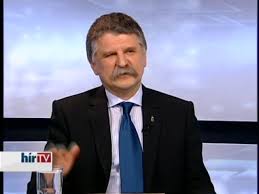
Fidesz National Assembly Speaker László Kövér: the Curia made a cowardly decision.

Fidesz National Assembly Speaker László Kövér: the Curia made a cowardly decision.

On December 19, National Assembly Speaker László Kövér said during an interview on the pro-government commercial television station Hír TV: “This was a cowardly decision, let’s just leave it at that. Instead of taking responsibility, the esteemed judicial body found a legalistic solution, tried to find an easy way out, and thank you very much, it will wait for the European Court to make a decision on this question at some time in the future and will, as it were, transmit this decision to Hungary” (source in Hungarian). 

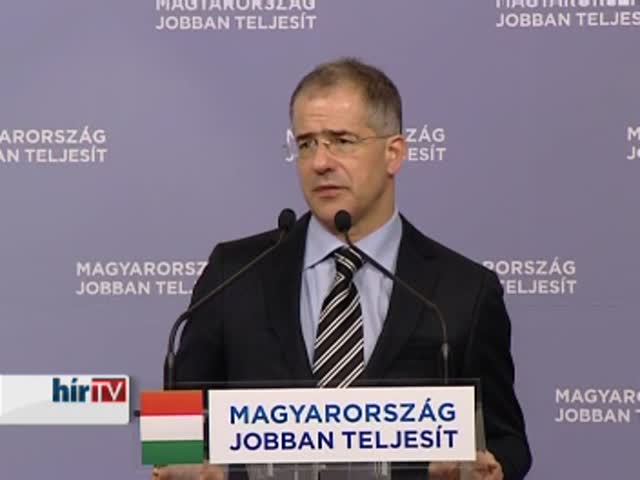
Fidesz National Assembly representative Lajos Kósa: the Curia made a cowardly decision.

Fidesz National Assembly representative Lajos Kósa: the Curia made a cowardly decision.

On December 20, Fidesz National Assembly representative and mayor of the city of Debrecen (eastern Hungary) Lajos Kósa referred to the Curia’s decision as a “bad, conflict-avoiding and cowardly step” that “exclusively favored banks” (source in Hungarian).

Speaking in Brussels later that day, Prime Minister Orbán stated that the “Curia stood on the side of the banks” when it made its decision on the validity of fx loan contracts (source in Hungarian).

Fidesz officials from the top down did not hesitate to criticize the Curia’s verdict on the issue of fx loans. 

It has not always been this way. 

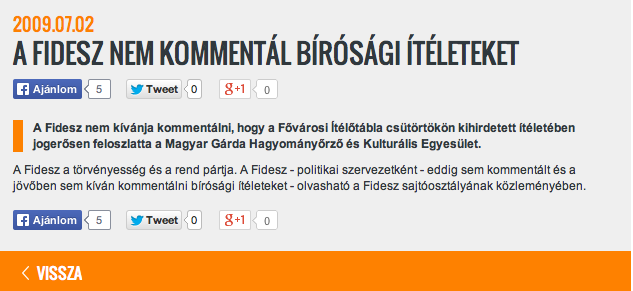
After the Budapest Court of Appeals dissolved the radical-nationalist paramilitary Hungarian Guard in July 2009, Fidesz issued the following statement (source in Hungarian from fidesz.hu website): 

Fidesz does not wish to comment with regard to the legally binding verdict of the Budapest Court of Appeals pronounced on Thursday dissolving the Hungarian Guard. Fidesz is the party of order and legality. Fidesz—as a political organization—has not in the past nor will in the future make comment regarding court verdicts.

Fidesz statement following the legal dissolution of the Hungarian Guard: the party does not comment on court decisions.

Fidesz statement following the legal dissolution of the Hungarian Guard: the party does not comment on court decisions.

Fidesz would undoubtedly respond to this apparent contradiction by claiming that Orbán, Kövér, Rogán and Kósa had all expressed individual opinions in their criticism of the Curia’s decision on fx loan contracts and were not speaking on behalf of the party. Fidesz officials use this tactic all the time: they claim to speak in the name of the entire party (or the entire Hungarian nation) in their own pronouncements, though decline to recognize this collectivity when asked to account for discomfiting statements from other Fidesz officials, claiming that they reflected private viewpoints.

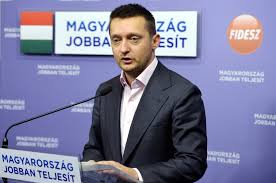
Fidesz Spokesman Róbert Zsigó: the Curia stood on the side of banks.

Fidesz Spokesman Róbert Zsigó: the Curia stood on the side of banks.

However, Fidesz Spokesman Róbert Zsigó, whose statements can hardly be said to reflect mere personal opinion, also criticized the Curia’s decision on fx loans, asserting during a press conference on December 21: “With this verdict, the Curia has stood unambiguously on the side of the banks, just as the Gyurcsány-Bajnai governments did when they unleashed foreign-currency loans on the people.” (source in Hungarian).

Here again Fidesz wants to have its cake and eat it too, adhering strictly to the principle of judicial independence when it is to the party’s benefit not to take a stand on legal decisions, such as in 2009 when it did not want to risk alienating potential radical-nationalist voters by expressing approval for the dissolution of the Hungarian Guard, and totally ignoring this principle when it is to the party’s political advantage to do so. 

—————————————————————————————————————————————–

The First Little Pinprick

The new mayor of Ásotthalom: Toroczkai leading demonstrators to Hungarian State Opera House in Budapest to hold anti-government demonstration on October 22, 2007 (Orange Files photo).

László Toroczkai leading anti-government demonstration in Budapest on October 22, 2007 (photo: Orange Files).

In by-elections held on Sunday, December 15, voters in Ásotthalom (southern Hungary, population 4,000) elected the president of the radical-nationalist 64 Counties Youth Movement, László Toroczkai, to serve as mayor of the village. Toroczkai, who serves as a Jobbik representative in the Csongrád County General Assembly, ran for mayor of Ásotthalom as an independent, defeating a single rival candidate from the ruling Fidesz party with over 70 percent of the vote. Following the announcement of the election results, Jobbik issued the following communiqué: “Jobbik heartily congratulates its Csongrád County General Assembly representative and president of its ally, the 64 Counties Youth Movement  (Hatvannégy Vármegye Ifjúsági Mozgalom), László Toroczkai” (source in Hungarian).

Toroczkai is one of the most prominent radical nationalists in Hungary. He gained national recognition as the leader of the group of 1,500 football ultras and political extremists that overwhelmed police guarding the Hungarian Television headquarters in Budapest and laid waste to the building on September 19, 2006. He was one of the main leaders of the frequent and occasionally violent anti-government demonstrations that took place in the city over the subsequent two years.

Toroczkai-led extremists lay siege to the Hungarian Television headquarters in Budapest on September 19, 2006.

Toroczkai-led extremists lay siege to Hungarian Television headquarters on September 19, 2006.

The Toroczkai-lead 64 Counties Youth Movement is the organizer of the annual radical-nationalist festival Hungarian Island (Magyar Sziget) that hosts explicitly anti-Semitic, anti-Gypsy and anti-West speakers and rock bands. Toroczkai, himself, is known for his extremist rhetoric, such as when he spoke openly at the Hungarian Island festival in 2011 of  the “shooting to death” (agyonlövés) of both Prime Minister Viktor Orbán and former Prime Minister Ferenc Gyurcsány, stating that “We would have done an even greater favor for the Hungarian nation had we shot him [Gyurcsány] to death at the Communist Youth League’s camp when he was ten years old” (source in Hungarian). 

One should not draw overarching conclusions from the results of local by-elections. Nor should one ignore them completely. The election of the radical-nationalist icon László Toroczkai to serve as the mayor of a village in southern Hungary over a Fidesz rival may be the product of purely local, personal politics with no greater political implications. However, it may also suggest that the effort of Jobbik to build the party’s base of support in rural Hungary at Fidesz’s expense through the espousal of tough measures to combat “Gypsy crime” may have begun to pay off.

—————————————————————————————————————————————–