Seen from the corner of Fremont and Cedar political events in Hungary seem so distant, yet so much clearer than they do from inside the country.
Especially when one has so much time and emotion invested in the non-stop series of conflicts that embody the Orbán era, the significance of every episode in this sad pageant of futile defiance is magnified to such preposterous lengths that all context is lost when viewed from up close.
The landslide Fidesz victory in local elections, the U.S. travel ban scandal, the mass demonstrations against Orbán’s proposed Internet tax: seen from Budapest, vastly important, self-contained events; seen from a small town in the Midwestern United States, constituent elements of a greater whole, mile posts along Hungary’s pathway from the liberal-democratic West toward the authoritarian East.
The heightened sense of proportion that comes with distancing oneself from the object under consideration. Distance needed in order to contribute constructively to an understanding and—perhaps even—resolution of the problem.
But it is so exciting to be there in person. And this may be the central meaning of it all: Hungarians are just too high-strung and bored with continuity to bear the tedium of stability.
As Imre Kertész, the Jewish Hungarian author of the Nobel Prize-winning novel Fatelessness, said with regard to the upheaval stemming from the Orbán government’s conflict with Europe: “Nothing new. No problem. And no solution because there is no problem” (see Fateful Endings).
Péter Szijjártó takes his oath of office as minister of external economy and foreign affairs.
On September 24, 2014, Péter Szijjártó took his oath of office as the Orbán government’s new minister of external economy and foreign affairs at the Hungarian Parliament Building in Budapest.
A few hours later, the opposition television station RTL Klub (see The Big Gun Swings into Action) broadcast a report revealing that in May the newly inducted 36-year-old foreign minister had purchased a house in the Budapest suburb of Dunakeszi for 167 million forints.
The amount of money Szijjártó paid for the house is 710 times the average gross monthly wage of 235,000 forints in Hungary. This means that average Hungarians would have to save their entire monthly pay for a period of nearly 60 years in order buy a house of the same value (source in Hungarian).
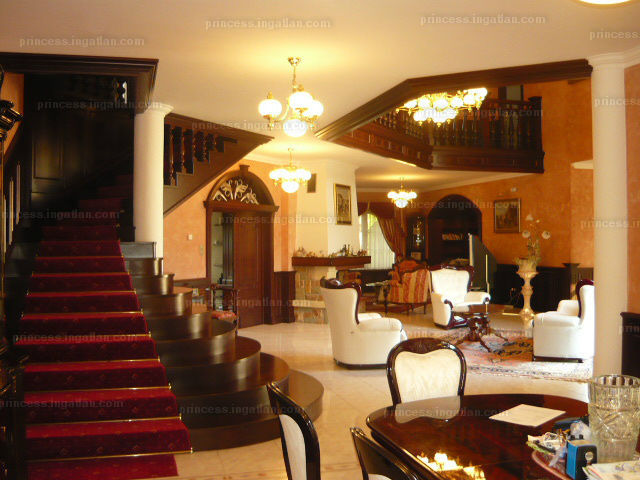
Minister Szijjártó’s living room.
Szijjártó told RTL Klub that he had paid for the house using 80 million forints in personal savings, 67 millions forints from his parents—just over half of which he would repay—as well as 20 million from his wife and his wife’s parents (source A and B in Hungarian).
Ministry of External Economy and Foreign Affairs Press Director Judit Fülöp reported that the foreign minister’s new house had total floor area of 391 square meters.
On September 26, RTL Klub reported that Szijjártó, who has never held employment unconnected to Fidesz, had submitted revised figures regarding the source of payment for the house, decreasing the amount he had paid by 12 million forints and increasing the amount he had received in loans from his parents by the same amount (source A and B in Hungarian).
Minister Szijjártó’s indoor swimming pool.
On September 29, RTL KLUB reported information from the Dunakeszi town clerk which showed that, including the five-car underground garage and indoor swimming pool, the official total floor area of Szijjártó’s house was 708 square meters rather than the previously stated 391 square meters (source in Hungarian).
On September 30, Szijjártó told the opposition website 444.hu during a video interview that he was not ashamed of the luxurious new house, because his parents (1) had contributed a major portion of the money needed to purchase it (source in Hungarian, from 00:41).
I am not really willing to feel ashamed of myself because my parents created the material circumstances through a lifetime of strenuous work that guarantee a secure material background for us, the children, that is, their children and their grandchildren as well. I am not willing to be ashamed of this, I am proud, I am proud of my parents, who worked for an entire lifetime so that there would be a secure material background for us, their children, and for their grandchildren and I made it clear from the start that very broad family cooperation was necessary so that we could buy this house after looking for three years and that the parents helped significantly, so I have nothing to hide or be ashamed of.
This is the same Péter Szijjártó who, as Fidesz spokesman when the party was in opposition from 2006 to 2010, led attacks on the “luxury left-wing” [luxusbaloldal] government of Hungarian Socialist Party Prime Minister Ferenc Gyurcsány. In March 2006, Szijjártó issued the following communiqué (source in Hungarian):
People have had enough of luxury government. Fidesz believes that there is a need for a plebian government that keeps puritan principles in mind in order to make important decisions for people and that instead of limousine socialists, responsible decision-makers are needed in the parliament and in the government as well.
Minister Szijjártó tells 444.hu that he feels no shame.
Szijjártó’s passage from opposition-party spokesman assailing the privileges of the Hungarian Socialist Party leadership to Fidesz plenipotentiary who enjoys these very same privileges himself reflects the progression of the Orbán administration along the same path from champion of the people to oppressor of the people that Hungary’s previous authoritarian régime traveled over the four decades ending in 1989. This path is composed of the following four stages:
Stage 1: opposition attacks the privileges of the ruling power as a means of gaining the popular support necessary to depose it and assume power itself.
Stage 2: the new ruling power gradually acquires privileges of its own, though does not initially display them to the public, and continues to solidify its own legitimacy through attacks on the privileges of the former ruling power.
Stage 3: the new ruling power no longer hides it own privileges, though attempts to justify them as the product of its own honorable and beneficial principles (in Szijjártó’s case, family values and hard work).
Stage 4: the new ruling power no longer hides nor attempts to justify its own privileges, which have come to be regarded as an implicit right of those who are affiliated with it.
The Orbán administration has just entered stage 3. Orange Files expects it to make the transition into stage 4 of this process after Prime Minister Orbán’s anticipated jump to the office of the presidency à la Putin in the year 2017.
1-The father of the Orbán government’s new minister of external economy and foreign affairs, István Szijjártó, was the primary owner of a profitable company based in the city of Győr (northwest Hungary, pop. 129,000) that installs railway track. In 2011, he sold his share in this company and started an engineering firm that had revenue of 240 million forints in 2012 (source in Hungarian).
State Secretary László L. Simon glares at Hír TV reporter during September 4 press conference.
On September 4, 2014, the following exchange took place between a reporter from the pro-government television station Hír TV and Prime Ministry State Secretary László L. Simon during a press conference held at the second official opening of the Castle Garden Bazaar (Várkert Bazár) in Budapest (source in Hungarian):
Hír TV reporter: This is the second time you have opened it, despite this visitors still have to stumble over a construction site. When will it really be finished?
State Secretary L. Simon: (extended pause) . . . I would predict about two- or three-hundred years or so.
Hír TV reporter: That is a long-range plan. Who is going to finance it?
State Secretary L. Simon: The question is rather who is going to oversee it and if Hír TV will be in a position to report about it in two-, three-hundred years.
Hír TV and the pro-government newspaper Magyar Nemzet, which operate a joint website, reported that State Secretary L. Simon had warned the television station’s journalist in person after the press conference that “If you continue to ask questions like that life will be hard at Hír TV.”
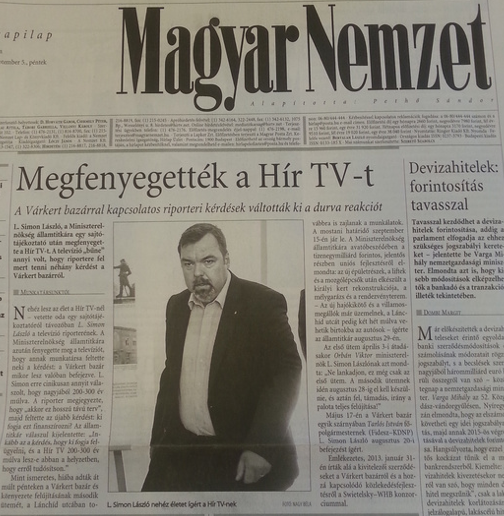
Magyar Nemzet: “They Threatened Hír TV.”
State Secretary L. Simon did not deny making this statement.
The front page of the print edition of Magyar Nemzet on September 5 featured a menacing photo of State Secretary L. Simon under the headline “They Threatened Hír TV.”
This confrontation between Prime Minister’s Office State Secretary L. Simon and the Hír TV reporter represents the most explicit public manifestation yet of the greater conflict taking place mostly behind the scenes between the Orbán government and the Lajos Simicska-led Fidesz oligarchy that gained control over the state-affiliated sectors of Hungary’s economy during the 2010–2014 parliamentary cycle.
Prime Minister Viktor Orbán launched this battle under the direct command of newly appointed National Development Minister Miklós Seszták following the National Assembly election in April 2014 in an attempt to reduce the enormous economic-cum-political power that the Fidesz oligarchs had attained over the previous four years (source in Hungarian).
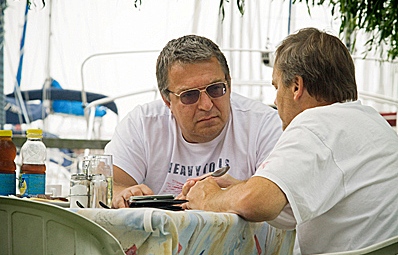
Businessman Lajos Simicska.
The Orbán government has utilized economic weapons in this struggle, suspending the authority of state-owned companies to conclude new contracts without prior permission from the National Development Ministry (source in Hungarian) and initiating a new tax on advertising revenue and other measures that specifically serve to reduce the profits of Lajos Simicska-owned companies and media, which not incidentally include both Hír TV and Magyar Nemzet (see Lajos Simicska/Közgép).
This is not the first internal conflict that has taken place within Fidesz since the party returned to power in 2010: the establishment of the state monopoly on the retail sale of tobacco and the adoption of the Land Law in June 2013 both entailed instances of high-profile individual dissent from Orbán administration officials (see Cracks in the Monolith); and a large number of National Assembly representatives from the Fidesz-Christian Democratic People’s Party governing alliance defied the Orbán administration’s opposition to a legislative bill introduced in 2012 calling for access to communist-era domestic-intelligence files to be opened all citizens of Hungary (see Communist-Era Domestic Intelligence Files).
However, it is by far the most serious one.
The question is: will this conflict grow to significantly undermine the unity and power of Fidesz or will Prime Minister Orbán manage to bring party oligarchs under control, just as President Vladimir Putin did in Russia during the early 2000s?
Orange Files believes the latter alternative to be much more likely.
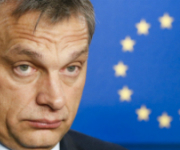
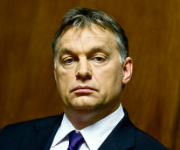
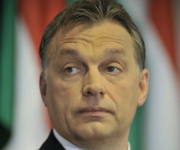
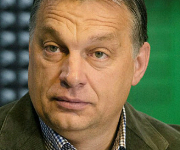
Prime Minister Orbán’s physiognomy: deep asymmetrical furrows, taught lines spreading like stress cracks across his face and forehead; glassy, bloodshot, bulbous eyes; incongruous primary features that defy the mind’s attempt to place them into a unified whole.
What these facial characteristics might reflect about the prime minister’s disposition and personality: mistrust, insecurity, hostility, belligerence; the stress and tension of always feeling besieged; the physical and mental exhaustion of ceaseless struggle against ever-present enemies.
The normal wear and tear national leadership? Or the disfigurations of excessive fear and misguided conviction?
Judgment of physical appearance: always a dangerous game, always vulnerable to subjective interpretation and error; often mean-spirited and meaningless.
But nonetheless: the evidence of physical and mental strain in Prime Minister Orbán’s facial expressions and features may suggest that the Fidesz revolution that has transformed Hungary from a westward-looking liberal democracy into an eastward-looking authoritarian democracy could culminate in the all-powerful leader’s incapacitation via crisis of the spirit, mind or body.
One would hope that this does not prove to be the case: fellow-man, father of five, highly competent individual, Prime Minister Orbán would make for a model civilian, an excellent lawyer, perhaps president of the Hungarian Football Federation.
However, it is an eventuality that those interested in the politics of Hungary should take into account.
Author Imre Kertész accepts congratulations from Prime Minister Viktor Orbán before receiving an Order of Saint Stephen medal on August 20, 2014.
On August 20, 2014, Jewish-Hungarian author Imre Kertész (along with Rubik’s Cube inventor Ernő Rubik) received an Order of Saint Stephen medal—the highest state award in Hungary—in an official ceremony at the presidential Sándor Palace in Budapest.
Kertész is the author of the Nobel Prize-winning novel Fatelessness, a semi-autobiographical work based on his experiences at the Auschwitz-Birkenau and Buchenwald concentration camps in 1944–1945.
Kertész is regarded as a liberal author in Hungary. The explicitly anti-liberal administration of Prime Minister Viktor Orbán presumably decided to present Kertész with the Order of Saint Stephen in honor of the government-sponsored Holocaust Remembrance Year commemorating the 70th anniversary of the deportation of around 500,000 Jews from Hungary to concentration camps in greater Nazi Germany during the spring and summer of 1944 (see official website in English).
Kertész accepted the award from President János Áder in spite of his sharply critical views of the Orbán administration. Speaking about Hungary in a September 2012 interview in the French daily newspaper Le Monde, Kertész said (source in French, Orange Files translation):
Nothing new in this country. The leader who fascinates: today one is in the same situation as during the era of János Kádár. Hungary is enchanted by Orbán like the Pied Piper of Hamelin. This goes back to something very profound. And, with me, to a true doubt. . . . The question that I ask myself is: why does Hungary always go wrong? . . . The current situation is nothing more than an illustration of this propensity for error. The Hungarian state is currently choosing to oppose Europe in the name of defending national interests, which can give the impression of a return to sovereignty. But, once again, this is a mistake. Nothing new. No problem. And no solution because there is no problem. . . . Hungary is an inevitability that has no meaning or explanation and is unique in Europe. Hungarians cling to their destiny. They will no doubt end up failing without understanding why.
In a statement released before the ceremony, Kertész said that “the desire and urgent necessity to establish concensus” had prompted him to accept the Order of Saint Stephen award from an administration for which he has expressed nothing but disdain in the past (source in Hungarian).
This is the same administration that maintains an official policy of strict opposition to all manifestations of anti-Semitism in Hungary, yet at the same time deflects blame for the mass deportation of Jews from the country in the final year of the Second World War from the Hungarian government onto the Germans both explicitly in the Fundamental Law and implicitly in the symbolism of the recently inaugurated German Occupation Memorial in Budapest. This is the same administration that has accorded official recognition to current journalists such as Zsolt Bayer, Ferenc Szaniszló and Péter Szentmihályi Szabó and past authors such as Cécile Tormay, József Nyirő and Albert Wass who have expressed overt anti-Semitism in their writings.
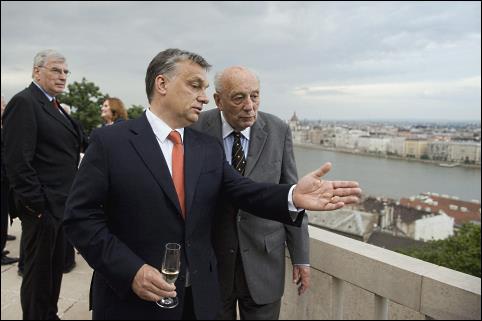
Prime Minister Viktor Orbán and historian John Lukacs look out over the city of Budapest in May 2013.
The above actions have prompted U.S. authors and survivors of the Hungarian Holocaust Elie Wiesel and Randolph Braham to return Hungarian state awards. Many left-liberal Hungarians were disappointed that Kertész, who is dying of Parkinson’s Disease, chose to accept the Order of Saint Stephen from the Orbán administration—disillusionment reflected in the title of an editorial published on the opposition website index.hu on August 15: “Imre Kertész has Become the Government’s Holocaust Clown” (source in Hungarian).
Kertész is not the first elderly author from Hungary to accept honors from an administration that embodies the very authoritarian-populist politics that he strenuously opposed throughout his professional career: in May 2013, Hungarian-born U.S. historian John Lukacs was among six recipients of the Corvin Chain state award to attend an honorary dinner at the Sándor Palace along with Prime Minister Orbán and current Prime Ministry chief János Lázár during his “final visit to Budapest” (source in Hungarian).¹
The primary motive of the Orbán government for honoring Kertész and Lukacs is obvious: to make a show of support for Hungarian intellectuals who have gained high esteem in the liberal-democratic West in order to counterbalance the heavy criticism from that direction of the illiberal, quasi-Putinist system it is building in Hungary.
However, one wonders what factors impelled the 84-year-old Kertész and 89-year-old Lukacs to fraternize with the Orbán administration in what were very likely their final public appearances: Yearning? Resignation? Isolation? Degeneration?
The fate of very old men to make peace with the world before they leave it?
1-Lukacs did publish an editorial in the opposition newspaper Népszabadság in January 2014 in which he criticized the Orbán government’s rapprochement with Russia (see An Archconservative Speaks Out).
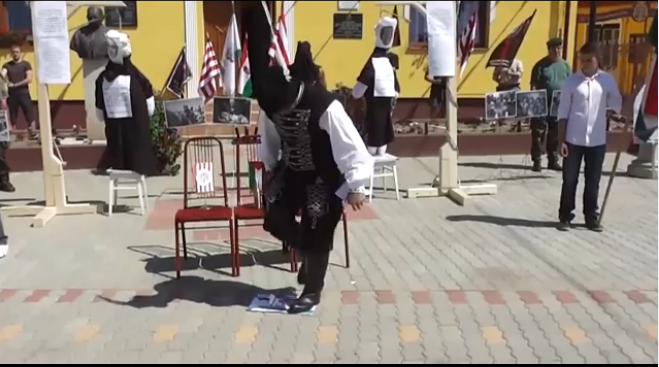
Érpatak Mayor Mihály Zoltán Orosz stomps on a modified Israeli flag.
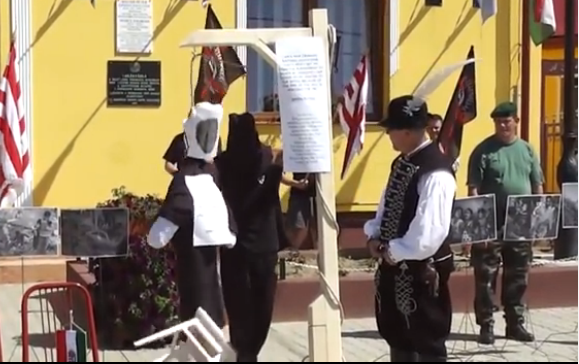
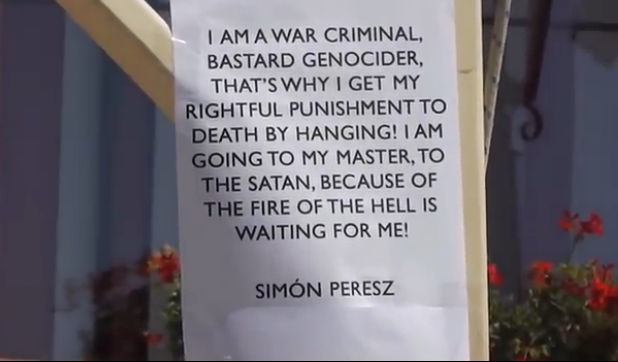
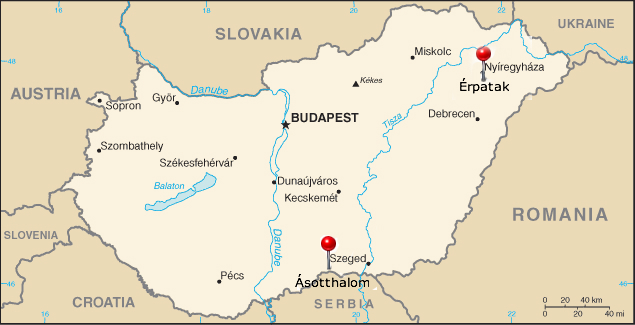
On August 2, 2014, de facto Jobbik (de jure independent) Mayor Mihály Zoltán Orosz of Érpatak (eastern Hungary, population 1,700) hanged current Prime Minister Benjamin Netanyahu and former President Shimon Peres of Israel in effigy from gallows erected in front of the village council building. Mayor Orosz conducted the mock executions after ceremonially trampling on an Israeli flag bearing a Masonic Square and Compass in place of the Star of David to protest the “continual holocaust taking place in Palestine,” specifically the hundreds of Palestinians killed during Israel’s military operations in Gaza (video of event in Hungarian).
Orosz, who became the mayor of Érpatak in 2010, has become well-known in Hungary for appearing at public events in various types of Hungarian historical costume and for his so-called “Érpatak Model” of maintaining order in the village, which essentially consists of imposing coercive measures on its Gypsy inhabitants in order to compel them to do public work and respect the law (source in Hungarian).
Orosz is also a known for his close connection to radical-nationalist organizations such as the New Hungarian Guard, the Outlaw Army (Betyársereg) and the 64 Counties Youth Movement (Hatvannégy Vármegye Ifjúsági Mozgalom) as well as various neo-Nazi Hungarist groups (source in Hungarian).
Mayor Orosz watches as the executioner kicks the stool from underneath the effigy of Shimon Peres.
During one of his annual public commemorations of the attempt of German and Hungarian military forces to break out of the Soviet siege of Budapest in February 1945, Orosz referred to Second World War fascist Arrow Cross head of state and government Ferenc Szálasi as Hungary’s “martyred national leader” (source in Hungarian).
Orosz has also launched an increasing number of high-profile attacks on liberals and manifestations of liberalism in Hungary, most recently making the 200-kilometer trip to Budapest earlier in the summer to heckle participants in the city’s annual gay parade (source in Hungarian).
On June 18, 2014, the Nyíregyháza Court of Justice ruled that Orosz had committed an illegal act of political discrimination when he ordered police to remove a local member of the Hungarian Civil Liberties Union from his 2013 commemoration of the 1945 German-Hungarian attempt to escape the Soviet siege of Budapest (source in Hungarian).
The hanging in effigy of Israel’s head of government and former head of state that Orosz organized on August 2 may entail further legal proceedings against him: on August 5, Hungary’s Chief Prosecutor’s Office announced that at the request of the Israeli embassy in Budapest it had initiated an investigation of the mayor of Érpatak on suspicion of incitement (source in Hungarian).
Sign on gallows used to hang the effigy of Shimon Peres.
And, for the first time, the Orbán administration condemned Orosz’s antics: on August 4, Minister of External Economy and Foreign Affairs Tibor Navracsics issued a statement in which he declared that “Arbitrary and symbolic administration of justice toward the leaders of other states is incompatible with European norms and rule of law. The mayor is exploiting the innocent victims of the Gaza war as a pretext for disseminating his malicious propaganda“ (source in Hungarian).
Perhaps the Orbán government will soon decide that it really wants to inhibit the spread of racist radical nationalism in the economically disadvantaged regions of rural eastern and southern Hungary after either ignoring or tacitly encouraging this phenomenon during the 2010–2014 parliamentary cycle. However, Mihály Zoltán Orosz’s ardently anti-liberal, anti-Semitic, anti-West and anti-democratic policies and activities as mayor of Érpatak, the victory of 64 Counties Youth Movement leader László Toroczkai in by-elections for mayor in the village of Ásotthalom in December 2013 (see The First Little Pinprick) and the significant degree of support for the New Hungarian Guard (see Uniform Disorder) and Jobbik (see Crunching the Election Numbers) in these parts of the country suggest that it may be too late.
Postscript: a reporter from the opposition weekly Magyar Narancs talked to the man who played the role of executioner in the mock hanging: he reported that Mayor Orosz had enlisted him to do this job as part of his village “social work” duties and that “It doesn’t matter to me who’s shooting who and who they are hanging” (source in Hungarian).
Fidesz Rural Development Minister Sándor Fazekas presents Péter Szentmihályi Szabó with a Hungarian Order of Merit state award for his literary and journalistic achievement on March 14, 2013.
On July 20, 2014, news emerged that the Ministry of External Economy and Foreign Affairs had nominated the well-known pro-government author, poet, translator and editorialist Péter Szentmihályi Szabó to serve as Hungary’s new ambassador to Italy (source in Hungarian).
Szentmihályi Szabó has published several science-fiction and historical novels as well as volumes of poetry and translated Aldous Huxley’s Brave New World into Hungarian, though he is best known for the regular column he writes in the pro-Orbán newspaper Magyar Hírlap in which he castigates the domestic opposition, liberalism, capitalism, the West and the European Union in the vitriolic, name-calling vernacular of Fidesz-friendly journalists (see previous post In Defense of Illiberal Democracy).
The political opposition immediately protested: not only did Szentmihályi Szabó lack previous diplomatic experience and speak no Italian, but he had voiced explicitly anti-Semitic and anti-Gypsy viewpoints on several occasions, particularly during the years in which he was a regular contributor to Magyar Fórum, the weekly newspaper of the radical-nationalist Hungarian Party of Justice and Life, or MIÉP (source in Hungarian).
In a December 2000 article in the Magyar Fórum, for example, Szentmihályi Szabó referred to Jews as “pharisees, hypocrites, agents of Satan” (source in Hungarian). Writing in the same newspaper in September 2002, Szentmihály Szabó declared “We will leave our Hungarian homeland to the Roma, the Romanian, the Austrian, the Jew, the Serb, German and the Slovak, let them fix what they messed up so bad” (source in Hungarian).
Szentmihályi Szabó in fact, ran unsuccessfully for the National Assembly as a representative of the Hungarian Party of Justice and Life in 2002 before gradually drifting between the similarly radical-nationalist Jobbik party and Christian-nationalist Fidesz following MIÉP’s collapse after 2006.
On October 21, 2007, Szentmihályi Szabó recited a poem in honor of the Jobbik-sponsored Hungarian Guard at the radical-nationalist paramilitary organization’s initiation ceremony on Heroes’ Square in Budapest (source in Hungarian).
However, Szentmihályi Szabó has not always been an ardent Hungarian nationalist. His 1977 book of poetry Dream of the Mind (Az ész álma) included the following lyrical poem in praise of communism (Orange Files translation, source A and B in Hungarian):
“Raw Supplication to Communism”
Where do you tarry, communism,
my happiness, my pure love?
Our happiness, our pure love.
The basket of plenty! The table of law!
Daylight of the spirit!
Eat, drink, embrace, sleep!
Weigh yourself against the universe!
Instead of exclamation points,
question marks fall upon us.
I know, it is not urgent.
As the apocalypse, only to the
prophets:
your unfulfilled state
sorrows not many.
–
Where do you tarry, communism?
The forces of production, the conditions of production,
the machines rumble,
and the consciousness . . . our subconscious
the state does not want to wither.
–
Where do you tarry, communism?
Spring comes upon spring,
my child’s eye blinks old;
communism, you, promised one,
flex all your muscle,
shake off the parasites.
Communism, grow my little child.
–
Péter Szentmihályi Szabó.
On July 23, the New York-based Anti-Defamation League (ADL) wrote a letter to Foreign Minister Federica Mogherini and President Giorgio Napolitano of Italy asking them not to accept the credentials of the “known anti-Semite” Szentmihályi Szabó (source in English).
In a July 25 opinion piece entitled “Intolerance and Anti-Semitism. The Ancient Poison of Prejudice” in the liberal Milan-based daily Corriere della Sera, the newspaper’s former deputy editor Pierluigi Battista asked the Italian government to seriously consider the ADL’s request to reject Szentmihályi Szabó’s appointment as Hungary’s ambassador to Italy (source in Italian).
That same day, the Hungary’s Ministry of External Economy and Foreign Affairs issued the following terse statement (source in Hungarian):
Péter Szentmihályi Szabó today informed the leadership of the Ministry of External Economy and Foreign Affairs that he does not want to fill any ambassadorial position of any kind and from his perspective regards the issue to be closed.
In a July 26 interview with Corriere della Sera, Szentmihályi Szabó said that “The reason I stood aside was because I did not want to disturb relations between Italy and Hungary.” Szentmihályi Szabó claimed in the interview “I don’t regard myself to be an anti-Semite. All racist and xenophobic sentiments stand very distant from me. If you want to know my opinion, the contention was not directed at me, but against the Hungarian government and Prime Minister Viktor Orbán” (source in Hungarian).
Zsolt Bayer (left) receives a piece of cake from Viktor Orbán at Fidesz’s 21st birthday celebration in 2009.
Zsolt Bayer is one of the most prominent pro-Fidesz journalists in Hungary. He is one of the 37 founding members of the party along with Viktor Orbán, László Kövér and other high-ranking officials in the country’s current political administration. Bayer is one of the main organizers of the pro-government Peace March demonstrations that have taken place in Budapest since 2012, walking in the vanguard of the massive processions each time. He is known for his unswerving pro-Fidesz partisanship and steadfast loyalty to Prime Minister Orbán as well as his caustic attacks on the West, domestic political opponents and, occasionally, Jews and Gypsies (see The Same Stench and Who Should Not Be?).
Neither Orbán nor Fidesz have ever distanced themselves from Bayer’s fulminations. Speaking at Bayer’s 50th birthday celebration in February 2013, National Assembly Speaker Kövér said “We have lived together through good and bad, trouble and joy. Not one single time have we disavowed one another, nor shall we” (source in Hungarian).
Below is an Orange Files translation of an editorial that Bayer wrote in defense of Prime Minister Orbán’s proclaimed illiberal democracy (see Proclamation of the Illiberal Hungarian State) published in the pro-government newspaper Magyar Hírlap on July 30, 2014 (source in Hungarian).
Now then, here you go: The ridiculed failure of liberal democracy that you put together over the past 30 years is living its final hours. And everybody knows it besides you Pangloss masters of liberal democracy and free-market capitalism. By now it is only you who are having a fit and proclaiming that this is the best of all worlds.
It is not that. The final symbol of free-market capitalism is Detroit. The onetime industrial center and bastion of American automobile manufacturing that has become a ghost down. Where besides the homeless only rubble and ruin have found a home. The middle of nowhere, the branch of nothing—the end of free-market capitalism, that is Detroit.
The other symbol of free-market capitalism is the everyday tragedy of refugees arriving to the island of Lampedusa. As they drown on the shores of the Promised Land or get into Europe and become both part and cause of Europe’s ultimate decline.
Capital is hauling work ever further to the east in the name of efficiency because the Earth still contains hundreds of millions who perform work at the conveyor for a bowl of rice for which the eastern European slaves have already begun to ask for “too much.” The work is going, the production is going, the capital is going east, while from the east and the south the labor force and the misery and the untreatable, unbearable foreignness is streaming to the west. A true danse macabre. But back in the day participants in this dance knew what the end was. However the miserable wretches reeling in today’s danse macabre all believe that they have discovered a solution for their lives.
There is no solution. There isn’t anymore. Under the circumstances that the Pangloss masters imagine it, there isn’t anymore.
This is what Viktor Orbán was talking about. That it isn’t going to continue this way. Yes. And the work-based society is the opposite of the parasitical society, not the elimination of liberal freedoms. Nobody has eliminated these here and has not even thought of doing so. Although you eliminate liberal freedoms and place them into parentheses any time you want. America has been spitting upon all of this for years. When it watches and conducts surveillance on not only its own citizens (this is also an atrocious crime!), but on anybody in the world. This is the elimination of liberal freedoms in itself. When it holds people captive without trial and verdict amid indescribable conditions at Guantánamo, this is the elimination of liberal freedoms. But you never blather or throw a fit about this you cretins, paid panic-mongers, you unmitigated scoundrels. And at such times you keep quiet and explain: because we must fight against the terrorists. Oh, of course! It is always necessary to fight against somebody, this is the nature of dictatorship.
Your liberal democracy and your free-market capitalism are dictatorship themselves. You only give them the nickname freedom and with the help of the knowledge industry working under your command and pay make people believe that the essence of freedom is none other than the marriage of “queers.”
This is how much has remained of freedom. Ugh.
This is how much has remained and the putrefied educational system that has become a caricature of itself, where today a university degree is worth a high-school diploma fifty years ago. Or even less. And if somebody mentions this they are immediately accused of élitism. There is not one segment of western societies that has not become infected, unbearable, that hasn’t begun to rot and become condemned to destruction. And meanwhile you are horribly afraid of dictatorship, which there is not of course, but at least it’s necessary to paint it on the wall because how else are you going to sustain your own miserable, good-for-nothing and totally useless existences?
I say it one more time via Canetti: “To the crowd in its nakedness everything seems the Bastille.” And if it doesn’t see it on its own, well then there is you to channel its thoughts in the suitable direction. At any cost, with lies of any magnitude, that doesn’t matter. Orbán says in Tusnád that the president of the United States was condemned for exceeding his authority, moreover this took place several times and everybody imagine what would happen if he WERE condemned for this reason, then how long COULD he remain in office. This means that, in fact, the United States is the true country without consequences, the showcase democracy, but if he were to exceed his authority and were condemned for it, then he would have to go right away. From this the scoundrels’ media army manufactured the following interpretation: with this Orbán wanted to say that, contrary to the president of the United States, he cannot be condemned. The cloaca called Index expounded upon this for a long while, there are more refined and vile swine than Népszabadság, they simply forged it into Orbán’s words so that the concept would be more salable. They cap off Orbán’s conditional mode (would condemn) with a can/may deverbal verbum derivative (could condemn) in order to make it possible for them to lie. Here is how the portrait of the cynical dictator is prepared for the cretins in the world of paid panic-mongers and unmitigated scoundrels.
But all of this is really secondary.
The point of the matter is that your world is drawing to an end. And you are such idiots that you are not aware of it. Because you don’t know The Tragedy of Man. But we are so good, merciful and liberal that you will have a place in the new world as well. At most you will have to quit lying. In exchange, you will be free too and, if you work, you CAN get something to eat. Scram!
Prime Minister Viktor Orbán speaking in Tusnádfürdő on July 26, 2014.
On July 26, 2014, Prime Minister Viktor Orbán proclaimed during his annual speech at the Tusványos Summer University and Student Camp (Tusványos Nyári Szabadegyetem és Diáktábor) in Tusnádfürdő (Băile Tușnad), Romania that “the new state that we are building in Hungary is an illiberal state, not a liberal state.”
Prime Minister Orbán maintained during the speech that “we regard the great financial, global-economic, global-trade, global-power, global-military redistribution of strength that became obvious in 2008 as our point of departure,” citing China, Russia, India, Turkey and Singapore as examples of systems “which are not western, not liberal, not liberal democracies, perhaps not even democracies at all, and nevertheless make nations successful” in the post-2008 world.
Prime Minister Orbán identified the activity of non-government organizations (“the civil sphere”) in Hungary and the control that European Union bureaucracies exercise over the distribution of the country’s EU funding as obstacles to the building of the illiberal state.
–
Below are a video of Prime Minister Orbán’s speech and a verbatimOrange Filestranslation of the portions of the speech (roughly one-half of it) related directly to its main theme building illiberal democracy in Hungary (seetranscription of speechin Hungarian).
–
–
The translation begins at the 3:20 point in the above video with Prime Minister Orbán articulating his premise that the global financial and economic crisis of 2008—which he referred to as the fourth “major world system-change” in the past century after the First World War, the Second World War and the collapse of communism—necessitated the transformation of the liberal-democratic Hungarian state into an illiberal Hungarian state.
. . .
. . . at the same time, a change of just as much significance is taking place in the world as the experience of the System Change. Therefore the task that stands before us intellectually in connection to the debates regarding an understanding of the future and the designation of the roads leading to the future is to use the System Change as an experience, but no longer as a reference point. Much rather, we regard the great financial, global-economic, global-trade, global-power, global-military redistribution of strength that became obvious in 2008 as our point of departure. . . . Therefore I believe it would be of more use if we would regard the System Change as a closed historical process and a storehouse of experience and not as the point of departure for thinking about the future.
. . .
The contention that intended to serve as the point of departure for my presentation today is that a change of similar weight and importance is taking place in the world today. We can identify the time when this manifested itself and became obvious as the 2008 global financial crisis, more precisely the financial-West crisis. And the meaning of this change is not so obvious because people perceive it differently than the previous three. It was not obvious at the time of the western financial collapse in 2008 that we are going to live in a different world from this time on. The change is not so sharp as took place at the time of the first three global system-changes. But it is unfolding slowly in our minds, somewhat as when fog settles on the landscape, the awareness is slowly descending upon us that if we really take a look around, if we thoroughly analyze all that it taking place around us, it is a different world from that in which we lived six years ago and if we project these processes on the future, which of course always entails some risk, though it is fundamentally justified intellectual work— if we do this, we see clearly that the changes will be even more vigorous.
. . .
There is an even more important race. We would put it this way—a race to discover the state that is the most capable of making a nation successful. Since the state is none other than the mode of organizing the community, which in our case sometimes coincides with state borders and sometimes not—I will get back to this later—perhaps the most significant theme in today’s world can be can be expressed as a race that is taking place between community-organization modes to come up with that state which is best able to make a nation, a community internationally competitive. This is what explains, my honored ladies and gentlemen, that today the hit theme in thought is understanding those systems which are not western, not liberal, not liberal democracies, perhaps not even democracies at all, and nevertheless make nations successful. Today the stars in international analyses . . . Singapore, China, India, Russia, Turkey. And I think that years ago our political community correctly felt, correctly put its finger on this challenge and perhaps even processed it intellectually and if we think back to what we did over the past four years and what we will do over the next four years, then it can be understood from here as well. Breaking away from western European dogmas and ideologies, making ourselves independent of them, we are seeking, we are trying to find that community-organizational form, that new Hungarian state, which over a range of decades is capable of making our community competitive in the great global competitiveness race.
My honored ladies and gentlemen!
In order for us to be capable of this in 2010, and especially these days, we have had to boldly utter a phrase similar to those previously quoted that belonged to the category of sacrilege in the liberal world order. We had to declare: a democracy is not necessarily liberal. Just because something is not liberal, it can still be a democracy. Moreover, it was necessary, it was possible to say that, in fact, societies built upon the state-organizational principles of liberal democracy will not likely be able to maintain their global competitiveness over the coming decades, rather they will suffer a reversal if they are not capable of changing themselves significantly.
My honored ladies and gentlemen!
Things are such that if we look from here at the events happening around us, then we usually choose as the point of departure that until now we have known three forms of state organization: the nation-state, the liberal state and the welfare state. But the question is, what will take place now? The Hungarian answer is that an age of the work-based state can begin, we want to organize a work-based society, which, as I mentioned previously, accepts the odium of declaring that, with regard to its character, it is not liberal in nature. What does all this mean?
My honored ladies and gentlemen!
This means that we must break with liberal social-organization principles, methods and the entire liberal understanding of society. I will only touch upon this in two dimensions, I don’t want to go into a longer presentation, I just want to touch upon it so that the gravity of the situation becomes apparent. The point of departure of liberal social organization with regard to the relationship between two people is built on the notion that we are free to do anything that does not violate the freedom of others. Twenty years of the Hungarian world prior to 2010 was built upon this conceptual-ideological point of departure. Accepting, by the way, a general principle in Western Europe. However, 20 years were necessary so that in Hungary we could express the problem that intellectually this is an exceptionally appealing thought, though it is not clear who will say from what point something violates my liberty? And since it is not a given, somebody has to determine this, to decide this. And since we did not designate anybody to decide this, we continually experienced in everyday life that the stronger decided it. We continually felt that they trampled upon those who were weaker. Conflicts arising from the mutual recognition of one another’s freedom are decided not according to some abstract principle of justice, but what happens is that the stronger is always right. It is always the stronger neighbor who says where the gate is, it is always the stronger, the bank that says how much the interest rate is, which it changes along the way if necessary. And I could otherwise continue to list the examples that continually impacted the defenseless, the weak, individuals and families with smaller economic defense forces than others as a life experience over the past 20 years. To this we propose and are trying to build Hungrian state life on the thought that this shouldn’t be the organizing principle, the organizing principle of society. This cannot be enacted into law, here we must speak of an intellectual point of departure. Don’t let the organizing principle of Hungarian society be that everything is permitted that does not violate the liberty of others, but that of don’t to do others what you wouldn’t want done to you. And we will attempt in Hungarian public thought, in the education system, in our own behavior through our own examples to place the world that we can call Hungarian society on this theoretical foundation. If we look at this same idea with regard to the individual and the community—because I was now speaking of the relationship of individual and individual—then we see that the Hungarian liberal democracy built up over the past 20 years was not able to accomplish a good many things. I made a short list of what it was not capable of.
Liberal democracy was not capable of stating openly and obliging—even with constitutional force—governments that they serve the national interest with their work. Whatsoever: to debate the notion of the existence of national interest. It did not oblige governments to recognize that Hungarians living throughout the world belong to our nation, to the Hungarian nation, and to attempt through its work to strengthen this affinity. Liberal democracy, the liberal Hungarian state did not protect communal property. . . . Then the liberal Hungarian state did not protect the country from indebtedness. And finally, it did not defend families, here one can think about the foreign-currency loan system. It did not defend famiies from debt servitude either. Consequently, the interpretation of the 2010 election—particularly in light of the 2014 electoral success—could admissibly sound like this: that in the great world competition that is taking place in the interest of establishing the most competitive state, the Hungarian citizens expect the Hungarian leaders to find, to form, to forge the new Hungarian state organization that, following the era of the liberal state and liberal democracy—of course maintaining respect for the values of Christianity, freedom and human rights—can again make the Hungarian community competitive and carries out and honors those unfinished duties, neglected obligations that I listed.
So, Honored Ladies and Gentlemen!
Namely, what is taking place in Hungary today can be interpreted as the political leadership having made an attempt to make it so that the individual work and interest of people, which must be recognized, stands closely interconnected to the community, the life of the nation and that the connection endures and that this connection strengthens. That is to say, the Hungarian nation is not a mere agglomeration of individuals, but a community, which must be organized, strengthened and, in fact, built. In this sense, therefore, the new state that we are building in Hungary is an illiberal state, not a liberal state. It does not deny the fundamental values of liberalism, such as freedom, and I could bring up a few more, but does not make this ideology the central element of state organization, but contains a unique national approach that diverges from it.
Honored Ladies and Gentlemen!
After this, I must speak about what obstacles must be overcome in order for this to take place. It may easily be that what I say seems evident within this circle, however when all of this must be elevated to the level of a political program and work, then it is not this way whatsoever. I will not enumerate all of the obstacles, I will just mention few, more precisely two of them, not even the most important necessarily, but the most interesting. The relationship between professional political officials versus those operating in the civil sphere. That is to say, somebody, leaders empowered and elected to do so, must organize and govern the state. However, civil organizations appear at the periphery of state life. In Hungary the civil world is showing a very unique face. Those operating in the civil sphere—contrary to the professional political official—are individuals, are a community that is organized from below, stands on its own financial feet and is naturally voluntary. Now in contrast to this, if I take a look at Hungary’s civil sphere, that which plays a regular role in public affairs—the controversy surrounding the Norway Fund has brought this to the surface—then I see that we are dealing with paid political activists. Activists paid by identifiable foreign spheres of interest . . .
And these paid political activists are, moreover, political activists paid by foreigners. Political activists paid by identifiable foreign spheres of interest about which it is difficult to imagine that they regard this as a social investment, rather the notion is much more justified that through this system of means they wish to exercise influence over Hungarian state life at a given moment and with regard to given issues. Therefore it is very important if we want to organize our national state in place of the liberal state to make it clear that here we are not standing opposite people from the civil sphere, it is not people from the civil sphere coming at us, but paid political activists who are trying to assert foreign interests in Hungary. This is why it is very correct that a committee was established in the Hungarian parliament that is engaged in the continual monitoring, recording and publicizing of foreign influence gathering so that everybody, you as well, can know precisely who the true characters are behind the masks.
I will mention another example that is another obstacle to the reorganization of the state. When I bring up the European Union, I don’t do it because I think that it isn’t possible to build an illiberal state standing upon national foundations within the European Union. I think this is possible. European Union membership does not exclude this. It is true that many questions arise, many conflicts develop, you could follow this over the past years, many battles must be waged, but now I am not thinking of this, but about another circumstance with which you are likely unfamiliar in this form. When the agreement expired between Hungary and the European Union that stipulated the financial relationship between the union and Hungary for seven years, it expired this year, and the conclusion of a new agreement for the next seven years appeared on the agenda, which is taking place right now, then a dispute erupted. . . .Now a dispute has developed between the union and Hungary because we changed this system and the government made a decision according to which it will have control over European Union money, in this new state conception, in the illiberal state conception . . .
. . .
Now the only question is, my honored ladies and gentlemen, though here the answer is not incumbent upon me, that in a situation like this in which anything can happen if we should be afraid or rather if we should be filled with confidence. Since the current order of things in the world does not exactly suit our tastes, I think that we should think that the anything-can-happen age that stands before us, though according to many it carries insecurity and could cause trouble, that it holds at least as many possibilities and chances for the Hungarian nation. Thus instead of fear, withdrawal and crawling into a shell, I recommend courage, forward-looking thought and sensible though bold action to the Hungarian community of the Carpathian Basin, in fact to the entire Hungarian national community spread out across the entire world. It could be that after anything happens, our time will come.
Workers complete the German Occupation Memorial early on the morning of July 20 (source: atlatszo.hu).
July 20, 2014—about an hour after midnight: a convoy of trucks, police vans and a crane pulls up to the incomplete German Occupation Memorial on Szabadság [Freedom] Square in central Budapest (see What Is Truth?).
Workers emerge from the trucks and erect security fence around the perimeter of the memorial and at all points of access to the square as approximately 100 police officers stand guard (source A and B in Hungarian).
A few late-night stragglers observe the spectacle from a distance. A couple of them take video on their mobile phones.
The crane lifts the missing statue elements—a German Imperial Eagle (Reichsadler) representing Hitler’s Third Reich descending upon an Archangel Michael representing Horthy’s Hungary—into place, thus completing the structure that has been standing unfinished for weeks.
The next morning the opposition media reports the news in the greatest detail possible, most of them relying on a video published on the website atlatszo.hu.
The Hungarian News Agency MTI that serves as the source of news for all Hungary’s state-run television and radio stations makes no mention of the overnight completion of the memorial, reporting only the protest of various opposition parties beginning later in the morning.
A group of about 200 demonstrators gathers spontaneously at the newly completed memorial to the victims of Nazi Germany’s occupation of fellow Axis power Hungary in the final year of the Second World War, pelting the statue of Archangel Michael with eggs. The large contingent of police protecting the memorial does not intervene, though initiates petty-offense procedures against the egg throwers (source in Hungarian).
Background
U.S. historian Randolph Braham: returned his Hungarian state award in protest.
The Prime Minister’s Office decided in January 2014 to build the memorial in an expedited procedure by the 70th anniversary of the 1944 German invasion of Hungary on March 19. Prime Minister Viktor Orbán and Prime Ministry chief János Lázár presumably intended the memorial to serve as a means of arousing pro-Fidesz patriotic fervor ahead the National Assembly election in April.
The published design for the statue showed a predatory Imperial Eagle swooping down, talons extended, upon a helpless Archangel Michael, arms spread in resignation, evoking harsh criticism from the liberal-left opposition and Jewish organizations because it implied that Germany, not Hungary, was responsible for the post-invasion deportation of around 430,000 Jewish Hungarians to concentration camps in the Third Reich, almost all of them to Auschwitz.
The main Jewish Hungarian organization MAZSIHISZ announced in early February that it would not participate in any official state commemorations of the 70th anniversary of the deportations, partially as a result of the government’s decision to build the memorial (source in Hungarian). Furthermore, the World Jewish Congress and 30 Jewish members of the U.S. Senate and House of Representatives asked the Orbán government to reconsider the planned memorial (source A and B in Hungarian).
U.S. historian and 1943–1944 Hungarian Labor Battalion conscript Randolph Braham, one of the leading world specialists on the Hungarian Holocaust, returned the state Order of Merit award the Orbán government presented to him in 2011 to protest the German Occupation Memorial, stating that “I regard this to be a cowardly attempt to divert attention from the role the Horthy régime played in the annihilation of Jews and to obfuscate the Holocaust with the ‘suffering’ that Hungarians incurred as a result of the German occupation, whereas the historical facts prove that rather than resistance, the latter was received with general applause” (source A and B in Hungarian).
Taking Horthy for a ride.
Prime Minister Orbán responded to international criticism of the proposed German Occupation Memorial during his February 17, 2014 “Appraisal of the Year” (évértékelő) address: “I am still astonished, though I didn’t undertake this profession just yesterday, how they get the nerve to tell us, even expect us, to think, how we should commemorate, what goals we should set, what we should do and what we should not do” (source in Hungarian).
However, on February 19 the opposition daily Népszabadság reported, citing unnamed sources, that the government had decided to postpone construction of the German Occupation Memorial until after the April 6 National Assembly elections for two reasons: because unveiling the statue before the elections would be “divisive”; and—perhaps more importantly—because preparation of the various elements of the memorial was behind schedule (source in Hungarian).
Although the government never officially announced the postponement, on February 20 the Prime Minister’s Office provided the media with a letter that Prime Minister Orbán had written to MAZSIHISZ stating that due to the election campaign “the time is hardly suitable for us to calmly and compassionately express our opinions to one another” and that they “continue their dialogue after the [post-election] Easter holidays that bring renewal to us all” (source in Hungarian).
Construction Begins
German Occupation Memorial under construction (photo: Orange Files).
Construction of the German Occupation Memorial began unannounced on April 8, two days after Fidesz won a convincing victory in Hungary’s 2014 National Assembly elections. About 300 protestors appeared at the location of the memorial immediately after the media reported that construction had begun, staging a spontaneous demonstration during which they pulled down a security fence that workers had built around the building site (source A and B in Hungarian).
Within days, the area in front of the German Occupation Memorial site was full of mourning stones (which Jews traditionally place at grave sites instead of flowers), records and mementos from the Holocaust, portraits and personal belongings of victims and signs and photographs showing scenes from the deportations and concentration camps as well as evidence of Hungary’s alliance with Nazi Germany (the iconic image of Horthy and Hitler enjoying a mirthful moment while riding together in the backseat of an open automobile in 1938 was especially popular).
Orange Files visited the location of the memorial on several occasions over the next three months: each time two or three dozen people, many of them foreigners, stood examining the growing protest shrine and police-protected columns rising above the covered security fence surrounding the work site (see Orange Files photo gallery).
Orbán’s Dilemma
Police protecting the newly completed memorial (photo: Orange Files).
It was one of the few times that Prime Minister Orbán, the consummate political tactician, had painted himself into a corner: he had vastly underestimated the vehemence of opposition to the German Occupation Memorial and the time it would take to build the structure, thereby nullifying its original purpose of generating nationalist political support in the run-up to the spring elections; and he had vastly overestimated the ability of average Hungarians to understand the intended symbolic message of the memorial portraying Hungary as victim rather than perpetrator during the Second World War, particularly with regard to the Holocaust. In short, it quickly became evident that the German Occupation Memorial entailed many potential political costs and no potential political benefits.
The prime minister ostensibly timed the overnight completion of the memorial on July 20 to attract as little attention as possible: not only was the city of Budapest remarkably deserted on that date, many of its residents either on vacation or at their summer homes along Lake Balaton for the weekend; but the shooting down of Malaysia Airlines Flight 17 over eastern Ukraine and the Israeli invasion of the Gaza Strip were consuming the interest of both the residents of Budapest and people throughout Europe and North America (source in Hungarian).
The Orbán government reportedly intended to hold an unveiling ceremony on July 21, though cancelled the event at the after the scheduled speaker, Prime Minister’s Office State Secretary László L. Simon, backed out at the last moment (source in Hungarian). Prime Ministry chief János Lázár announced on this date that there would be no official unveiling ceremony (source in Hungarian).
Prime Minister Orbán issued a three-paragraph statement later the same day in which he portrayed construction of the memorial as the government’s duty (first paragraph, source in Hungarian):
Yesterday the Hungarian government fulfilled its obligation to the constitutional order, to past victims and to Hungarians living today. We put the work of public art into place, one that is designed to express the pain and affliction that the Hungarian nation felt and suffered as a result of the loss of its freedom.
Opposition Mecca?
The newly built German Occupation Memorial has been the site of all-day peaceful protest activity and public discussion over the five days since its completion, much of it organized by the Facebook group Living Memorial (Eleven Emlékmű). Most of those present at the memorial appear to be either Budapest Jews or foreign tourists. However, the German Occupation Memorial could quickly become a rallying point for the Hungary’s growing democratic opposition, Jewish and non-Jewish alike.
An early indication: on July 25, a protestor suspended a banner reading “We Mourn Democracy” from one of the arms of the statue of Archangel Michael. More than a day later, police guarding the memorial had still not taken it down.
 Seen from the corner of Fremont and Cedar political events in Hungary seem so distant, yet so much clearer than they do from inside the country.











 The Orange Files