Easy as Pie

New PieThe dynamic that drives Hungarian politics is simple.  

Hungary’s population is divided into two political tribes of roughly equal size and strength: the nationalists and the internationalists. There is very little migration between them. 

Hungary’s economy is like a pie that always remains about the same size. It is too small if divided equally to provide the entire population with a comfortable subsistence.  

Both the nationalist tribe and the internationalist tribe always possess one-third of this pie.  The dominant tribe gains possession of the remaining third. They never share.  

Hungarian politics is the manifestation of the battle between the two tribes for the contested third of the pie.  

————————————————————————————————————————————-

Marching to Praetoria

TEK officer responding to false alarm at the Budapest Technical University in September 2012.

TEK officer responding to false alarm at the Budapest Technical University in September 2012.

On August 26, the Counter Terrorism Center (TEK) announced that it would extend until September 25 at the latest the closure imposed three days previously of the street where Prime Minister Viktor Orbán lives in Budapest (source in Hungarian). Though TEK specifically mentioned neither Orbán by name nor the grounds for closing off the area, the agency presumably did so in order to prevent groups advocating further government action to help foreign-currency debtors from repeating earlier attempts to demonstrate outside the prime minister’s house.

What are the differences between TEK and conventional secret services?

TEK operates not only as a security service protecting the prime minister, the president, their families, foreign dignitaries and other political officials, but as a special weapons and tactics (SWAT) agency that goes after pimps, drug dealers, bank robbers, hostage takers, murderers and, presumably, terrorists.

TEK officers wear helmets and body armor, not dark glasses and suits, and carry exposed submachine guns, not concealed weapons.

TEK needs permission only from the Orbán government’s Interior Minister or Minister of Justice and Public Administration to conduct searches and surveillance—it does not need to obtain authorization from a court (source in English).

The Orbán régime established TEK a few months after coming to power in May 2010. Orbán’s predecessors maintained only light personal security of the standard plain-clothes variety. The author passed within one meter of Ferenc Gyurcsány on several occasions while he was serving as prime minister (see short Orange Files video). TEK would not permit any unknown person to come anywhere near Prime Minister Orbán.  

The head of the organization is Orbán’s longtime bodyguard János Hajdú (source in Hungarian).

This is the third time over the past nine months and the second time this summer that the Counter Terrorism Center has sealed off the area around Orbán’s residence at the foot of the Buda Hills. One can expect TEK’s role of providing personal protection for the prime minister to become increasingly prominent as he heads into his next term in office. 

—————————————————————————————————————————————–

Butting Heads with the Wonder Deer

A late-summer garden party in a town on the outskirts of Budapest. 

250px-Csodaszarvas.svgA middle-aged couple standing under an apple tree in the half dark, away from the row of tables where the other guests are eating stew prepared in a bogrács, a traditonal Hungarian cooking pot. 

She: Did you see what Éva is wearing? How tacky. It reminds me of Republican taste in the United States. 

He: I’ve got to think that from an intelligent person like her it must be intentional. You know, the principle that something that is in really poor taste actually becomes beautiful again. The part I didn’t like was the Wonder Deer [Csodaszarvas] hanging on her neck. 

She: That part didn’t bother me. I really love ancient symbolism. 

He: The problem is who else really loves it. The anti-Semitic, anti-Gypsy, anti-West, anti-democracy, anti-capitalist people. They have taken these ancient Hungarian symbols,  yurts and archery and horses, and made them into something ugly. 

She: I don’t care. For me they don’t mean those things. 

He: Maybe for you they don’t, but for me and I would dare to say most Hungarians they do, whether they approve of those things or not. 

She: That is what I hate about politics. It ruins everything. 

They look at one another coldly. One of those reemerging disagreements. 

Note: The Wonder Deer is an animal from the mythology of the ancient Hungarians and other central Asian peoples.


csodaszarvas(2)

—————————————————————————————————————————————–

One Man’s Plaything

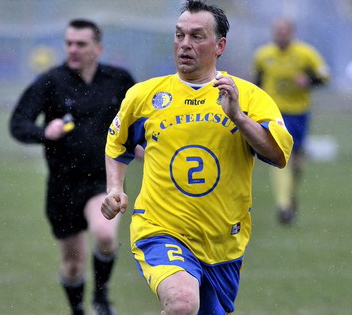
The FC Felcsút forward.

The FC Felcsút striker.

Prime Minister Viktor Orbán is building a football paradise around his home in Felcsút (population 1,789), the village where he grew up about 30 kilometers west of Budapest.

The prime minister’s enthusiasm for the game is legendary in Hungary: he played organized football as a hard-driving forward from the age of eleven, when he joined the local FC Felcsút team, until leaving college and launching his political career with Fidesz in 1988. He rejoined FC Felcsút during his first period as prime minister in 1999, taking the field for the division-two club on occasion until hanging up his cleats permanently at the age of 41 in 2005. Two years later, Orbán founded the Ferenc Puskás Football Academy (Puskás Ferenc Labdarúgó Akadémia), a live-in school offering academic instruction and intensive football training for 50 to 60 talented young Hungarian players on a sprawling complex of fields located right across from his weekend house in the village.

The academy’s team, Puskás Academy FC, (Puskás Akadémia FC), currently competes in division one of the Hungarian national football league against teams from Budapest, Debrecen, Miskolc, Pécs and other big cities in Hungary after receiving promotion from division two at the end of the 2012–2013 season. Felcsút mayor and businessman Lőrinc Mészáros, an Orbán ally who serves as president of the foundation that runs the Ferenc Puskás Football Academy, is having a new, 3.8-billion-forint (12.75-million-euro) stadium built for the team, 70 percent of which he is financing from revenue derived from corporate-tax deductions on donations (source in Hungarian) to five major team sports made possible through a law the FideszChristian Democratic People’s Party-controlled National Assembly passed in 2011 (note 1). The stadium will have seating capacity of 3,500, double the population of the village in which it is being built.  

Fő Street, Felcsút: Football academy building (background); prime minister's house, shed and gazebo (left); and the Golden Team Football Stadium (under construction, right).

Fő Street, Felcsút: Football academy building (background); prime minister’s house, shed and gazebo (left); and the Golden Team Football Stadium (under construction, right).

Orbán has two passions in life: politics and football. He is living his political dream right now as the most internally powerful leader of a country in Europe since the fall of communism. In establishing a football academy with a top-flight team and a state-of-the-art stadium right across the street from the house and stretch of land he owns in his home village, he is preparing to live his football dream after the inevitable end of his political career. The prime minister is exploiting his position as the all-powerful leader of Hungary to realize this dream, attracting donations (source in Hungarian) from prosperous companies (list in Hungarian) in order to finance the operations of the Ferenc Puskás Football Academy and, through his local political crony, using money that would otherwise flow into the state treasury to build a UEFA-compatible stadium for the academy’s professional team.

In doing so, Orbán is reflecting his fundamental attitude—one which is nearly universal among autocrats—that the country he leads is his plaything to be used as he sees fit.

notes

1- On June 27, 2011, the National Assembly approved a law that permitted companies to write off up to seventy percent of their corporate taxes in the form of donations to associations conducting activities in one of five team sports—football (soccer), basketball, hockey, handball or water polo. 

—————————————————————————————————————————————–

Mass Mobilization 101

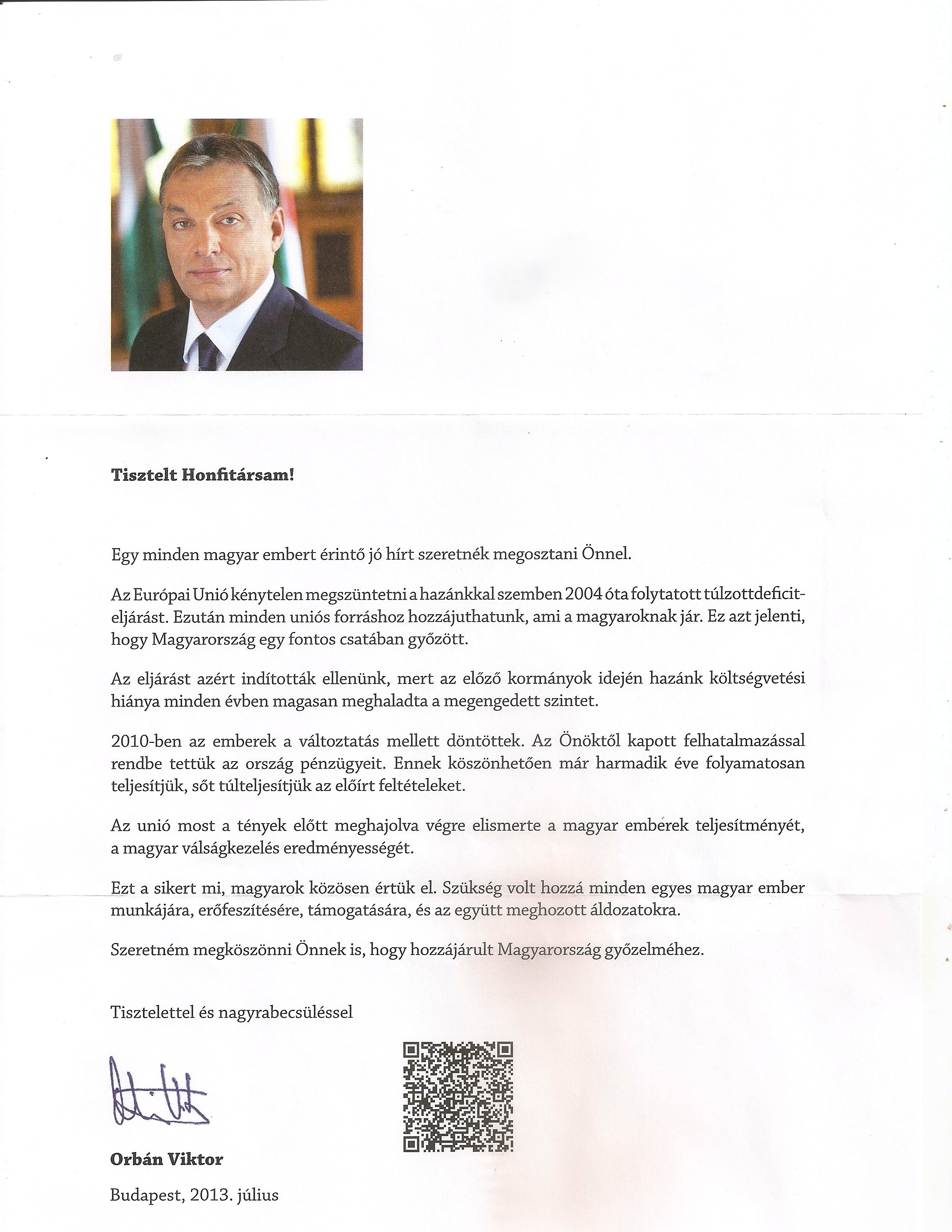
Orbán's newest letter.

Orbán’s newest letter.

Citizens of Hungary have this week received another letter from Viktor Orbán, the sixth the prime minister has sent to all adults in the country over the past three years as part of his government’s National Consultation [Nemzeti Konzultáció] campaign. This letter informs them of “Hungary’s victory” in the “battle” to have the European Union lift the Excessive Deficit Procedure that had been in place against Hungary since the country joined the European Union in 2004.  Below is an Orange Files translation of the letter: 

Dear Compatriots!

I would like to share with you good news affecting all Hungarian people.

The European Union has been obliged to lift the Excessive Deficit Procedure it has maintained against our homeland since 2004. We therefore have access to all EU funding due to Hungarians. This means that Hungary was victorious in an important battle.  

The EU launched the procedure against us, because our homeland’s budget deficit significantly exceeded the permitted level every year at the time of the previous governments.

People decided in favor of change in 2010. With your mandate we have put the country’s financial affairs in order. As a result, we have met, in fact exceeded, stipulated conditions for the last three years.

The EU has bowed before the facts and finally recognized the achievements of the Hungarian people and the effectiveness of Hungarian crisis management.

We, Hungarians, have accomplished this success together. The work, effort, support and common sacrifice of every single Hungarian person was necessary for this.

I would like to thank you as well for contributing to Hungary’s victory.

With Regards and Esteem,

Viktor Orbán

Budapest, July 2013

The explicit message of this letterPrime Minister Orbán has led the Hungarians to victory in battle against a powerful foreign adversary. 

The implicit message of this letter: Hungarians should continue to support their leader, because there are more such battles to be fought in the future. 

The fundamental claim of this letter: The European Union was arbitrarily refusing to recognize that Hungary had satisfied the EU requirement for members states to have a government deficit of less than three percent of GDP. 

The reality not expressed in this letter: The European Union was not disputing the fact that Hungary’s government deficit had fallen below three percent of GDP, but the sustainability of the means used to bring it below the required level. 

The literal cost of this letter: 140 forints per letter, sent via priority mail to all adult citizens in a country of ten-million people. The online news website Index.hu has calculated that the twelve previous letters the government dispatched as part of the National Consultation, including six sent to targeted groups of citizens, cost Hungarian taxpayers around 3.3 billion forints (11.1 million euros). 

The figurative cost of this letter: another authoritarian blow to the crumbling edifice of liberal democracy in Hungary. 

—————————————————————————————————————————————–

Cracks in the Monolith

József Ángyán

József Ángyán

Over the past few weeks, two Fidesz legislators and one powerful, pro-Fidesz businessman have come into open conflict with the Orbán government over its recent moves to further increase its direct and indirect command over Hungary’s economy.

On June 21, Fidesz National Assembly representative József Ángyán withdrew from the party’s parliamentary caucus to sit with legislative independents after his fellow caucus members adopted a new Land Law that Ángyán said would preserve the hold of major capital interests and party-affiliated “maffias” over agricultural property in Hungary to the exclusion of local farmers. Speaking to the news website FN24.hu after announcing that he was leaving Fidesz, Ángyán said “I hope that an honest third platform comes into being. They say that there are no other possibilities—either Orbán or the Bajnai-Mesterházy group. In truth, a mafia network is pulling the strings in the background, while in the foreground morning and afternoon political-shifts replace one another. An alliance composed of honest people needs to rise up instead. Those who have taken part in government since 1990 cannot be considered, because they are all tarnished, they have all become intertwined.”

Ángyán had long been the only member of the Orbán administration who dared to raise his voice against its construction of a Fidesz oligarchy exercising ever-greater control over political and economic life in Hungary. In January 2012, he left his post as Rural Development Ministry state secretary, telling his supporters after a month-long period of silence that he had resigned because “a coalition of greedy, plundering economic interest-groups, not to say ‘maffia families,’ speculative capitalist ‘oligarchs‘ and major land-owning ‘green barons‘” had emerged to prevent implementation of the ministry’s program to help small independent farmers acquire agricultural land. Ángyán confirmed reports in the media that Prime Minister Orbán had angrily told him he would not have him kicked out of the Fidesz National Assembly caucus, because he did not want to do him the favor of making him into a martyr. 

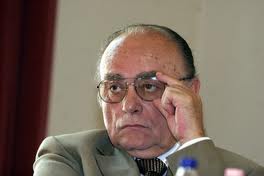
Sándor Demján

Sándor Demján

On June 26, construction magnate Sándor Demján, one of the wealthiest and most influential people in Hungary and previously an open supporter of Fidesz (source in Hungarian) , wrote a letter to Prime Minister Viktor Orbán stating that the de facto nationalization of the country’s savings cooperatives announced two days previously “violates the protection of private property, the freedom of enterprise and the conditions regarding fair competition contained in Hungary’s Fundamental Law.” On July 5, Demján, who serves as the head of the National Savings Cooperative Association (OTSZ) representing most of the roughly 135 savings cooperatives operating in Hungary, said at a press conference that nationalization of the cooperatives “opens the way for interest groups to appropriate the profit center.” Demján said that OTSZ would seek legal redress for the law “integrating” the cooperatives within every Hungarian and, if necessary, European forum.

On June 27, Fidesz local council member Ákos Hadházy from the town of Szekszárd announced that he was leaving the party because the government had failed to properly investigate his claim that the state-owned company overseeing the process of granting 6,700 concessions for the retail sale of tobacco in Hungary under a state monopoly had selected the winning bids based on family connections and political allegiance to Fidesz rather than non-partisan economic and business considerations.  

Ákos Hadházy

Ákos Hadházy

Hadházy broke the so-called “tobacco shop scandal” during an April 30 interview with the online version of the weekly HVG in which he claimed that Fidesz National Assembly representative and Szekszárd Mayor István Horváth had gone over a list of local tobacco-concession bidders with local-council members from the party during a private meeting in order to determine which of the bidders were sufficiently loyal to Fidesz to be selected as winners. Following the expected denials, HVG published audio recordings in which Horváth is heard to say while examining the list that “one must be a committed right-winger” and “good, good, don’t let the socialists win!” 

Shortly thereafter, in one of his regular Friday-morning interviews with state-run Kossuth Radio, Prime Minister Viktor Orbán flatly rejected the notion that politics had played a role in selecting the winning bids to open the so-called National Tobacco Shops, though noted that “We will never turn our backs on our own supporters.” The prime minister then posed the rhetorical question: “Why would it be a problem for that matter if entrepreneurs who subscribe to our value system win if they submit suitable bids in the tenders?”  

Hadházy told HVG that he decided to reveal the pro-Fidesz political bias in the selection of tobacco concessions in Szekszárd because “I came to the conclusion that I am doing the best for Fidesz over the long run if I say these things. Over the short run it is certainly unpleasant, its popularity could fall by a couple of percent, but I think that this is what can help the party over the long run.” Hadházy added that “The Fidesz membership is disciplined and I think that the unity of the right wing is valuable, though it has moved beyond a certain point. Debate, either due to a lack of time or for some other reason, does not take place and that is very bad.” In another interview with HVG after withdrawing from Fidesz, Hadházy compared the process of establishing the government monopoly on the retail sale of tobacco to the nationalization of Hungary’s economy following the Second World War: “I could make the very grave historical parallel that the communists took the homes of people considered to be class enemies and gave them to others.” In reference to Prime Minister Orbán’s comments on Kossuth Radio regarding the criteria that had been used to determine the winning bids to open National Tobacco Shops, Hadházy continued “Comrade Rákosi, if he would have given a Friday radio interview, would have also certainly said that ‘we cannot turn our backs on our own people.’” 

—————————————————————————————————————————————–

The Cardboard Men

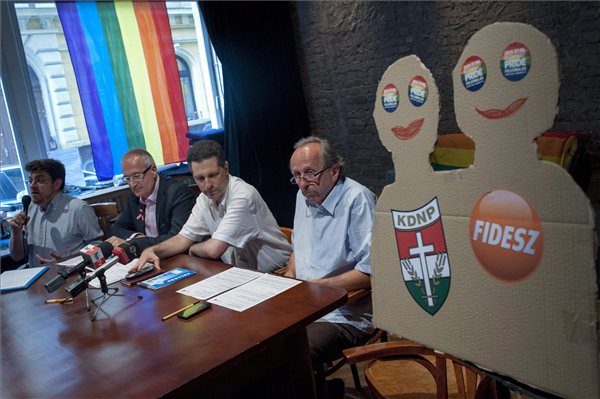
cardboard men

Representatives from the Fidesz-KDNP coalition (right) attend roundtable discussion on gay rights in Hungary.

The 2013 Budapest Pride gay parade was held on July 6 amid tight security, as it has since radical right-wing demonstrators severely disrupted the event in 2007 and 2008. For the past five years, the Budapest Police has prevented protesters from assaulting Budapest Pride procession by stationing riot cops at heavy security fence erected on cross streets one block on either side of the parade route along its entire length. One can gain access to the parade only by passing through a security checkpoint at the beginning of the route on Heroes‘ Square. Otherwise, one cannot get closer than a football field in length to the parade as it proceeds down Andrássy Avenue to the center of the city. There have been progressively fewer and fewer demonstrators heckling paraders from afar under this hermetically sealed security arrangement. Only a couple of hundred right-wing protesters showed up for this year’s Budapest Pride procession, most of them belonging to a new radical nationalist group that calls itself Guards of the Carpathian Homeland (Kárpát Haza Őrei).

The Budapest Pride parade is a microcosm of the overall status of homosexuality in Hungary: tolerated, though only in sterile isolation from the heterosexual world and to a lesser degree since Prime Minister Viktor Orbán started pulling the political strings in Hungary as opposition leader more than six years ago. The Fundamental Law that Orbán and the FideszChristian Democratic People’s Party (KDNP) administration adopted after coming to power in 2010 stipulates that marriage must be between a man and a woman, thus making Hungary the fifth European Union member state following Poland, Bulgaria, Latvia and Lithuania to constitutionally ban, by exclusion, same-sex marriage. (A sixth European Union member state, Romania, prohibits same-sex marriage in the country’s civil code.) Fidesz declined to participate in any of the Budapest Pride week events to which it was invited, sending nobody to represent the party at a roundtable discussion on gay rights in Hungary or to march in the annual parade.

Fidesz’s official stand on homosexuality is one of cold neutrality. A party communiqué to the news website Index.hu stated that “Homosexuality is a private affair that Fidesz does not want to make into a public affair. In connection to Budapest Pride, everybody has the right to participate in the event, just as they have a right to not participate in it.” In response to a question from the news website 444.hu whether Fidesz supported the Budapest Pride parade, party Communications Director Máté Kocsis said “Fidesz has no opinion on this question. I have not conducted a poll regarding who is going and who is not. Everybody will decide for themselves. I, myself, am not going to participate.” Asked about news that  Budapest Pride organizers planned to present him with a rainbow flag to fly temporarily outside city hall, de facto Fidesz Budapest Mayor István Tarlós said that “It would be better if they would refrain from this open provocation, because the mayor does not have the ways and means of placing this flag on city hall.” Tarlós earlier in the week pretended not to know what Budapest Pride was when a reporter from 444.hu asked him a question about the event. After being told what it was, he answered “I stand on the other side.”

Both Mayor Tarlós and Prime Minister Orbán declined invitations to participate in the Budapest Pride parade. This is understandable from a political point of view. Under the conditions of extreme political polarization that exist in Hungary, for them to attend an event that in political terms has traditionally been identified with the Budapest liberal élite would signify a concession to the opponent. Moreover, it would drive a certain number of Fidesz voters into the arms of the radical right-wing nationalist Jobbik party, which announced this week that if it ever comes to power it will ban Budapest Pride and other “deviant, provocative, exhibitionist programs.” However, in this instance Fidesz could still have sent lesser party representatives, even non-official known sympathizers, to attend the Budapest Pride events to which it was invited. Instead, only feigned ignorance, haughty standoffishness and rigidly noncommittal communiqués.

Throughout much of western Europe and North America national and city government officials openly support gay-pride events, often marching at the head of gay parades. Hungary, though a more traditional eastern European country, appeared to be proceeding in this direction during the first decade of Budapest Pride, which started in earnest in 1997. The reversal of progress in the area of gay rights in Hungary over the past seven years fits squarely into the overall pattern of democratic regression that has taken place in the country over that period.

See Orange Files photo gallery of 2013 Budapest Pride parade. 

Gay Parade Post Photo


See Orange Files photo gallery of 2007 and 2008 Budapest Pride parades.

Post Photo Gay Parade-2


—————————————————————————————————————————————–

Swallowing the Frog

Orbán the Bullshitter

Prime Minister Orbán speaking to the National Assembly on July 4, 2013.

The Orbán government reacted in predictable fashion to the European Union’s July 3 approval of the Tavares Report criticizing it for undermining fundamental democratic rights in Hungary: the EU doesn’t really object in principle to what we are doing, but is engaging in petty party politics at the bidding of corporate lobbyists who want to get back at us for reducing exorbitant company profits to the benefit of the people.

Speaking at a session of the National Assembly on July 4, Prime Minister Viktor Orbán said that the Tavares report is “unjust” and “hostile toward Hungarians” and that it “gravely insults Hungary” and “violates Hungary’s sovereignty.” Orbán also called the European Union “unjust” and accused the EU of “applying a double standard” toward Hungary and “abusing its power.” He claimed that corporate interests had instigated the report as a means of countering the government’s utility-fee cuts, which harmed the interests of European corporations that “for years collected as much money as they could from Hungarian families.”

Speaking during one of his regular Friday-morning interviews on state-run Kossuth Radio on July 5, Orbán asserted that the Tavares Report was a “left-wing action” taken against the government because it had written a constitution that “is not liberal” and because European left-wing parties “cannot swallow the frog” (literal translation of a Hungarian idiom meaning “to swallow the bitter pill”) of Fidesz’s landslide election victory over the Hungarian Socialist Party in 2010. The prime minister said that these left-wing parties are intertwined with “capital interests” that are attempting to reverse the government’s bank tax and utility-fee cuts. Orbán claimed that “Not since the Soviet Union existed has any outside force had the audacity to openly, choosing a legal form, limit the independence of Hungarians.”

Later on July 5, FideszChristian Democratic People’s Party (KDNP) National Assembly representatives approved a resolution submitted by Fidesz caucus leader Antal Rogán and two others entitled “On the Equal Treatment due to Hungary.” Representatives from the Hungarian Socialist Party and Politics Can Be Different boycotted the vote on the resolution, while the six representatives present from the Democratic Coalition and Dialogue for Hungary voted against it. Only Fidesz-KDNP representatives voted to approve document, which speaks in the name of the entire nation. The following is an Orange Files translation of the resolution (source in Hungarian):

We Hungarians joined the family of European nations more than one-thousand years ago with the foundation of the state and the adoption of Christianity.

We Hungarians have stood up for European values on many occasions.

There were times when we defended these values with our blood in the face of external attacks. In 1956 we took up arms against the communist dictatorship. In 1989 we contributed to the reunification of Europe through the dismantling of the Iron Curtain.

We Hungarians joined the European Union of our own free will.

We did this in the hope that we had joined a community standing on the foundation of law,  justice and freedom.

We Hungarians do not want a Europe in which freedom is limited and is not permitted to develop to its fullest. We do not want a Europe in which the stronger abuses its power, in which the sovereignty of nations is violated and in which the smaller must honor the bigger.

We had enough of dictates in the forty years spent behind the Iron Curtain.

We Hungarians have always honored the initiative of competent European Union institutions to engage in dialogue and have always been prepared to come to agreements conceived in the spirit of reason.

It is for this reason that we rightfully desire the respect and equal treatment due to Hungary from the institutions of the European Union.

We expect the European Union to honor the rights accorded to us following our accession just as it does with regard to every member state.

The Hungarian National Assembly voices its astonishment that the European Parliament adopted a resolution that it had no right to adopt and with which the European Parliament overstepped the boundaries of its authority. It arbitrarily establishes demands, arbitrarily introduces new procedures and creates new institutions that violate Hungary’s sovereignty as stipulated in the fundamental treaty of the European Union.

In this way the European Parliament is going against European values and placing the European Union on a dangerous path.

The fact that business interests are behind this abuse of power afflicting Hungary gives cause for further worry.

Hungary is decreasing the price of energy used by Hungarian families. This may harm the interest of several major European corporations, which used their monopolies to generate extra profit in Hungary for many years on end. It is unacceptable that the European Parliament is attempting to place pressure on our homeland in the interest of these major corporations.

The Hungarian National Assembly considers it dangerous for all of Europe if business interests are able to assert themselves without impediment within the European Union and are able to supersede the provisions of the fundamental treaty.

Today we approve a resolution aimed at defending Hungary’s sovereignty and the equality of Hungarian people within Europe.

We ask the government of Hungary not to yield to the pressure of the European Union, not to permit the rights guaranteed to the country in the fundamental treaty to be impaired and to continue the policies that serve to make the lives of Hungarian families easier.

The Orbán government’s claim that the European Parliament approved the Tavares Report at the behest of large energy companies seeking to reverse the government-imposed utility-fee cuts is especially absurd in light of the fact that the EP commissioned the report on February 16, 2012, more than nine months before Fidesz announced the mandatory ten-percent reduction in the price of household gas and electricity.

—————————————————————————————————————————————–

Fill in the Blanks

nagybeszed_n294_116287

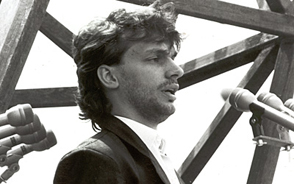
Viktor Orbán speaking on June 16, 1989.

Twenty-five years ago this week, on June 16, 1989, Prime Minister Viktor Orbán, then the spirited leader of the liberal, anti-communist Alliance of Young Democrats (now a conservative, Christian-nationalist party known only by its acronym Fidesz), gave a speech at the reburial of 1956 revolutionary Prime Minister Imre Nagy on Heroes’ Square in Budapest that vaulted him into the center stage of Hungarian politics, a position that he has occupied ever since. This is an Orange Files translation of that speech (video of speech in Hungarian):    

My Fellow Citizens! 

Since the beginning of the Russian occupation and the communist dictatorship 40 years ago, Hungarian people once had an opportunity, once had adequate courage and strength to attempt to reach the objectives articulated in 1848: national independence and political freedom. To this day our goals have not changed, today we still have not relented on ’48, just as we have not relented on ’56 either.  

Those young people who today are fighting for the establishment of liberal democracy in Hungary bow their heads before the communist Imre Nagy and his associates for two reasons. We honor them as statesmen who identified with the will of Hungarian society, who in order to do this were able to relinquish their holy communist taboos, that is, the unquestioned service of the Russian empire and the dictatorship of the party. For us, they are statesmen who even in the shadow of the gallows refused to stand in file with the murderers who decimated society, statesmen who even at the cost of their lives did not disavow the nation that had accepted them and placed their confidence in them. We learned from their fate that democracy and communism are irreconcilable. 

We know well that the majority of the victims of the revolution and the retribution were young people of our age and kind. But it is not only for this reason that we feel the sixth coffin to be ours. Until the present day, 1956 was our nation’s last chance to step onto the path of western development and create economic prosperity. The ruin that weighs upon our shoulders today is the direct consequence of the fact that they suppressed our revolution in blood and forced us back into that Asian impasse from which we are again trying to find a way out.  

It was, in truth, then that the Hungarian Socialist Workers’ Party deprived us, the young people of today, of our future. It is for this reason that not only the corpse of a murdered young person lies in the sixth coffin, but our next 20—or who knows how many—years lie in there as well. 

 My Friends! 

We young people do not understand many things that are perhaps natural for the older generations. We are at a loss to explain how those who not long ago stood among the chorus vilifying the revolution and its prime minister have today unexpectedly realized that they are advocates of Imre Nagy’s reform policies. Neither do we understand how those party and state leaders who commanded that we be taught using textbooks falsifying the revolution are today jostling to lay a hand on these coffins like some lucky talisman.  

We believe that we owe no gratitude for the permission to bury our dead after 31 years. Nobody deserves thanks because today we are able to operate our own political organizations. It is not the merit of the Hungarian political leadership that it has not acted against those demanding democracy and free elections, though the weight of its weapons would permit it to do so, using methods similar to those of Li Peng, Pol Pot, Jaruzelski or Rákosi.  

Today, 33 years after the revolution and 31 years after the execution of the last legitimate prime minister, we have the opportunity to peacefully achieve all that the ’56 revolutionaries attained for the nation through bloody conflict, if only for a few days. If we believe in our own strength, we will be capable of bringing an end to the communist dictatorship, if we are sufficiently resolute, we can force the ruling party to submit itself to free elections. If we do not lose sight of the principles of ’56, we can elect for ourselves a government that will initiate immediate talks regarding the quick withdrawal of Soviet troops. If we have the mettle to want all this, then, but only then, we can fulfill the will of our revolution. 

Nobody can believe that the party state is going to change on its own. Recall that on October 6, 1956, the day of László Rajk’s burial, the party newspaper Szabad Nép proclaimed in colossal letters on its front page “Never Again!” Just three weeks later, the communist party’s ÁVH officers opened fire on peaceful, unarmed demonstrators. Not even two years later after the “Never Again,” the HSWP sentenced innocent hundreds, among them their own comrades, to death in show trials similar to that of Rajk. 

It is for this reason that we cannot be satisfied with the promises of communist political officials,  promises that oblige them to nothing at all. We must ensure that the ruling party cannot use force against us, even if it wants to. There is no other way to avoid more coffins and overdue funerals such as today’s. 

Imre Nagy, Miklós Gimes, Géza Losonczy, Pál Maléter, József Szilágyi and the nameless hundreds sacrificed their lives for Hungarian independence and freedom. Young Hungarians, before whom these ideas remain inviolable to this day, bow their heads before your memory. 

Rest in Peace.

There is a striking similarity between the conflict-centered, aggressive rhetoric of Orbán’s iconic Imre Nagy eulogy and that which he uses today as the head of the FideszChristian Democratic People’s Party government. Only the objects of his antagonism and sympathy have changed in the two and a half decades since the 1989 speech. The Orbán of today would not classify “Russian,” “Asian” and “Li Peng” among the former, just as he would not classify “Western” among the latter. However, the speech still represents one of the greatest instances of twentieth-century Hungarian political oratory, boldly and explicitly articulating the widespread antipathy felt in Hungary at the time of the System Change toward the Hungarian Socialist Workers’ Party and the role it had played in the suppression of the the 1956 Hungarian Revolution and the post-revolutionary campaign of retribution that entailed the execution of Imre Nagy and hundreds of others. 

—————————————————————————————————————————————–

Who Should Not Be?

Zsolt Bayer.

Zsolt Bayer

On May 8, the government’s National Media and Infocommunications Authority (NMHH) fined the newspaper Magyar Hírlap 250,000 forints (850 euros) for the January 5, 2013 publication of staff journalist Zsolt Bayer’s editorial “Ki ne legyen?” (Who Should Not Be?), which the authority’s Media Council said had violated paragraph 17 of Media Law CIV prohibiting media content that could serve to inspire hatred or ostracism of “any nation, community, national, ethnic, linguistic or other minority or any majority or religious community.”

Bayer, one of the 37 founding members of Fidesz and one of the most prominent voices in the pro-government media, wrote the editorial in reference to the knife wounding of two athletes—Budapest MTK sports club boxer Gergő Sávoly and Szigetszentmiklós Sports Club wrestler Roland Gergő Bozsány—during a fight with Gypsies in the restroom of a night club in the village of Szigethalom, just south of Budapest, early on New Year’s Day morning. 

It was the first time that the NMHH’s Media Council had ever imposed such a fine since the Orbán government’s Media Law CIV went into effect on January 1, 2011 (source in Hungarian). Below is an Orange Files translation of a major portion of the editorial (source in Hungarian). Note that the Cozma affair refers to the February 8, 2009 stabbing death of Romanian handball player Marian Cozma during a fight with Gypsies outside a bar in Veszprém (central Hungary): 

The year 2013 started with another Cozma affair. The only difference is that the victims are not internationally known athletes, but “only” top youth athletes. Whom the cowardly, disgusting, noxious animals knifed.

The above sentence will be the cause of bogus indignation. Which is much easier, much more lucrative and generates more profit in the politically correct world than facing the facts.

These are the facts: a significant portion of the Gypsy population is not fit for coexistence. It is not fit for living among people. These Gypsies are animals and behave as animals. They want to rut with whomever they see whenever and wherever they see them. If they meet with resistance, they kill. They relieve themselves whenever and wherever the need comes over them. If they feel they are being prevented from doing this, they kill. They want what they see. If they don’t get it immediately, they take it away and kill. These Gypsies are incapable of any kind of communication that could be called human. Most often inarticulate sounds surge forth from their animal skulls and the only thing they understand in this miserable world is violence. Meanwhile the half of the Gypsy population that has turned animal utilizes the “achievements” of the idiotic western world. Everybody take a look at how these “subsistence criminals” pose on Facebook with weapons in their hands, half-kilo golden necklaces around their necks and an “I’ll do you in at any moment, you stupid Hungarian peasant” expression on their faces. Take a look at the rat who stabbed Gergő Sávoly and his buddies on Facebook: you will see that all three of them are potential killers. Eo ipso killers. You don’t need to tolerate and understand, but retaliate. And it is here that the politically correct part of the idiotic western world commits its gravest sin. It pretends out of pure, calculating self-interest that these animals can be tolerated for any reason, that they are understandable, even admirable, as if they deserve any kind of respect and human dignity. And the most horrible thing about this whole nightmare is that in just a few moments they totally ruin the chances of the normal half of the Gypsy population. When Gergő Oláh won X-Factor, I thought well here, now you have it, what a beautiful and resounding answer the people gave to all the scoundrels who call Hungarians racist when they voted this talented, nice, modest Gypsy who movingly arose from the depths to become the contest’s winner. And I also thought that this extremely likeable Gypsy young man who emerged from the depths himself did more to alleviate the Gypsy-Hungarian conflict than all the “civil rights” scum bags put together. Then came New Year’s Eve and along came some forty rotten animal Gypsies, among them a certain János Jónás, and they set about killing.  Because they couldn’t go immediately into the john when the need came over them. Because they would have had to wait for two minutes. Because. . . . There is no because. They did it because they are not people. Because they draw knives right away, even if there are forty of them, and stab. In the heart, often one time after another. Good Lord, how intolerable all this is, how it destroys everything that is human. And how there is no room here for excuses or tolerance of any kind!

In fining Magyar Hírlap for publishing Who Should Not Be?, the Fidesz-appointed Media Council was following the letter of the law prohibiting hate speech in the Hungarian Media. However, the minimal size of the fine—one percent of the maximum 25 million forints in such cases—and the Orbán government’s steadfast refusal to distance itself from Bayer, one of its most loyal and influential supporters, causes one to wonder if the Media Council’s primary motive in imposing the penalty was not to punish the illegal dehumanization of Gypsies, but to provide itself with suitable grounds to rebuff charges of pro-Fidesz partisanship if in the future it takes such action against the opposition media. 

—————————————————————————————————————————————–