Workers of the World!

Looking for promotion or a better work schedule at this store?

CBA store in Budapest.

Shortly before this year’s national holiday celebrating the outbreak of the 1956 Hungarian Revolution, presidents and owners László Baldauf and Vilmos Lázár of the CBA grocery store chain, the second biggest in Hungary behind Tesco, sent the following letter to all of their thousands of stores throughout the country (see original in Hungarian):

Dear Colleagues!

On October 23 we are going to commemorate the heroes and martyrs of the 1956 revolution. This celebration creates a good opportunity for us to express our sympathy toward our national government.

This effort and unity are important because only in cooperation can we impede and categorically reject the machinations of the post-communist liberal scoundrels [gazember] who betray our homeland at every turn, serve the interests of foreign multinationals, all the while sacrificing the prosperity and development of the Hungarian people.

We ask all of those who are interested in the further strengthening and harmonious and systematic development of our homeland to come and participate with us in the Peace March and then listen to our Prime Minister’s holiday speech. It is important that all of us true patriots with nationalist sentiments support our greatest Hungarian political figure, the prime minister of our nation, Viktor Orbán.

The Peace March departs at 2:00 p.m from the Bem statue and will proceed along the Grand Avenue to the Oktogon and from there up Andrássy Avenue to Heroes’ Square.

We ask Esteemed Shop Managers to please inform all personnel of this letter and its important contents.

Sincerely,

László Baldauf, Vilmos Lázár

CBA Communications Director Attila Fodor said after the opposition newspaper Népszava published the letter on November 12 that it was a private summons from Baldauf and Lázár to their employees and that participation in the Peace March was in no way obligatory (source in Hungarian).

One can imagine that some CBA shop managers passed the message from the company’s owners on to their employees haphazardly, or maybe not at all. 

One can also imagine that other CBA shop managers, either out of political conviction or self-interest, systematically informed their employees of the message, perhaps using the same spiteful and inflammatory language as that contained in the original letter. 

And one can imagine that many employees working under the latter managers chose to participate in the October 23 Peace March (see The Soft White Underbelly) in order to win the favor of their superiors even if they do not support Fidesz. 

This is the ethos that predominates in Fidesz-controlled Hungary: support the party and gain financial and material benefit; oppose the party and suffer financial and material loss. 

This is an ethos with which Hungarians who were part of the national economy  before 1990 are all too familiar. 

—————————————————————————————————————————————–

Minus 20 Everywhere

Fidesz National Assembly representative responsible for utility-fee cuts Szilárd Németh.

Fidesz National Assembly representative responsible for utility-fee cuts Szilárd Németh.

On November 22, Fidesz representative Szilárd Németh submitted a bill to the National Assembly that would require an official notice informing residents of the money they have saved as a result of the government’s twenty-percent cuts in utility fees to be displayed in a visible place in every residential building containing privately owned apartments in Hungary. This bill, as all others that the Orbán government or FideszChristian Democratic People’s Party National Assembly representatives submit, will certainly become law. Below is an Orange Files translation of the notice (see original notice in Hungarian): 

Utility Fee Cuts Send HOme

The Orbán government’s National Development Ministry issued a decree that went into effect earlier this year stipulating that all utility bills had to display the amount of money saved as a result of the utility-fee cuts in a field of orange, the party color of Fidesz. Below is an Orange Files translation of the relevant parts of the officially decreed format for utility bills (see original bill format in Hungarian):   

Good Utility Bill POst

IMG_2775The National Consumer Protection Authority subsequently fined six energy companies the albeit nominal total sum of 37.5 million forints (around 125,00 euros) for failing to follow the new bill format (source in Hungarian). 

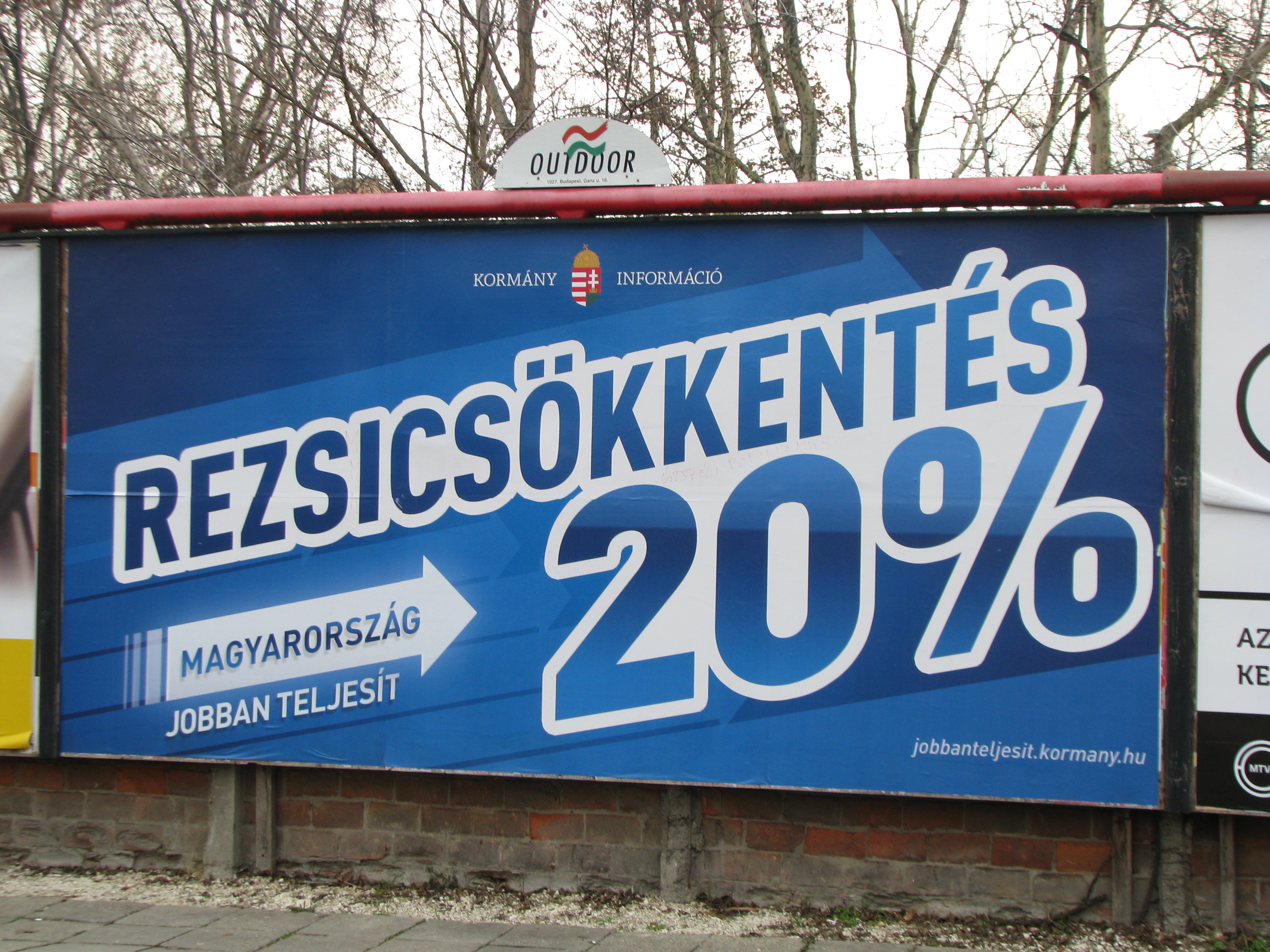
In order to even better publicize the utility-fee cuts, the government has put up signs and posters all over Budapest (and presumably the rest of Hungary) reading either  “-20% Utility-Fee Cuts” or simply “Utility-Fee Cuts.” 

National Economy Minister Mihály Varga has said that the government may cut the centrally regulated fees for electricity, gas and district heating by a further 10 percent next year.  

The utility-fee cuts have become the cornerstone of the Orbán government’s attempt to mobilize popular support ahead of the 2014 National Assembly election. The primary purpose of the cuts is to portray the Prime Minister Viktor Orbán as a benevolent, though strong-handed leader who is willing to take on multinational energy companies in order to defend the interests of the Magyar nation.   

—————————————————————————————————————————————–

The Start of Something Big

Miklós Horthy: ruled Hungary for 24 years (1920-1944).

Horthy: ruled Hungary for 24 years (1920–1944).

For a long time after the Orbán government came to power in Hungary following 2010 national elections, dissidents in the country believed that it was a passing phenomenon, a relatively brief and natural anti-democratic regression following twenty years of tough progress in the construction of post-communist democracy.

They no longer believe this. Everybody in the Hungary—whether they are among the vast majority of voters who support the government or the shrinking minority who oppose it—knows and feels in their bones that Orbán is going to lead the country for years, if not decades, to come.

This is not politics as usual. Since Prime Minister Viktor Orbán came to office three and a half years ago with the unquestioning support of a two-thirds majority of the National Assembly, he has systematically dismantled the liberal western democracy built in Hungary following the collapse of communism and replaced it with an authoritarian eastern democracy—Putinism Lite.

The opposition is fractured, enervated and sinking out of sight in the polls. The eastern-style guided capitalist economy that the Orbán administration has put in place appears to be working much better than skeptics expected. Hungarians are not prospering, but the government has brought them a somewhat greater degree of economic stability and reinforced their loyalty through centrally mandated twenty-percent cuts to their electricity, gas and heating bills.

Kádár: ruled Hungary for 32 years (1956-1988).

Kádár: ruled Hungary for 32 years (1956–1988).

The FideszChristian Democratic People’s Party (KDNP) alliance already has 2014 general election in the bag. The only question that remains to be answered is whether the party will maintain its super majority in the National Assembly.

Even if the opposition regains its footing and wins 2018 elections, a FideszKDNP-elected president, conceivably Orbán himself, will have the power to dissolve the National Assembly and call new elections if the Fidesz-appointed State Budget Council does not approve the draft budget for the following year. This seems like an outlandish prospect within a democratic system. But one must remember that Hungary is no longer a democracy in the western sense of the term.

Moreover, any future democratic government will be saddled with the large number of Fidesz-KDNP-adopted Cardinal Laws that serve as the foundation for Hungary’s current semi-authoritarian political and institutional structure. Such laws require the support of two-thirds of the representatives in the National Assembly to amend or repeal. No government composed of the current democratic opposition is likely to gain the degree of support needed to change these Cardinal Laws.

Viktor Orbán: how long will he rule Hungary?

Orbán: how long will he rule Hungary?

For a long time pro-Western, pro-democracy Hungarians believed that the intoxicating spell of the Orbán government’s neo-tribal, collectivist, Christian-nationalist ideology would wear off quickly, that the electorate would come to its senses and begin to resist the authoritarian restoration that has been taking place since 2010. They believed that the forces of democracy would return to power and resurrect the Third Hungarian Republic in both structure and spirit before the Orbán government could do irreversible damage to it.

They have realized over the past few months that this was an illusion. Orbán and Orbánism are well on their way to becoming as deeply entrenched in Hungary as were Horthy and Horthyism during the interwar period and Kádár and Kádárism following the 1956 Hungarian Revolution.  

This is not politics as usual.

This is the start of something big.

—————————————————————————————————————————————–

Follow the Evil Twin

The pretty extreme Hungarian nationalist.

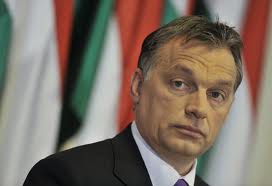
Prime Minister Viktor Orbán.

The Orbán government likes to pretend, primarily for external consumption, that it has thoroughly distanced itself from the radical-nationalist opposition party Jobbik

“If we want to protect democracy, we must take a firm stand against Jobbik,” Prime Minister Viktor Orbán told the Israeli daily newspaper Yedioth Ahronoth in May 2013 (source in English). 

National Assembly Speaker László Kövér, Orbán’s right-hand man, told the Hungarian newspaper Magyar Hírlap in July 2013 that “Jobbik, the HSP [Hungarian Socialist Party] and the liberals are striking a single chord in terms of their conception of the rule of law and their political morals. They proclaim as one: the worse it is, the better!” (source in Hungarian). 

The really extreme Hungarian nationalist.

Jobbik President Gábor Vona.

The Orbán government does not acknowledge that since coming to power three and a half years ago it has carried out the Jobbik political program almost to the letter. 

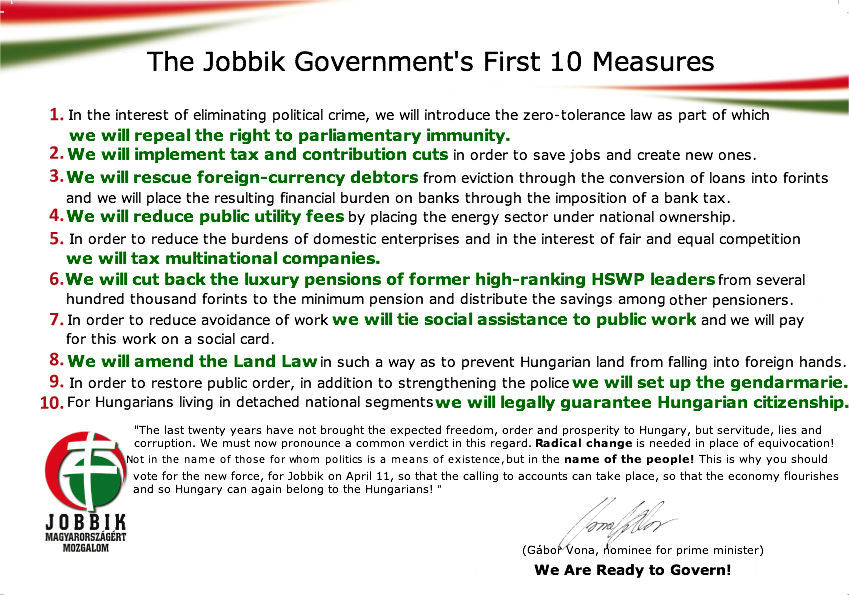
Before the first round of the 2010 National Assembly election, Jobbik published a party platform entitled “The Jobbik Government’s First 10 Measures.” 

The FideszChristian Democratic People’s Party-controlled government and National Assembly have implemented eight of the ten measures stipulated in the document, though specifically cited none of these in the party alliance’s 2010 electoral program (source in Hungarian).

Below is an Orange Files translation of the March 2010 Jobbik platform with notes regarding the Orbán government’s subsequent implementation of each of the specified initiatives (see original Hungarian version of the Jobbik program). 

Jobbik English Good

1. Parliamentary immunityThe Orbán government has not conducted a wholesale repeal of parliamentary immunity.

2. Tax and contribution cutsThe Orbán government has implemented tax and contribution cuts. 

3. Conversion of foreign-currency-denominated loans into forints: The Orbán government has passed legislation making it possible to convert foreign-currency-denominated loans into forints, first announcing their consideration of this measure in March, 2013,  three years after Jobbik proposed it in the party’s election program (source in Hungarian). 

Imposition of bank tax: The Orbán government has introduced a tax on banks operating in Hungary. Prime Minister Orbán first announced this tax as part of his government’s Economic Action Plan on June 8, 2010, three months after Jobbik proposed such a tax in the party’s election program (source in Hungarian). 

4. Utility-fee cuts: The Orbán government has conducted two centrally mandated cuts in utility fees. The government announced the first round of utility-fee cuts in December 2012, two years and nine months after Jobbik proposed such cuts in the party’s election program (source in Hungarian). 

5. Taxation of multinational companies: The Orbán government has imposed extraordinary taxes on companies operating in the energy, telecommunications and retail sectors. Prime Minister Orbán initially announced these taxes as part of his government’s Second Economic Action Plan on October 13, 2010, seven months after Jobbik proposed such taxes in the party’s election program (source in Hungarian).  

6. Reducing the Pensions of former high-ranking communist-party officials: The Orbán government has withdrawn the pension supplement from those “whose actions before 1990 were incompatible with the democratic system of values.” The government first made reduction of pensions for former communist officials possible in the Transitional Provisions of the Fundamental Law adopted on December 30, 2011, one year and nine months after Jobbik proposed such taxes in the party’s election program. The National Assembly approved the law stipulating such a reduction in pensions on July 2, 2012, two years and four months after Jobbik published its 2010 election platform (source in Hungarian).

7. Tying social assistance to public work: The Orbán government has tied receiving social assistance to public work. The National Assembly approved a law requiring those who receive secondary unemployment benefits or social support to accept public work if offered or lose these benefits in July 2011, one year and four months after Jobbik suggested linking social assistance to public work in the party’s election program (see The Fluorescent Army). 

8. Amendment of the Land Law to prevent foreigners from buying arable land: The Orbán government has adopted a new Land Law, which Prime Minister Orbán said following the passage of the law in June 2013 would serve to ensure that agricultural land in Hungary “remains in the hands of Hungarians” (source in Hungarian). The government began talking about the need for such a law in June 2012, two years and three months after Jobbik advocated the adoption of a new Land Law in the party’s election program (source in Hungarian). 

9. Reconstitution of the gendarmarie: The Orbán government has not reconstituted the Hungarian gendarmarie (csendőrség) abolished in 1945 as the result of the force’s role in the deportation of Jews from Hungary the previous year. 

10. Guaranteeing Hungarian citizenship for Hungarian minorities: The Orbán government has passed legislation expediting the process of obtaining Hungarian citizenship for Hungarian minorities living in the countries surrounding Hungary. The government first announced this measure on May 3, 2010, about six weeks after Jobbik proposed the measure in the party’s election program (source in Hungarian). 

————————–

In addition to the proposals contained in the above Jobbik election program, party President Gábor Vona publicly advocated three further initiatives following 2010 National Assembly elections that later came to serve as cornerstones of the Orbán government’s economic and political policy. 

New Constitution 

Speaking at the annual Jobbik May Day celebration in Budapest on May 1, 2010, less than a week after the second round of National Assembly elections, Vona declared (see video in Hungarian starting at 4:18): 

Hungary has not had a constitution with legal continuity from a historical perspective since 1949. We are not proceeding along a constitutional path. We live within the framework of a Stalinist patchwork constitution and nobody has talked about this in parliament over the past 20 years. Well we will. 

In May 2010 the Orbán government had not yet announced that it would introduce a new constitution in place of that adopted in the second year of communist dictatorship in Hungary. In fact, Fidesz Member of the European Parliament and future president Pál Schmitt insisted between the first and second rounds of National Assembly elections in April 2010 that the party did not intend to “drastically alter” the existing constitution and would only make “required modifications” to it (source in Hungarian). Prime Minister Orbán first announced that his government would initiate the adoption of a new constitution on May 25, 2010, three weeks after Vona intimated that Hungary needed a new constitution. 

Eastern Opening 

Also speaking at the May 1, 2010 May Day celebration, Vona said (see video in Hungarian starting at 8:45): 

Since the time of Pál Teleki, for seventy years, nobody has declared Look east Hungarian! You are an eastern people. You are the most western eastern people. If Hungary were to build strong relations in Asia, in eastern countries . . . I am not thinking of the Middle East just in case anybody should accuse me . . .  it would present us with political, economic and cultural opportunities. Many countries there consider us to be brothers. We should try to benefit from this. This is one of the most important national strategies for us. The next century will be Asia’s century. And the country, Hungary, that recognizes this and has the chance to take advantage of it—that country will become the heart of Europe.

Although Orbán began to talk of strengthening relations with China while still in opposition (source in Hungarian), he did not begin to openly advocate reorienting Hungary toward the east until the late fall of 2010 and his government did not begin to refer to this shift as its Eastern Opening Policy until the spring of 2011 (source A and B in Hungarian).

Nationalization of Private Pension Funds

Finally, Jobbik President Vona made the following statement to the Hungarian News Agency MTI on September 3, 2010 in connection to the first 100 days of Prime Minister Orbán’s government (source in Hungarian):

It can be clearly seen that even with a two-thirds majority in its possession, the government does not dare to deal with questions such as renegotiation of the debt, the critical review of European Union membership, putting a stop to the tax evasion of multinationals or even the nationalization of private pension-funds.

Prime Minister Orbán did not initiate his administration’s nationalization of private pension funds in Hungary until October 13, 2010, six weeks after Vona criticized his government for failing to do so (source in Hungarian).  

 ————————–

The Orange-to-Black Continuum 

The Orbán government does not acknowledged that it has essentially implemented the policies that only Jobbik publicly advocated at the time of 2010 National Assembly elections. Prime Minister Orbán and his subordinates would like to maintain the illusion, perhaps self-deception, that their political thinking differs greatly from that of Gábor Vona and other Jobbik leaders.

Neither has Jobbik highlighted the fact that the Orbán administration has carried out its program for fear that doing so could drive the party’s voters into the Fidesz-KDNP camp. Perhaps foreseeing this prospect, Jobbik President Gábor Vona assured shortly after the 2010 general election that “Jobbik will remain a significant force even if Fidesz implements the complete Jobbik program” (source in Hungarian)

In parliamentary opposition, Jobbik has either supported the Orbán government’s policies or opposed them on the grounds that they were too moderate or failed to serve the intended objective. 

Jobbik supported the government’s nationalization of private pension funds, bank and sector-based taxes, utility-fee cuts, elimination of pension supplements for former communist officials and conversion of foreign-currency-denominated loans into forints, though sometimes expressed reservations (utility-fee cuts should have been twice as high, forintization of fx loans was “aspirin for the dying”).¹

Jobbik did not support the legislation making eligibility for social assistance contingent upon acceptance of public work for technical reasons and opposed the Fundamental Law due to the Orbán government’s exclusion of other National Assembly parties from the framing process (“Fidesz embezzled the procedure of constitution-making,” Vona said).²  

Jobbik vehemently opposed the Orbán government’s Land Law, not because the party disagreed with the stated purpose of the legislation to ensure that agricultural land in Hungary would “remain in the hands of Hungarians,” but because it claimed that the law would promote foreign ownership of such land. (Jobbik parliamentarians occupied the National Assembly Speaker’s rostrum holding a sign reading “Playing Hungarian Land Off to Foreigners: Treason!” before Fidesz-KDNP representatives adopted the law). Source in Hungarian. 

Fidesz-KDNP and Jobbik are both political outgrowths of Hungarian nationalism and its main contemporary manifestations—rejection of western culture, rejection of the western free-market and rejection of western liberal-democracy.

In terms of concrete policy, Jobbik and Fidesz are virtually indistinguishable. The only true difference between them lies in the severity of their language and proposed means of attaining common objectives and their attitude toward religious and racial minorities in Hungary.

Jobbik is simply a somewhat more radical and outspoken, explicitly anti-Semitic and anti-Gypsy version of Fidesz.

¹See sources A, B, C, D, E and F in Hungarian.

²See sources A and B in Hungarian.

—————————————————————————————————————————————–
The Fluorescent Army

Interior Minister Pintér introduces legislation withdrawing government support from those who refuse public work.

Interior Minister Pintér introduces legislation withdrawing government support from those who refuse public work.

In September 2013, the Central Statistics Office published data showing that the number of employed people in Hungary rose by 67,000 from the summer of 2012 to a two-decade high of 3.98 million in the summer of 2013 (source in Hungarian).

The Orbán government trumpeted this happy fact as evidence of its successful employment policies. Following the publication of the data, the National Economy Ministry issued a communiqué stating that the rise in employment “reflects the success of the government’s economic policy. Government measures have succeeded in halting the fall in employment . . . “ (source in Hungarian).  

This is absolutely true. The rise in employment in Hungary stems directly from the government’s policy. 

Its policy of forcing people without jobs who want to retain their minimal unemployment benefits to take part in public work projects. 

No More Free Lunch  

Start-munka.fmh_.hu_In July 2011, FideszChristian Democratic People’s Party National Assembly representatives approved legislation reducing the period during which those who lose their jobs are eligible to receive primary unemployment benefits, called  “job-seeking support” (álláskeresési járadék), to three months from nine months and requiring those who receive secondary unemployment benefits of a smaller amount, called “employment-substitution support” (foglalkoztatást helyettesítő támogatás), or social support (szociális segély) to accept public work if offered or lose these benefits (source A and B in Hungarian). 

Interior Minister Sándor Pinter, who sponsored the bill, said the legislation was aimed at encouraging the unemployed to return to the labor market and simplifying the system of state support (source in Hungarian). These changes went into effect on September 1, 2011. 

Working for Peanuts

kozmunkasok-miskolcon3In Budapest they sweep the streets, pick up trash in parks and shovel snow in the winter. In the countryside they also cut grass, clear brush and clean ditches and canals. Men and women in fluorescent shirts or vests armed with brooms, shovels, rakes and scythes. Those participating in government work-training programs also count as public workers.

They work six hours per weekday. Take-home pay is between 43,700 and 47,000 forints (147–159 euros) per month for unskilled public workers and between 56,000 and 60,000 forints (189–202 euros) per month for skilled workers. Public workers can be obliged to travel up to three hours per day to and from work at the expense of the state employer. If the government offers unemployed people public work at a location that is farther than an hour and a half from their homes, the employer must provide them with room and board (source in Hungarian).

The Fluorescent Army  

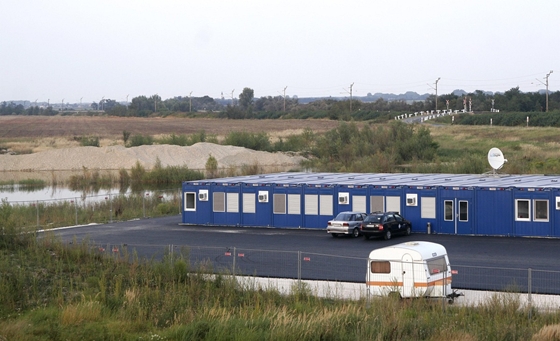
Temporary housing for those taking part in public-work projects.

Temporary housing for those taking part in public-work projects.

The number of public workers has risen significantly since the adoption of the legislation canceling secondary unemployment benefits and social assistance for those who refuse to participate in government public-work programs. According to the Central Statistics Office, the average number of public workers employed in Hungary rose to an average of 148,933 in the summer of 2013 from an average of 106,733 in the summer of 2012 (source in Hungarian). According to Interior Ministry data published on the website 444.hu, the average number of public workers rose to an average of 166,831 in the summer of 2013 from 90,707 the previous summer (source in Hungarian).

National Economy Ministry State Secretary Sándor Czomba announced in the fall that the government would employ 200,000 Hungarians in public-work programs for the five-month period beginning on November 1—100,000 at six-hour-per-day jobs and 100,000 in four-hour-per-day labor-training (source in Hungarian).  The government’s 2014 draft budget allocates 183.8 billion forints (620 million euros) for public-work programs, up 20 percent from 2013, intended to employ between 250,000 and 300,000 workers (source in Hungarian). 

The Truth Behind the Numbers  

images-7Central Statistics Office data shows that public workers accounted for over 60 percent of the rise in total employment to its highest level since 1992 recorded during the summer of 2013. If one uses the Interior Ministry data published on 444.hu regarding the number of public workers in this period, the number of people employed in Hungary decreased by more than 9,000 in the summer of 2013 as compared to the previous summer if one subtracts the increase in public workers.  

Hungarians who work abroad though have left their families in Hungary also count toward the number of employed registered in the Central Statistics Office labor data (source in Hungarian). The number of such people increased 50 percent to 60,000 in the first two years after the Orbán government came to power in 2010 and accounted for one-third of the measured rise in employment in Hungary in 2012 and 30 percent of the measured rise in the second quarter of 2013 (source A and B in Hungarian).  

In its communication to the general public, the Orbán government does not mention the fact that temporary workers earning measly wages to participate in public-work projects, many of them under the threat of losing all forms of state economic support, and Hungarians working abroad account for the entire increase in the number of employed people recorded in Hungary since it came to power. It does, however, recognize this fact in the information it provides to narrower target groups. The National Bank of Hungary, which under the leadership of former finance minister György Matolcsy has become an integral part of the Orbán government’s governing mechanism, admitted in its September 2013 inflation report, for example, that “Employment within the national economy has long been rising primarily as a result of public work and expanding work abroad” (source in Hungarian). 

The Orbán government hails the recent rise in the number of employed in Hungary to a post-System Change high of nearly four-million as one if its successes, which along with its 20 percent cuts in utility fees provides evidence of its people-friendly policies. In fact, the increase in employment recorded in the country since Viktor Orbán came to power in 2010 is founded entirely upon the rising number of people employed in two categories that reflect the inability of his statist administration to create real jobs: public work-project employees and workers employed abroad.  

Chart

—————————————————————————————————————————————–

Why Just Now?

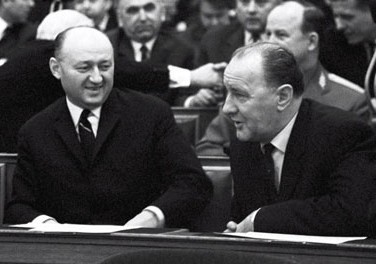
Béla Biszku and János Kádár at the Hungarian Parliament Building

Béla Biszku and János Kádár at the Hungarian Parliament Building.

On October 16, 2013, the Budapest Investigative Prosecutor’s Office submitted an indictment to the Budapest Court of Justice accusing former Kádár-régime official Béla Biszku of war crimes committed during the suppression of the 1956 Hungarian Revolution. The indictment charges that as a member of the Hungarian Revolutionary Worker-Peasant Government’s Provisional Executive Committee (Ideiglenes Intéző Bizottság) that exercised political power in Hungary following the Soviet army’s defeat of revolutionary forces in early November 1956, Biszku is guilty of ordering pro-communist militia to fire upon demonstrators in Budapest on December 6 and in the city of Salgótarján in northern Hungary on December 8 of that year, killing a total of 52 people. The prosecutor’s charges against Biszku are based on crimes defined in the 1949 Fourth Geneva Convention Relative to the Protection of Civilian Persons in Time of War, which the communist Rákosi régime enacted into Hungarian law in 1954 (source in Hungarian). The indictment does not accuse the 92-year-old Biszku of crimes related to the execution of several hundred people, including revolutionary Prime Minister Imre Nagy, as punishment for their actions during the 1956 Hungarian Revolution while he served as the Kádár régime’s interior minister between March 1957 and September 1961. Biszku faces a maximum sentence of life in prison if found guilty of war crimes pursuant to the massacre of civilians in December 1956.

The question is: why just now?

Why is Biszku to be put on trial for crimes committed during the Kádár régime’s retribution against participants in the 1956 Hungarian Revolution nearly 25 years following the fall of communism?

Out of Obscurity 

Righteous imposters: Crime and Impunity directors Fruzsina Skrabski and Tamás Novák

The (self-) righteous imposters: Crime and Impunity directors Fruzsina Skrabski and Tamás Novák.

Biszku lived the quiet life of a pensioner in the upscale Rose Hill district of Budapest for two decades following the System Change. Most Hungarians assumed that Biszku, as all other high-ranking Kádár-régime officials, had died long ago until two young journalists posing as members of the non-existent Bereg Youth Association tricked him into conducting interviews with them under the pretext that they were making a documentary film about notable people born in his home village of Márokpapi in eastern Hungary.  The journalists, Fruzsina Skrabski and Tamás Novák of the pro-Fidesz website Mandiner.hu, then used the interviews, during which they enticed Biszku into talking about his political role in the communist restoration that took place in Hungary following the 1956 revolution, to make a documentary film about him called Crime and Impunity (Bűn és büntetlenség). In the film, which premiered in June 2010, Biszku declares that Imre Nagy “deserved his fate” and that he feels no guilt for the post-revolution executions, claiming that as interior minister he exercised no influence over the courts that pronounced the death sentences (source in Hungarian, including film trailer).  

Statute of Limitations

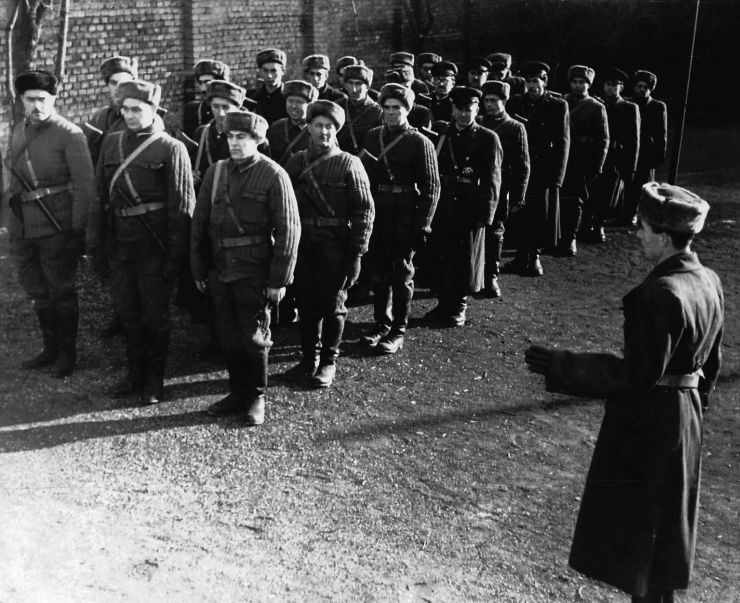
Communist militia of the type that massacred demonstrators in Salgótarján

Communist militia of the type that massacred demonstrators in Salgótarján.

A few months after Crime and Impunity vaulted Biszku back into the public spotlight, a private individual submitted a complaint to the Budapest Chief Prosecutor’s Office charging him with complicity in murder following the 1956 revolution. However, the prosecutor’s office rejected the complaint on the grounds that Hungary’s statute of limitations had expired on the alleged criminal offenses and that the latter did not constitute crimes against humanity as defined in international law (source in Hungarian). 

The prosecutor’s finding contradicted the 1995 verdict of the Budapest Court of Justice condemning two members of the 1956-1957 communist militia each to five years in prison based on the Fourth Geneva Convention for the killing of 46 pro-revolution demonstrators in Salgótarján on December 8, 1956. The court declared that the war crimes were not subject to Hungary’s statute of limitations (source in Hungarian).

The Orbán government took two measures in order to ensure that the statute of limitations would not serve as an impediment to the prosecution of war crimes committed in the aftermath of the 1956 revolution: on December 30, 2011 it adopted (with the support of the opposition) a law, the so-called Lex Biszku, declaring that the statute of limitations does not apply to crimes against humanity, including war crimes (source in Hungarian); and it stipulated in the Fundamental Law that came into effect on January 1, 2012 that the Hungarian Socialist Workers’ Party and its predecessors “were criminal organizations and their leaders shall have responsibility without statute of limitations for maintaining and directing an oppressive régime and for the breaches of law committed and for the betrayal of the nation.”  

With this obstacle removed, in February 2012 the radical-nationalist Jobbik party submitted another complaint against Biszku to the Budapest Chief Prosecutor’s Office accusing him of crimes committed during the suppression and aftermath of the 1956 revolution (source in Hungarian). The office initiated proceedings against Biszku based on these charges on February 29, 2012 (source in Hungarian). 

The Reprehensible Scapegoat 

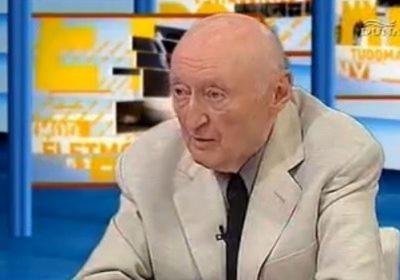
Biszku speaking on Duna TV

Biszku speaking on Duna TV.

Béla Biszku has steadfastly denied that he bears any guilt in connection to the massacres and executions that took place as part of the Kádár régime’s consolidation of power following the 1956 revolution. On January 27, 2011, the Budapest Chief Prosecutor charged Biszku with violating the law adopted in June 2010 declaring public refutation of national-socialist or communist crimes to be an offense punishable by up to three years in prison (source in Hungarian) as the result of statements he made during an interview on Duna TV the previous summer. After clearing a legal hurdle in the Constitutional Court, this case is also headed to court (source in Hungarian). 

The prosecutors are going to have a difficult time gaining a conviction of Biszku on either the charge of war crimes or public denial of communist crimes. Former Budapest Chief Prosecutor Endre Bócz, who oversaw the proceedings in the mid-1990s against the militia members found guilty of shooting demonstrators in Salgótarján in December 1956, has stated that he did not bring charges against Biszku at the time because there was no evidence indicating that as part of the Kádárist Provisional Executive Committee he had ordered the use of lethal force. Bócz told the website Origo.hu that “None of the perpetrators said that the committee or anybody else had told them to start shooting. They just started to shoot” (source in Hungarian). The charge of public denial of communist crimes during his August 4, 2011 interview on Duna TV appears to be based on his reference to the revolution as a “counterrevolution” and his assertion that in 1956 “the struggle on behalf of the [communist] system was just” (source A and B in Hungarian). It will be difficult to prove in a court of law that these statements constitute denial of any sort.  

Biszku leaving the Budapest Municipal Court after being charged with war crimes

Biszku leaving the Budapest Municipal Court after being charged with war crimes.

But the outcome of the legal proceedings launched against Biszku don’t really matter, because the point of prosecuting the old communist, the living ghost of the Kádár régime, is not to bring him to justice. The point is to provide the Orbán government with the means to mobilize political support through the incitement of popular indignation against portrayed enemies of the Hungarian state and nation. If Prime Minister Viktor Orbán and his party are primarily interested in justice, why did they not initiate the prosecution of Biszku during Fidesz’s first term in power between 1998 and 2002? Why, then, did Orbán and his party oppose the Hungarian Democratic Forum-initiated 1991 law, subsequently annulled by the Constitutional Court, eliminating the statute of limitation on crimes that remained unpunished for political reasons during the communist era in view of bringing Biszku and other members of the Kádár régime who were still alive at the time to justice (source in Hungarian)?

The prosecution of Biszku—notwithstanding his true moral corruption and complicity in perpetuating communist dictatorship—represents a political device aimed at further consolidation of the Orbán government’s power.  

—————————————————————————————————————————————–

The Soft White Underbelly

The pro-Orbán Peace March crosses Margaret Bridge in Budapest

The Peace March crosses Margaret Bridge.

Party events in Budapest on the October 23 anniversary of the 1956 Hungarian Revolution confirmed what everybody already knew: the Orbán government has managed to maintain the overwhelming support that propelled the FideszChristian Democratic People’s Party alliance to a two-thirds majority in the National Assembly in 2010.

 The fourth pro-government Peace March (Békemenet) again drew an enormous crowd, perhaps up to 300,000 people. Orange Files observed the beginning of the march perched on a lamppost on Margaret Bridge: the broad column of pro-government marchers stretched nearly a mile from the Buda end of the bridge around a bend in the approaching street and down the road running parallel to the Danube River.

One of the main organizers of the Peace Marches, pro-government journalist Gábor Bencsik, warned marchers not to react to possible opposition provocation as they proceeded down the Grand Boulevard and up Andrássy Avenue to Heroes’ Square to listen to Prime Minister Viktor Orbán give a speech.

The rumor circulating among the crowd of conservative common folk, a large proportion of them from the provinces, was that naked women planned to storm the march at some point along the route.

The united opposition rally in front of the Budapest Technical University

The united opposition rally in front of the Budapest Technical University

Orange Files let the tide of Peace Marchers flow past, then rode down the Danube to the Budapest Technical University to check out the unified opposition October 23 demonstration, arriving just in time to hear the crowd chanting “Orbán Get Out!” (Orbán takarodj!) and former Prime Minister Ferenc Gyurcsány speaking ardently about the need for cooperation among the factious left-wing and liberal parties. There must have been around 25,000-30,000 people squeezed into the street between the university and the Danube, roughly one-tenth the number of people who participated in the pro-government march.

András Schiffer and Politics Can Be Different (LMP) did not participate in the united opposition demonstration, holding the party’s October 23 rally at the public cemetery in the outskirts of Pest where many of those executed for their roles in the 1956 Revolution are buried, including revolutionary Prime Minster Imre Nagy. The cemetery was too far away to reach by bicycle, though the Index.hu video reveals that attendance was sparse (see source in Hungarian). 

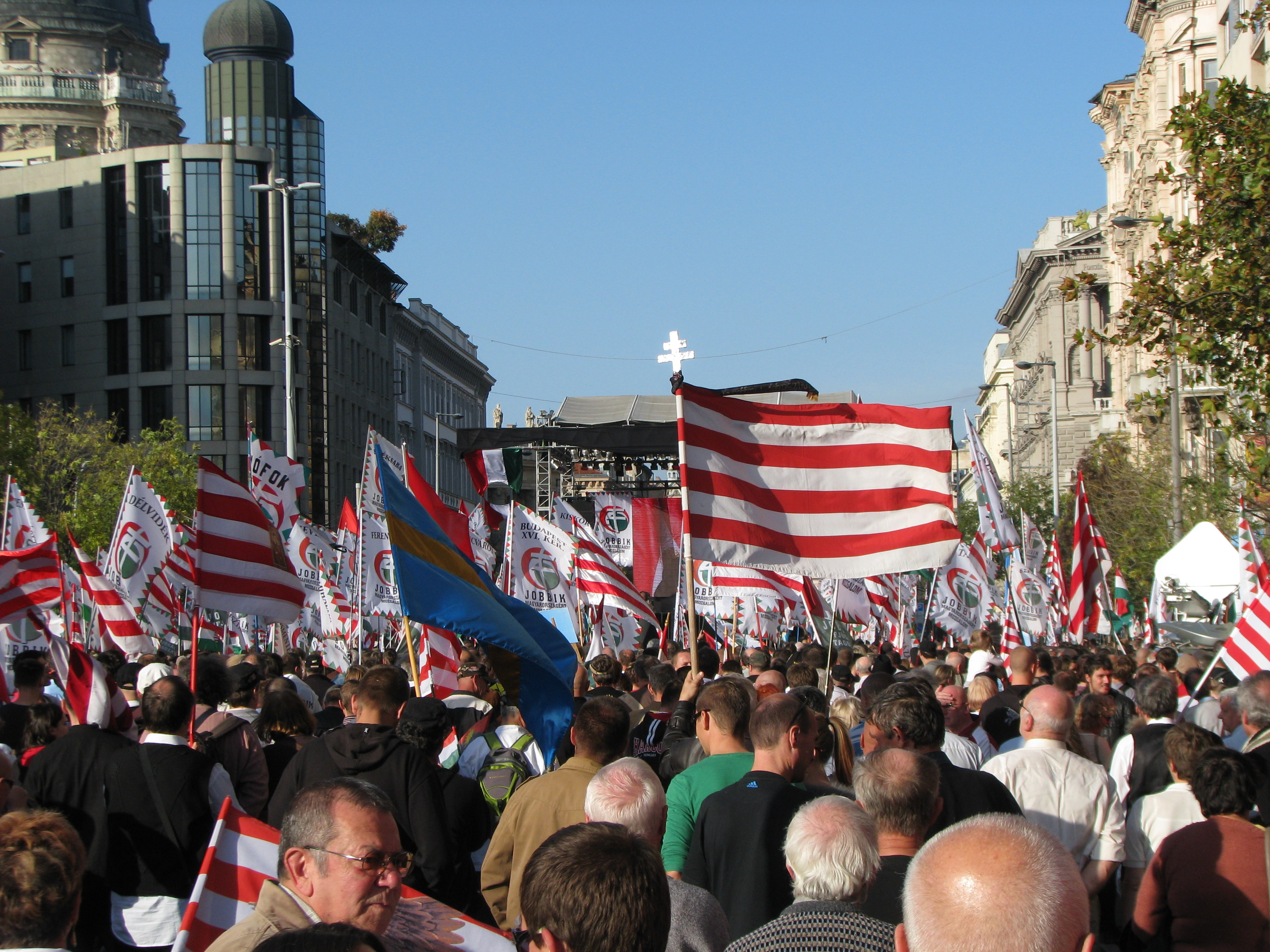
Orange Files then went to Deák Square to get a head count at the Jobbik demonstration: about 5,000, maybe 6,000 people under a forest of Árpád-striped and Jobbik flags, a few of them in black-and-white paramilitary uniforms of the New Hungarian Guard

Jobbik rally on Deák Square

Jobbik rally on Deák Square

Finally up Andrássy Avenue to hear the Orbán speech on Heroes’ Square. What a glorious fall day it was in Budapest, a warm wind blowing leaves across the avenue shut off to vehicle traffic and wide open to bicycles. However, the pro-government demonstration was so big that it stretched back down Andrássy Avenue nearly a half mile from the square. No hope of getting through the crowd to hear Orbán speak.

But it didn’t really matter. The main lesson of the day was not in the words of the various party leaders, but in the size of the crowds that showed up to hear them. Fidesz won this contest by a large margin, just as it will win the 2014 national elections by a large margin and maybe even gain another two-thirds majority in the National Assembly.

This is what the Hungarian people wants. And in spite of all the measures the Orbán administration has taken to curtail democracy and civil liberties in Hungary, the elections that bring it back to power will be free and fair, an accurate expression of national political will.

 This is what the people wants—good old fashioned Hungarian Christian-nationalism, the 21st-century version of the Horthy régime; this is what most Hungarian citizens will think they want right up until the day they realize (and not for the first time) that what they really want is to be part of the liberal-democratic West and not the authoritarian East. But by then it might be too late to turn back.

The events in Budapest on October 23 showed one thing very clearly: that in a state under the control of a skilled demagogue such as Prime Minister Orbán, the will of the common man can become the greatest enemy to the political system that is designed to serve him.

 ————————————————————————————————————————————-

Where Have all the Bums Gone?

Budapest eleventh-district homeless resident Johnny [Jánoska].

Budapest eleventh-district homeless resident Johnny (Jánoska).

It sure is nice not to have all the homeless people living around the eleventh district of Budapest anymore. They have no respect for their environment, they relieve themselves in the open, they leave empty bottles and other refuse behind them, they throw garbage all over the place when they rummage through trash cans. They are a real mess and  probably a health hazard. There used to be dozens of them living along the railroad embankment where people walk their dogs just down the street. One guy, whom locals claimed had tuberculosis, lived at the entry of the nearby main post office for several years, grumbling insanely at people as they walked past.

The Orbán government has got rid of them. Soon after Orbán came to power in 2010, the cops started checking their identity cards after nightfall and sending them away. Many men in blue standing around shriveled homeless people examining their IDs with a flashlight. Then the extended arm with the finger pointing. Then the shriveled men gather their bags and tramp off into the dark.

The government says that they are “lending them a helping hand” and sending them to stay the night in homeless shelters. But not even the government claims that there are enough beds in these shelters to accommodate all the homeless in Hungary. Official Central Statistics Office data from the year 2011 showed that there were 17,000 homeless people in the country, while civil society places this number at about 30,000. The government news agency MTI and civil society both estimate that there are about 8,000 homeless people living in Budapest.

Police conduct identity check on homeless men in the 11th district of Budapest.

Police conduct identity check on homeless men in the 11th district of Budapest.

According to everybody’s data, here are 5,500 beds in homeless shelters in Budapest and 5,000 beds in homeless shelters throughout the rest of Hungary. Thus between half and two-thirds of homeless people in the country do not have access to beds in homeless shelters. They have probably found places to spend the night where the cops do not harass them. One homeless man who used to live in the neighborhood can now be seen wandering around the tree- and shrub-lined streets at the foot of Gellért Hill. Some may have moved into camps at the periphery of the city, though the FideszChristian Democratic People’s Party (KDNP) administration appears to have razed many of these, such as those that used to lie along the Danube in southern Buda.

It will certainly become even harder for homeless people to find a place to stay now that Fidesz-KDNP has adopted an amendment to the Fundamental Law (the name of the party’s new constitution for Hungary) that makes it possible for municipal councils, such as that in the eleventh district of Budapest, to enact statutes banning the habitation of public spaces and punish violation of them as a Petty Offense entailing possible fines and imprisonment (see Orbán Government Homeless Policy).

It sure is nice not to have all the bums around. But one has to ask: where have they all gone? And more importantly, where will they go now that the constitution makes it possible to outlaw living on the street, yet there is not nearly enough capacity in homeless shelters to accommodate all of them?

See: photo gallery Homelessness in the Eleventh District of Budapest.

—————————————————————————————————————————————–

Testament to Weakness

IMG_2689About 1,500 people showed up to the square between the foot of Castle Hill and the head of the Chain Bridge in Budapest on Sunday, September 29, to watch one of Hungary’s many opposition groups pull down a model statue of Prime Minister Viktor Orbán.

The average age of the crowd was about 55. The rapper Dopeman was the master of ceremonies, while Together 2014 leader and former prime minister Gordon Bajnai and some other minor opposition figures gave speeches in which they castigated Orbán in roughly the same coarse language as the current prime minister used to castigate Gyurcsány and Bajnai when he was in opposition.

“The fish stinks from the head,” Bajnai said. Bajnai’s subsequent comparison of the Orbán government to the communists did not excite the audience members, many of whom were themselves presumably members of the Hungarian Socialist Workers’ Party. Several of the speakers used the Orbánian opposition mantra “they lie, they steal, they cheat” (hazudnak, lopnak, csalnak). Dopeman called Orbán a “pile of trash” (szemétláda). He also sang a version of the Hungarian national anthem interspersed with the refrain “Fuck the Government! Fuck Orbán!” (Bazd meg a kormányt! Bazd meg Orbánt!). The elderly crowd clapped politely after the number.

IMG_2694Toppling the roughly 12-foot statue, which was molded and painted very skillfully to represent the Stalin statue pulled down in Budapest at the beginning of the 1956 Hungarian Revolution, was the highlight of the event. The statue was erected on a protruding part of the exterior wall at the entry of the tunnel passing under Castle Hill. The neck and the legs above the heavy boots were cut most of the way through from behind so it would break at those places. Dopeman threw a coil of rope tied around the statue at the other end into the crowd among a bunch of old ladies who didn’t know what to do with it. The statue came down suddenly, the photo missed. Orff’s “O Fortuna” from Carmina Burana sounded dramatically from the PA system. The Orbán-Stalin head rolled along the pavement, right to Dopeman, who gave it hard football kick. The boots remained on the pedestal just as planned, just as in ’56. Men hoisted the headless torso onto a truck and led a procession across the Chain Bridge to the House of Terror, where they planned to deposit the broken statue.

See Index.hu video of falling Orbán statue. 

See Orange Files photo gallery of the event.

IMG_2699

—————————————————————————————————————————————–
In Márai’s Footsteps

Márai -1Sándor Márai, born in Kassa, Austria-Hungary (now Košice, Slovakia) in 1900, has been one of the most popular Hungarian writers both in Hungary and abroad since being (re)discovered following the fall of communism. He was one of the few 20th-century Hungarian thinkers and creators who managed to retain his intellectual independence amid the intense nationalist-internationalist polarization of politics in Hungary.

How was Márai able to preserve his independence of thought while nearly all of his peers failed?

He left the country.

Márai left Hungary along with his wife and adopted son through the final small opening in the Iron Curtain in August 1948, eventually moving to the United States, where he spent most of the remaining 40 years of his life writing in splendid isolation, far away from the uncompromising force of Hungarian politics. Márai was certainly not the only Hungarian writer to leave Hungary in search of creative freedom, though he was one of the few who had not lost his intellectual independence before leaving the country and did not cease to write important Hungarian literature after leaving the country. 

——

Márai distanced himself equally from both the nationalist Horthy régime that ruled Hungary from 1920 to 1944 and the communist Rákosi régime that seized power in the country in the years 1947–1948. The following excerpts from Márai’s 1943–1944 journal reveal his attitude toward the interwar Horthy régime, which he referred to as “neo-baroque fascism” (source in Hungarian): 

What happened here for 25 years? A confederation of interests in defense of feudal landed-estates, which under the pretense of Trianon prolonged for 25 years a system that oppressed and appropriated all quality endeavors with more and less delicate forms of terror. Everybody who could rightfully be suspected of wanting quality was a Jew or a suspected Jew or had a Jewish wife or was a decadent Anglophile and Francophile, Freemason and communist (source in Hungarian).  

And:

Over a period of 25 years—in a national, social and moral sense!—we wrote everything in only half-sentences; the other half of the sentence remained in the pen and in the nervous systems of the writers. That refined intellectual reign of terror which worked not with gallows and billy clubs, but for a quarter of a century conducted the concert of the Hungarian spirit with a wink and a wave from a signet-ringed functionary (source in Hungarian).  

Márai held the Horthy régime, not the Arrow Cross, to be primarily responsible for the ravages of war and persecution that afflicted Hungary during the Second World War as the following entry from his 1945 journal shows:

It is not true that the Arrow Cross is the chief culprit. The Arrow Cross was simply the result of all that this society did over the past 25 years so that it could validate itself without culture, morality or ability. The Arrow Cross horde is only as guilty as the Hungarian leadership class, which under the cloak of constitutionality shamelessly fanned and encouraged reaction of every type during the 25 years of Horthy (source in Hungarian).  

——

The following excerpts from Márai’s 1942 “Pamphlet on the Issue of National Education” and 1972 Memoir of Hungary reveal his attitude toward the communist system that established itself throughout eastern Europe following the Second World War:

The 20-year Soviet experiment has doubtlessly proven during this war that the strictest political education and the ruthless denial of all demands of individual life have built an enormous social and military organization in Mongolized Soviet-Russia. . . . Though it has also proven that this Bolshevik exertion also absorbs the entire content of individual life and deprives people of all the rewards and values of life, without which it ceases to have true meaning for the European man, whether he be a philosopher in Königsberg or a gutter cleaner in London (source in Hungarian).

And:  

An immense people turned the course of world history with dreadful sacrifice at Stalingrad. . . .and today I encountered one of the embodiments of this great power. For many, for those persecuted by the Nazis, this young Russian brought liberation of sorts, escape from Nazi terror. But he could not have brought liberty, because he doesn’t have any (source in Hungarian).

Márai realized that he had to leave Hungary in order to preserve his freedom of thought and creation after the Hungarian Workers’ Party established a one-party dictatorship during the summer of 1948. Márai wrote the following with regard to his decision to emigrate in his 1944-1948 Memoir of Hungary:

I’ve got to leave this beautiful, sad, smart and colorful city, Budapest, because if I stay I will drift into the aggressive stupidity that surrounds me here. And I must take  with me from here something which is perhaps an obsession: the “ego,” the personality of which there is only one copy (source in Hungarian).

And: 

This was the time when I realized I would have to leave my country; I had to leave it not just because the Communists would not let me write freely, but mainly and even much more so because they would not let me be silent freely (source in English).

——

The question is: when are the contemporary equivalents of Márai, Hungarian writers, artists and intellectuals who want to retain their freedom of thought and creation amid the stifling authoritarian mendacity of the Orbán II era, going to follow his footsteps?  

—————————————————————————————————————————————–