Where Have all the Bums Gone?

Budapest eleventh-district homeless resident Johnny [Jánoska].

Budapest eleventh-district homeless resident Johnny (Jánoska).

It sure is nice not to have all the homeless people living around the eleventh district of Budapest anymore. They have no respect for their environment, they relieve themselves in the open, they leave empty bottles and other refuse behind them, they throw garbage all over the place when they rummage through trash cans. They are a real mess and  probably a health hazard. There used to be dozens of them living along the railroad embankment where people walk their dogs just down the street. One guy, whom locals claimed had tuberculosis, lived at the entry of the nearby main post office for several years, grumbling insanely at people as they walked past.

The Orbán government has got rid of them. Soon after Orbán came to power in 2010, the cops started checking their identity cards after nightfall and sending them away. Many men in blue standing around shriveled homeless people examining their IDs with a flashlight. Then the extended arm with the finger pointing. Then the shriveled men gather their bags and tramp off into the dark.

The government says that they are “lending them a helping hand” and sending them to stay the night in homeless shelters. But not even the government claims that there are enough beds in these shelters to accommodate all the homeless in Hungary. Official Central Statistics Office data from the year 2011 showed that there were 17,000 homeless people in the country, while civil society places this number at about 30,000. The government news agency MTI and civil society both estimate that there are about 8,000 homeless people living in Budapest.

Police conduct identity check on homeless men in the 11th district of Budapest.

Police conduct identity check on homeless men in the 11th district of Budapest.

According to everybody’s data, here are 5,500 beds in homeless shelters in Budapest and 5,000 beds in homeless shelters throughout the rest of Hungary. Thus between half and two-thirds of homeless people in the country do not have access to beds in homeless shelters. They have probably found places to spend the night where the cops do not harass them. One homeless man who used to live in the neighborhood can now be seen wandering around the tree- and shrub-lined streets at the foot of Gellért Hill. Some may have moved into camps at the periphery of the city, though the FideszChristian Democratic People’s Party (KDNP) administration appears to have razed many of these, such as those that used to lie along the Danube in southern Buda.

It will certainly become even harder for homeless people to find a place to stay now that Fidesz-KDNP has adopted an amendment to the Fundamental Law (the name of the party’s new constitution for Hungary) that makes it possible for municipal councils, such as that in the eleventh district of Budapest, to enact statutes banning the habitation of public spaces and punish violation of them as a Petty Offense entailing possible fines and imprisonment (see Orbán Government Homeless Policy).

It sure is nice not to have all the bums around. But one has to ask: where have they all gone? And more importantly, where will they go now that the constitution makes it possible to outlaw living on the street, yet there is not nearly enough capacity in homeless shelters to accommodate all of them?

See: photo gallery Homelessness in the Eleventh District of Budapest.

—————————————————————————————————————————————–

Testament to Weakness

IMG_2689About 1,500 people showed up to the square between the foot of Castle Hill and the head of the Chain Bridge in Budapest on Sunday, September 29, to watch one of Hungary’s many opposition groups pull down a model statue of Prime Minister Viktor Orbán.

The average age of the crowd was about 55. The rapper Dopeman was the master of ceremonies, while Together 2014 leader and former prime minister Gordon Bajnai and some other minor opposition figures gave speeches in which they castigated Orbán in roughly the same coarse language as the current prime minister used to castigate Gyurcsány and Bajnai when he was in opposition.

“The fish stinks from the head,” Bajnai said. Bajnai’s subsequent comparison of the Orbán government to the communists did not excite the audience members, many of whom were themselves presumably members of the Hungarian Socialist Workers’ Party. Several of the speakers used the Orbánian opposition mantra “they lie, they steal, they cheat” (hazudnak, lopnak, csalnak). Dopeman called Orbán a “pile of trash” (szemétláda). He also sang a version of the Hungarian national anthem interspersed with the refrain “Fuck the Government! Fuck Orbán!” (Bazd meg a kormányt! Bazd meg Orbánt!). The elderly crowd clapped politely after the number.

IMG_2694Toppling the roughly 12-foot statue, which was molded and painted very skillfully to represent the Stalin statue pulled down in Budapest at the beginning of the 1956 Hungarian Revolution, was the highlight of the event. The statue was erected on a protruding part of the exterior wall at the entry of the tunnel passing under Castle Hill. The neck and the legs above the heavy boots were cut most of the way through from behind so it would break at those places. Dopeman threw a coil of rope tied around the statue at the other end into the crowd among a bunch of old ladies who didn’t know what to do with it. The statue came down suddenly, the photo missed. Orff’s “O Fortuna” from Carmina Burana sounded dramatically from the PA system. The Orbán-Stalin head rolled along the pavement, right to Dopeman, who gave it hard football kick. The boots remained on the pedestal just as planned, just as in ’56. Men hoisted the headless torso onto a truck and led a procession across the Chain Bridge to the House of Terror, where they planned to deposit the broken statue.

See Index.hu video of falling Orbán statue. 

See Orange Files photo gallery of the event.

IMG_2699

—————————————————————————————————————————————–

In Márai’s Footsteps

Márai -1Sándor Márai, born in Kassa, Austria-Hungary (now Košice, Slovakia) in 1900, has been one of the most popular Hungarian writers both in Hungary and abroad since being (re)discovered following the fall of communism. He was one of the few 20th-century Hungarian thinkers and creators who managed to retain his intellectual independence amid the intense nationalist-internationalist polarization of politics in Hungary.

How was Márai able to preserve his independence of thought while nearly all of his peers failed?

He left the country.

Márai left Hungary along with his wife and adopted son through the final small opening in the Iron Curtain in August 1948, eventually moving to the United States, where he spent most of the remaining 40 years of his life writing in splendid isolation, far away from the uncompromising force of Hungarian politics. Márai was certainly not the only Hungarian writer to leave Hungary in search of creative freedom, though he was one of the few who had not lost his intellectual independence before leaving the country and did not cease to write important Hungarian literature after leaving the country. 

——

Márai distanced himself equally from both the nationalist Horthy régime that ruled Hungary from 1920 to 1944 and the communist Rákosi régime that seized power in the country in the years 1947–1948. The following excerpts from Márai’s 1943–1944 journal reveal his attitude toward the interwar Horthy régime, which he referred to as “neo-baroque fascism” (source in Hungarian): 

What happened here for 25 years? A confederation of interests in defense of feudal landed-estates, which under the pretense of Trianon prolonged for 25 years a system that oppressed and appropriated all quality endeavors with more and less delicate forms of terror. Everybody who could rightfully be suspected of wanting quality was a Jew or a suspected Jew or had a Jewish wife or was a decadent Anglophile and Francophile, Freemason and communist (source in Hungarian).  

And:

Over a period of 25 years—in a national, social and moral sense!—we wrote everything in only half-sentences; the other half of the sentence remained in the pen and in the nervous systems of the writers. That refined intellectual reign of terror which worked not with gallows and billy clubs, but for a quarter of a century conducted the concert of the Hungarian spirit with a wink and a wave from a signet-ringed functionary (source in Hungarian).  

Márai held the Horthy régime, not the Arrow Cross, to be primarily responsible for the ravages of war and persecution that afflicted Hungary during the Second World War as the following entry from his 1945 journal shows:

It is not true that the Arrow Cross is the chief culprit. The Arrow Cross was simply the result of all that this society did over the past 25 years so that it could validate itself without culture, morality or ability. The Arrow Cross horde is only as guilty as the Hungarian leadership class, which under the cloak of constitutionality shamelessly fanned and encouraged reaction of every type during the 25 years of Horthy (source in Hungarian).  

——

The following excerpts from Márai’s 1942 “Pamphlet on the Issue of National Education” and 1972 Memoir of Hungary reveal his attitude toward the communist system that established itself throughout eastern Europe following the Second World War:

The 20-year Soviet experiment has doubtlessly proven during this war that the strictest political education and the ruthless denial of all demands of individual life have built an enormous social and military organization in Mongolized Soviet-Russia. . . . Though it has also proven that this Bolshevik exertion also absorbs the entire content of individual life and deprives people of all the rewards and values of life, without which it ceases to have true meaning for the European man, whether he be a philosopher in Königsberg or a gutter cleaner in London (source in Hungarian).

And:  

An immense people turned the course of world history with dreadful sacrifice at Stalingrad. . . .and today I encountered one of the embodiments of this great power. For many, for those persecuted by the Nazis, this young Russian brought liberation of sorts, escape from Nazi terror. But he could not have brought liberty, because he doesn’t have any (source in Hungarian).

Márai realized that he had to leave Hungary in order to preserve his freedom of thought and creation after the Hungarian Workers’ Party established a one-party dictatorship during the summer of 1948. Márai wrote the following with regard to his decision to emigrate in his 1944-1948 Memoir of Hungary:

I’ve got to leave this beautiful, sad, smart and colorful city, Budapest, because if I stay I will drift into the aggressive stupidity that surrounds me here. And I must take  with me from here something which is perhaps an obsession: the “ego,” the personality of which there is only one copy (source in Hungarian).

And: 

This was the time when I realized I would have to leave my country; I had to leave it not just because the Communists would not let me write freely, but mainly and even much more so because they would not let me be silent freely (source in English).

——

The question is: when are the contemporary equivalents of Márai, Hungarian writers, artists and intellectuals who want to retain their freedom of thought and creation amid the stifling authoritarian mendacity of the Orbán II era, going to follow his footsteps?  

—————————————————————————————————————————————–

Easy as Pie

New PieThe dynamic that drives Hungarian politics is simple.  

Hungary’s population is divided into two political tribes of roughly equal size and strength: the nationalists and the internationalists. There is very little migration between them. 

Hungary’s economy is like a pie that always remains about the same size. It is too small if divided equally to provide the entire population with a comfortable subsistence.  

Both the nationalist tribe and the internationalist tribe always possess one-third of this pie.  The dominant tribe gains possession of the remaining third. They never share.  

Hungarian politics is the manifestation of the battle between the two tribes for the contested third of the pie.  

————————————————————————————————————————————-

Marching to Praetoria

TEK officer responding to false alarm at the Budapest Technical University in September 2012.

TEK officer responding to false alarm at the Budapest Technical University in September 2012.

On August 26, the Counter Terrorism Center (TEK) announced that it would extend until September 25 at the latest the closure imposed three days previously of the street where Prime Minister Viktor Orbán lives in Budapest (source in Hungarian). Though TEK specifically mentioned neither Orbán by name nor the grounds for closing off the area, the agency presumably did so in order to prevent groups advocating further government action to help foreign-currency debtors from repeating earlier attempts to demonstrate outside the prime minister’s house.

What are the differences between TEK and conventional secret services?

TEK operates not only as a security service protecting the prime minister, the president, their families, foreign dignitaries and other political officials, but as a special weapons and tactics (SWAT) agency that goes after pimps, drug dealers, bank robbers, hostage takers, murderers and, presumably, terrorists.

TEK officers wear helmets and body armor, not dark glasses and suits, and carry exposed submachine guns, not concealed weapons.

TEK needs permission only from the Orbán government’s Interior Minister or Minister of Justice and Public Administration to conduct searches and surveillance—it does not need to obtain authorization from a court (source in English).

The Orbán régime established TEK a few months after coming to power in May 2010. Orbán’s predecessors maintained only light personal security of the standard plain-clothes variety. The author passed within one meter of Ferenc Gyurcsány on several occasions while he was serving as prime minister (see short Orange Files video). TEK would not permit any unknown person to come anywhere near Prime Minister Orbán.  

The head of the organization is Orbán’s longtime bodyguard János Hajdú (source in Hungarian).

This is the third time over the past nine months and the second time this summer that the Counter Terrorism Center has sealed off the area around Orbán’s residence at the foot of the Buda Hills. One can expect TEK’s role of providing personal protection for the prime minister to become increasingly prominent as he heads into his next term in office. 

—————————————————————————————————————————————–

Butting Heads with the Wonder Deer

A late-summer garden party in a town on the outskirts of Budapest. 

250px-Csodaszarvas.svgA middle-aged couple standing under an apple tree in the half dark, away from the row of tables where the other guests are eating stew prepared in a bogrács, a traditonal Hungarian cooking pot. 

She: Did you see what Éva is wearing? How tacky. It reminds me of Republican taste in the United States. 

He: I’ve got to think that from an intelligent person like her it must be intentional. You know, the principle that something that is in really poor taste actually becomes beautiful again. The part I didn’t like was the Wonder Deer [Csodaszarvas] hanging on her neck. 

She: That part didn’t bother me. I really love ancient symbolism. 

He: The problem is who else really loves it. The anti-Semitic, anti-Gypsy, anti-West, anti-democracy, anti-capitalist people. They have taken these ancient Hungarian symbols,  yurts and archery and horses, and made them into something ugly. 

She: I don’t care. For me they don’t mean those things. 

He: Maybe for you they don’t, but for me and I would dare to say most Hungarians they do, whether they approve of those things or not. 

She: That is what I hate about politics. It ruins everything. 

They look at one another coldly. One of those reemerging disagreements. 

Note: The Wonder Deer is an animal from the mythology of the ancient Hungarians and other central Asian peoples.


csodaszarvas(2)

—————————————————————————————————————————————–

One Man’s Plaything

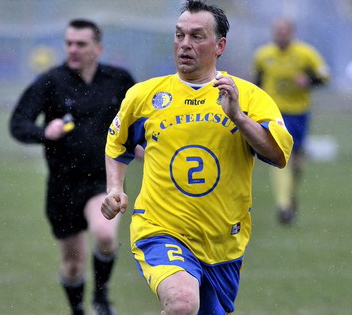
The FC Felcsút forward.

The FC Felcsút striker.

Prime Minister Viktor Orbán is building a football paradise around his home in Felcsút (population 1,789), the village where he grew up about 30 kilometers west of Budapest.

The prime minister’s enthusiasm for the game is legendary in Hungary: he played organized football as a hard-driving forward from the age of eleven, when he joined the local FC Felcsút team, until leaving college and launching his political career with Fidesz in 1988. He rejoined FC Felcsút during his first period as prime minister in 1999, taking the field for the division-two club on occasion until hanging up his cleats permanently at the age of 41 in 2005. Two years later, Orbán founded the Ferenc Puskás Football Academy (Puskás Ferenc Labdarúgó Akadémia), a live-in school offering academic instruction and intensive football training for 50 to 60 talented young Hungarian players on a sprawling complex of fields located right across from his weekend house in the village.

The academy’s team, Puskás Academy FC, (Puskás Akadémia FC), currently competes in division one of the Hungarian national football league against teams from Budapest, Debrecen, Miskolc, Pécs and other big cities in Hungary after receiving promotion from division two at the end of the 2012–2013 season. Felcsút mayor and businessman Lőrinc Mészáros, an Orbán ally who serves as president of the foundation that runs the Ferenc Puskás Football Academy, is having a new, 3.8-billion-forint (12.75-million-euro) stadium built for the team, 70 percent of which he is financing from revenue derived from corporate-tax deductions on donations (source in Hungarian) to five major team sports made possible through a law the FideszChristian Democratic People’s Party-controlled National Assembly passed in 2011 (note 1). The stadium will have seating capacity of 3,500, double the population of the village in which it is being built.  

Fő Street, Felcsút: Football academy building (background); prime minister's house, shed and gazebo (left); and the Golden Team Football Stadium (under construction, right).

Fő Street, Felcsút: Football academy building (background); prime minister’s house, shed and gazebo (left); and the Golden Team Football Stadium (under construction, right).

Orbán has two passions in life: politics and football. He is living his political dream right now as the most internally powerful leader of a country in Europe since the fall of communism. In establishing a football academy with a top-flight team and a state-of-the-art stadium right across the street from the house and stretch of land he owns in his home village, he is preparing to live his football dream after the inevitable end of his political career. The prime minister is exploiting his position as the all-powerful leader of Hungary to realize this dream, attracting donations (source in Hungarian) from prosperous companies (list in Hungarian) in order to finance the operations of the Ferenc Puskás Football Academy and, through his local political crony, using money that would otherwise flow into the state treasury to build a UEFA-compatible stadium for the academy’s professional team.

In doing so, Orbán is reflecting his fundamental attitude—one which is nearly universal among autocrats—that the country he leads is his plaything to be used as he sees fit.

notes

1- On June 27, 2011, the National Assembly approved a law that permitted companies to write off up to seventy percent of their corporate taxes in the form of donations to associations conducting activities in one of five team sports—football (soccer), basketball, hockey, handball or water polo. 

—————————————————————————————————————————————–

Mass Mobilization 101

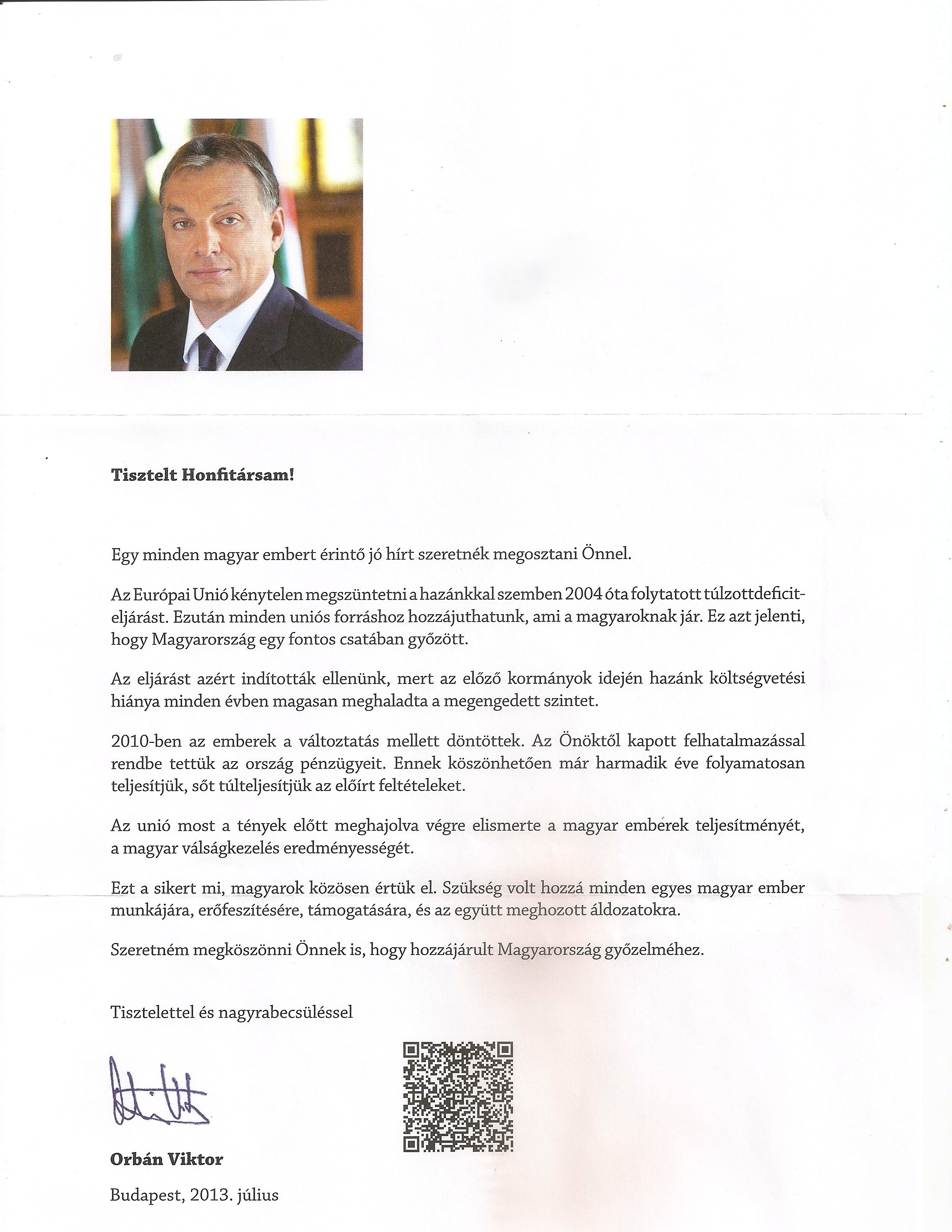
Orbán's newest letter.

Orbán’s newest letter.

Citizens of Hungary have this week received another letter from Viktor Orbán, the sixth the prime minister has sent to all adults in the country over the past three years as part of his government’s National Consultation [Nemzeti Konzultáció] campaign. This letter informs them of “Hungary’s victory” in the “battle” to have the European Union lift the Excessive Deficit Procedure that had been in place against Hungary since the country joined the European Union in 2004.  Below is an Orange Files translation of the letter: 

Dear Compatriots!

I would like to share with you good news affecting all Hungarian people.

The European Union has been obliged to lift the Excessive Deficit Procedure it has maintained against our homeland since 2004. We therefore have access to all EU funding due to Hungarians. This means that Hungary was victorious in an important battle.  

The EU launched the procedure against us, because our homeland’s budget deficit significantly exceeded the permitted level every year at the time of the previous governments.

People decided in favor of change in 2010. With your mandate we have put the country’s financial affairs in order. As a result, we have met, in fact exceeded, stipulated conditions for the last three years.

The EU has bowed before the facts and finally recognized the achievements of the Hungarian people and the effectiveness of Hungarian crisis management.

We, Hungarians, have accomplished this success together. The work, effort, support and common sacrifice of every single Hungarian person was necessary for this.

I would like to thank you as well for contributing to Hungary’s victory.

With Regards and Esteem,

Viktor Orbán

Budapest, July 2013

The explicit message of this letterPrime Minister Orbán has led the Hungarians to victory in battle against a powerful foreign adversary. 

The implicit message of this letter: Hungarians should continue to support their leader, because there are more such battles to be fought in the future. 

The fundamental claim of this letter: The European Union was arbitrarily refusing to recognize that Hungary had satisfied the EU requirement for members states to have a government deficit of less than three percent of GDP. 

The reality not expressed in this letter: The European Union was not disputing the fact that Hungary’s government deficit had fallen below three percent of GDP, but the sustainability of the means used to bring it below the required level. 

The literal cost of this letter: 140 forints per letter, sent via priority mail to all adult citizens in a country of ten-million people. The online news website Index.hu has calculated that the twelve previous letters the government dispatched as part of the National Consultation, including six sent to targeted groups of citizens, cost Hungarian taxpayers around 3.3 billion forints (11.1 million euros). 

The figurative cost of this letter: another authoritarian blow to the crumbling edifice of liberal democracy in Hungary. 

—————————————————————————————————————————————–

Cracks in the Monolith

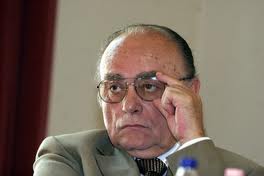
József Ángyán

József Ángyán

Over the past few weeks, two Fidesz legislators and one powerful, pro-Fidesz businessman have come into open conflict with the Orbán government over its recent moves to further increase its direct and indirect command over Hungary’s economy.

On June 21, Fidesz National Assembly representative József Ángyán withdrew from the party’s parliamentary caucus to sit with legislative independents after his fellow caucus members adopted a new Land Law that Ángyán said would preserve the hold of major capital interests and party-affiliated “maffias” over agricultural property in Hungary to the exclusion of local farmers. Speaking to the news website FN24.hu after announcing that he was leaving Fidesz, Ángyán said “I hope that an honest third platform comes into being. They say that there are no other possibilities—either Orbán or the Bajnai-Mesterházy group. In truth, a mafia network is pulling the strings in the background, while in the foreground morning and afternoon political-shifts replace one another. An alliance composed of honest people needs to rise up instead. Those who have taken part in government since 1990 cannot be considered, because they are all tarnished, they have all become intertwined.”

Ángyán had long been the only member of the Orbán administration who dared to raise his voice against its construction of a Fidesz oligarchy exercising ever-greater control over political and economic life in Hungary. In January 2012, he left his post as Rural Development Ministry state secretary, telling his supporters after a month-long period of silence that he had resigned because “a coalition of greedy, plundering economic interest-groups, not to say ‘maffia families,’ speculative capitalist ‘oligarchs‘ and major land-owning ‘green barons‘” had emerged to prevent implementation of the ministry’s program to help small independent farmers acquire agricultural land. Ángyán confirmed reports in the media that Prime Minister Orbán had angrily told him he would not have him kicked out of the Fidesz National Assembly caucus, because he did not want to do him the favor of making him into a martyr. 

Sándor Demján

Sándor Demján

On June 26, construction magnate Sándor Demján, one of the wealthiest and most influential people in Hungary and previously an open supporter of Fidesz (source in Hungarian) , wrote a letter to Prime Minister Viktor Orbán stating that the de facto nationalization of the country’s savings cooperatives announced two days previously “violates the protection of private property, the freedom of enterprise and the conditions regarding fair competition contained in Hungary’s Fundamental Law.” On July 5, Demján, who serves as the head of the National Savings Cooperative Association (OTSZ) representing most of the roughly 135 savings cooperatives operating in Hungary, said at a press conference that nationalization of the cooperatives “opens the way for interest groups to appropriate the profit center.” Demján said that OTSZ would seek legal redress for the law “integrating” the cooperatives within every Hungarian and, if necessary, European forum.

On June 27, Fidesz local council member Ákos Hadházy from the town of Szekszárd announced that he was leaving the party because the government had failed to properly investigate his claim that the state-owned company overseeing the process of granting 6,700 concessions for the retail sale of tobacco in Hungary under a state monopoly had selected the winning bids based on family connections and political allegiance to Fidesz rather than non-partisan economic and business considerations.  

Ákos Hadházy

Ákos Hadházy

Hadházy broke the so-called “tobacco shop scandal” during an April 30 interview with the online version of the weekly HVG in which he claimed that Fidesz National Assembly representative and Szekszárd Mayor István Horváth had gone over a list of local tobacco-concession bidders with local-council members from the party during a private meeting in order to determine which of the bidders were sufficiently loyal to Fidesz to be selected as winners. Following the expected denials, HVG published audio recordings in which Horváth is heard to say while examining the list that “one must be a committed right-winger” and “good, good, don’t let the socialists win!” 

Shortly thereafter, in one of his regular Friday-morning interviews with state-run Kossuth Radio, Prime Minister Viktor Orbán flatly rejected the notion that politics had played a role in selecting the winning bids to open the so-called National Tobacco Shops, though noted that “We will never turn our backs on our own supporters.” The prime minister then posed the rhetorical question: “Why would it be a problem for that matter if entrepreneurs who subscribe to our value system win if they submit suitable bids in the tenders?”  

Hadházy told HVG that he decided to reveal the pro-Fidesz political bias in the selection of tobacco concessions in Szekszárd because “I came to the conclusion that I am doing the best for Fidesz over the long run if I say these things. Over the short run it is certainly unpleasant, its popularity could fall by a couple of percent, but I think that this is what can help the party over the long run.” Hadházy added that “The Fidesz membership is disciplined and I think that the unity of the right wing is valuable, though it has moved beyond a certain point. Debate, either due to a lack of time or for some other reason, does not take place and that is very bad.” In another interview with HVG after withdrawing from Fidesz, Hadházy compared the process of establishing the government monopoly on the retail sale of tobacco to the nationalization of Hungary’s economy following the Second World War: “I could make the very grave historical parallel that the communists took the homes of people considered to be class enemies and gave them to others.” In reference to Prime Minister Orbán’s comments on Kossuth Radio regarding the criteria that had been used to determine the winning bids to open National Tobacco Shops, Hadházy continued “Comrade Rákosi, if he would have given a Friday radio interview, would have also certainly said that ‘we cannot turn our backs on our own people.’” 

—————————————————————————————————————————————–

The Cardboard Men

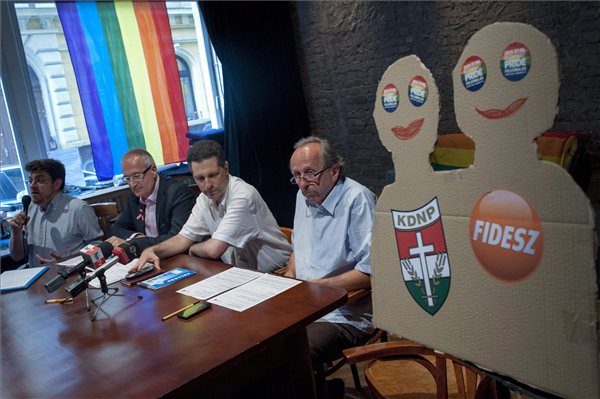
cardboard men

Representatives from the Fidesz-KDNP coalition (right) attend roundtable discussion on gay rights in Hungary.

The 2013 Budapest Pride gay parade was held on July 6 amid tight security, as it has since radical right-wing demonstrators severely disrupted the event in 2007 and 2008. For the past five years, the Budapest Police has prevented protesters from assaulting Budapest Pride procession by stationing riot cops at heavy security fence erected on cross streets one block on either side of the parade route along its entire length. One can gain access to the parade only by passing through a security checkpoint at the beginning of the route on Heroes‘ Square. Otherwise, one cannot get closer than a football field in length to the parade as it proceeds down Andrássy Avenue to the center of the city. There have been progressively fewer and fewer demonstrators heckling paraders from afar under this hermetically sealed security arrangement. Only a couple of hundred right-wing protesters showed up for this year’s Budapest Pride procession, most of them belonging to a new radical nationalist group that calls itself Guards of the Carpathian Homeland (Kárpát Haza Őrei).

The Budapest Pride parade is a microcosm of the overall status of homosexuality in Hungary: tolerated, though only in sterile isolation from the heterosexual world and to a lesser degree since Prime Minister Viktor Orbán started pulling the political strings in Hungary as opposition leader more than six years ago. The Fundamental Law that Orbán and the FideszChristian Democratic People’s Party (KDNP) administration adopted after coming to power in 2010 stipulates that marriage must be between a man and a woman, thus making Hungary the fifth European Union member state following Poland, Bulgaria, Latvia and Lithuania to constitutionally ban, by exclusion, same-sex marriage. (A sixth European Union member state, Romania, prohibits same-sex marriage in the country’s civil code.) Fidesz declined to participate in any of the Budapest Pride week events to which it was invited, sending nobody to represent the party at a roundtable discussion on gay rights in Hungary or to march in the annual parade.

Fidesz’s official stand on homosexuality is one of cold neutrality. A party communiqué to the news website Index.hu stated that “Homosexuality is a private affair that Fidesz does not want to make into a public affair. In connection to Budapest Pride, everybody has the right to participate in the event, just as they have a right to not participate in it.” In response to a question from the news website 444.hu whether Fidesz supported the Budapest Pride parade, party Communications Director Máté Kocsis said “Fidesz has no opinion on this question. I have not conducted a poll regarding who is going and who is not. Everybody will decide for themselves. I, myself, am not going to participate.” Asked about news that  Budapest Pride organizers planned to present him with a rainbow flag to fly temporarily outside city hall, de facto Fidesz Budapest Mayor István Tarlós said that “It would be better if they would refrain from this open provocation, because the mayor does not have the ways and means of placing this flag on city hall.” Tarlós earlier in the week pretended not to know what Budapest Pride was when a reporter from 444.hu asked him a question about the event. After being told what it was, he answered “I stand on the other side.”

Both Mayor Tarlós and Prime Minister Orbán declined invitations to participate in the Budapest Pride parade. This is understandable from a political point of view. Under the conditions of extreme political polarization that exist in Hungary, for them to attend an event that in political terms has traditionally been identified with the Budapest liberal élite would signify a concession to the opponent. Moreover, it would drive a certain number of Fidesz voters into the arms of the radical right-wing nationalist Jobbik party, which announced this week that if it ever comes to power it will ban Budapest Pride and other “deviant, provocative, exhibitionist programs.” However, in this instance Fidesz could still have sent lesser party representatives, even non-official known sympathizers, to attend the Budapest Pride events to which it was invited. Instead, only feigned ignorance, haughty standoffishness and rigidly noncommittal communiqués.

Throughout much of western Europe and North America national and city government officials openly support gay-pride events, often marching at the head of gay parades. Hungary, though a more traditional eastern European country, appeared to be proceeding in this direction during the first decade of Budapest Pride, which started in earnest in 1997. The reversal of progress in the area of gay rights in Hungary over the past seven years fits squarely into the overall pattern of democratic regression that has taken place in the country over that period.

See Orange Files photo gallery of 2013 Budapest Pride parade. 

Gay Parade Post Photo


See Orange Files photo gallery of 2007 and 2008 Budapest Pride parades.

Post Photo Gay Parade-2


—————————————————————————————————————————————–