Swallowing the Frog

Orbán the Bullshitter

Prime Minister Orbán speaking to the National Assembly on July 4, 2013.

The Orbán government reacted in predictable fashion to the European Union’s July 3 approval of the Tavares Report criticizing it for undermining fundamental democratic rights in Hungary: the EU doesn’t really object in principle to what we are doing, but is engaging in petty party politics at the bidding of corporate lobbyists who want to get back at us for reducing exorbitant company profits to the benefit of the people.

Speaking at a session of the National Assembly on July 4, Prime Minister Viktor Orbán said that the Tavares report is “unjust” and “hostile toward Hungarians” and that it “gravely insults Hungary” and “violates Hungary’s sovereignty.” Orbán also called the European Union “unjust” and accused the EU of “applying a double standard” toward Hungary and “abusing its power.” He claimed that corporate interests had instigated the report as a means of countering the government’s utility-fee cuts, which harmed the interests of European corporations that “for years collected as much money as they could from Hungarian families.”

Speaking during one of his regular Friday-morning interviews on state-run Kossuth Radio on July 5, Orbán asserted that the Tavares Report was a “left-wing action” taken against the government because it had written a constitution that “is not liberal” and because European left-wing parties “cannot swallow the frog” (literal translation of a Hungarian idiom meaning “to swallow the bitter pill”) of Fidesz’s landslide election victory over the Hungarian Socialist Party in 2010. The prime minister said that these left-wing parties are intertwined with “capital interests” that are attempting to reverse the government’s bank tax and utility-fee cuts. Orbán claimed that “Not since the Soviet Union existed has any outside force had the audacity to openly, choosing a legal form, limit the independence of Hungarians.”

Later on July 5, FideszChristian Democratic People’s Party (KDNP) National Assembly representatives approved a resolution submitted by Fidesz caucus leader Antal Rogán and two others entitled “On the Equal Treatment due to Hungary.” Representatives from the Hungarian Socialist Party and Politics Can Be Different boycotted the vote on the resolution, while the six representatives present from the Democratic Coalition and Dialogue for Hungary voted against it. Only Fidesz-KDNP representatives voted to approve document, which speaks in the name of the entire nation. The following is an Orange Files translation of the resolution (source in Hungarian):

We Hungarians joined the family of European nations more than one-thousand years ago with the foundation of the state and the adoption of Christianity.

We Hungarians have stood up for European values on many occasions.

There were times when we defended these values with our blood in the face of external attacks. In 1956 we took up arms against the communist dictatorship. In 1989 we contributed to the reunification of Europe through the dismantling of the Iron Curtain.

We Hungarians joined the European Union of our own free will.

We did this in the hope that we had joined a community standing on the foundation of law,  justice and freedom.

We Hungarians do not want a Europe in which freedom is limited and is not permitted to develop to its fullest. We do not want a Europe in which the stronger abuses its power, in which the sovereignty of nations is violated and in which the smaller must honor the bigger.

We had enough of dictates in the forty years spent behind the Iron Curtain.

We Hungarians have always honored the initiative of competent European Union institutions to engage in dialogue and have always been prepared to come to agreements conceived in the spirit of reason.

It is for this reason that we rightfully desire the respect and equal treatment due to Hungary from the institutions of the European Union.

We expect the European Union to honor the rights accorded to us following our accession just as it does with regard to every member state.

The Hungarian National Assembly voices its astonishment that the European Parliament adopted a resolution that it had no right to adopt and with which the European Parliament overstepped the boundaries of its authority. It arbitrarily establishes demands, arbitrarily introduces new procedures and creates new institutions that violate Hungary’s sovereignty as stipulated in the fundamental treaty of the European Union.

In this way the European Parliament is going against European values and placing the European Union on a dangerous path.

The fact that business interests are behind this abuse of power afflicting Hungary gives cause for further worry.

Hungary is decreasing the price of energy used by Hungarian families. This may harm the interest of several major European corporations, which used their monopolies to generate extra profit in Hungary for many years on end. It is unacceptable that the European Parliament is attempting to place pressure on our homeland in the interest of these major corporations.

The Hungarian National Assembly considers it dangerous for all of Europe if business interests are able to assert themselves without impediment within the European Union and are able to supersede the provisions of the fundamental treaty.

Today we approve a resolution aimed at defending Hungary’s sovereignty and the equality of Hungarian people within Europe.

We ask the government of Hungary not to yield to the pressure of the European Union, not to permit the rights guaranteed to the country in the fundamental treaty to be impaired and to continue the policies that serve to make the lives of Hungarian families easier.

The Orbán government’s claim that the European Parliament approved the Tavares Report at the behest of large energy companies seeking to reverse the government-imposed utility-fee cuts is especially absurd in light of the fact that the EP commissioned the report on February 16, 2012, more than nine months before Fidesz announced the mandatory ten-percent reduction in the price of household gas and electricity.

—————————————————————————————————————————————–
Fill in the Blanks

nagybeszed_n294_116287

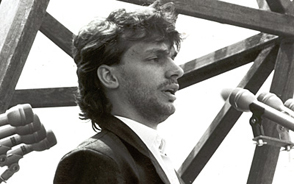
Viktor Orbán speaking on June 16, 1989.

Twenty-five years ago this week, on June 16, 1989, Prime Minister Viktor Orbán, then the spirited leader of the liberal, anti-communist Alliance of Young Democrats (now a conservative, Christian-nationalist party known only by its acronym Fidesz), gave a speech at the reburial of 1956 revolutionary Prime Minister Imre Nagy on Heroes’ Square in Budapest that vaulted him into the center stage of Hungarian politics, a position that he has occupied ever since. This is an Orange Files translation of that speech (video of speech in Hungarian):    

My Fellow Citizens! 

Since the beginning of the Russian occupation and the communist dictatorship 40 years ago, Hungarian people once had an opportunity, once had adequate courage and strength to attempt to reach the objectives articulated in 1848: national independence and political freedom. To this day our goals have not changed, today we still have not relented on ’48, just as we have not relented on ’56 either.  

Those young people who today are fighting for the establishment of liberal democracy in Hungary bow their heads before the communist Imre Nagy and his associates for two reasons. We honor them as statesmen who identified with the will of Hungarian society, who in order to do this were able to relinquish their holy communist taboos, that is, the unquestioned service of the Russian empire and the dictatorship of the party. For us, they are statesmen who even in the shadow of the gallows refused to stand in file with the murderers who decimated society, statesmen who even at the cost of their lives did not disavow the nation that had accepted them and placed their confidence in them. We learned from their fate that democracy and communism are irreconcilable. 

We know well that the majority of the victims of the revolution and the retribution were young people of our age and kind. But it is not only for this reason that we feel the sixth coffin to be ours. Until the present day, 1956 was our nation’s last chance to step onto the path of western development and create economic prosperity. The ruin that weighs upon our shoulders today is the direct consequence of the fact that they suppressed our revolution in blood and forced us back into that Asian impasse from which we are again trying to find a way out.  

It was, in truth, then that the Hungarian Socialist Workers’ Party deprived us, the young people of today, of our future. It is for this reason that not only the corpse of a murdered young person lies in the sixth coffin, but our next 20—or who knows how many—years lie in there as well. 

 My Friends! 

We young people do not understand many things that are perhaps natural for the older generations. We are at a loss to explain how those who not long ago stood among the chorus vilifying the revolution and its prime minister have today unexpectedly realized that they are advocates of Imre Nagy’s reform policies. Neither do we understand how those party and state leaders who commanded that we be taught using textbooks falsifying the revolution are today jostling to lay a hand on these coffins like some lucky talisman.  

We believe that we owe no gratitude for the permission to bury our dead after 31 years. Nobody deserves thanks because today we are able to operate our own political organizations. It is not the merit of the Hungarian political leadership that it has not acted against those demanding democracy and free elections, though the weight of its weapons would permit it to do so, using methods similar to those of Li Peng, Pol Pot, Jaruzelski or Rákosi.  

Today, 33 years after the revolution and 31 years after the execution of the last legitimate prime minister, we have the opportunity to peacefully achieve all that the ’56 revolutionaries attained for the nation through bloody conflict, if only for a few days. If we believe in our own strength, we will be capable of bringing an end to the communist dictatorship, if we are sufficiently resolute, we can force the ruling party to submit itself to free elections. If we do not lose sight of the principles of ’56, we can elect for ourselves a government that will initiate immediate talks regarding the quick withdrawal of Soviet troops. If we have the mettle to want all this, then, but only then, we can fulfill the will of our revolution. 

Nobody can believe that the party state is going to change on its own. Recall that on October 6, 1956, the day of László Rajk’s burial, the party newspaper Szabad Nép proclaimed in colossal letters on its front page “Never Again!” Just three weeks later, the communist party’s ÁVH officers opened fire on peaceful, unarmed demonstrators. Not even two years later after the “Never Again,” the HSWP sentenced innocent hundreds, among them their own comrades, to death in show trials similar to that of Rajk. 

It is for this reason that we cannot be satisfied with the promises of communist political officials,  promises that oblige them to nothing at all. We must ensure that the ruling party cannot use force against us, even if it wants to. There is no other way to avoid more coffins and overdue funerals such as today’s. 

Imre Nagy, Miklós Gimes, Géza Losonczy, Pál Maléter, József Szilágyi and the nameless hundreds sacrificed their lives for Hungarian independence and freedom. Young Hungarians, before whom these ideas remain inviolable to this day, bow their heads before your memory. 

Rest in Peace.

There is a striking similarity between the conflict-centered, aggressive rhetoric of Orbán’s iconic Imre Nagy eulogy and that which he uses today as the head of the FideszChristian Democratic People’s Party government. Only the objects of his antagonism and sympathy have changed in the two and a half decades since the 1989 speech. The Orbán of today would not classify “Russian,” “Asian” and “Li Peng” among the former, just as he would not classify “Western” among the latter. However, the speech still represents one of the greatest instances of twentieth-century Hungarian political oratory, boldly and explicitly articulating the widespread antipathy felt in Hungary at the time of the System Change toward the Hungarian Socialist Workers’ Party and the role it had played in the suppression of the the 1956 Hungarian Revolution and the post-revolutionary campaign of retribution that entailed the execution of Imre Nagy and hundreds of others. 

—————————————————————————————————————————————–